

Pakistan’s political crises do not erupt spontaneously, nor is there ever a single, premeditated mastermind behind them. They are, more often than not, born from a long chain of mistakes: first a flawed political decision, then an attempt to suppress the ensuing dissent through coercion, followed by a condescending political lexicon, and finally, the fatal error of dismissing public backlash as merely the "Sindh Card" or political mischief. This is precisely the pattern of behaviour that transforms a routine administrative question first into provincial unease, and subsequently into a national tragedy.
Could the dismissal of Sindh's resistance as merely the PPP's "Sindh Card" be a historical blunder that deepens the trust deficit between the Centre and Sindh for years to come? To comprehend the political bitterness and mistrust flourishing in Sindh today, one need not resort to theories of conspiracy. Instead, it requires understanding the fundamental divergence in the political and intellectual lineages of both regions.
Sindh’s historical and political consciousness is structurally different from the dominant political narrative of Punjab. For Sindh, the millennia-old civilisational memory rooted in Mohenjo-Daro, its language, its history, the Indus River, and its deep connection to the land are not merely cultural references but foundational components of its political identity. In contrast, the ruling elite of Punjab which has long dominated the state has prioritised development, centralisation, administrative expansion, and economic efficiency as the primary benchmarks of political success. The tragedy lies in the fact that the federal power elite, instead of acknowledging this fundamental dichotomy, dismisses Sindh’s existential connection to its identity as mere economic backwardness or ignorant obstructionism.
The experiences of Balochistan and Khyber Pakhtunkhwa stand as testimony that federal crises are first born in the minds of the people before they manifest on the streets. When a province begins to feel that decisions are being made about them but not with them, the resulting restlessness transcends mere economic grievances, it becomes a matter of identity and honour. The state first interprets this as political opposition, then as nationalism, and finally as the theatrics of a few opportunistic politicians. By the time the reality is grasped, the situation has spiralled beyond the reach of administrative remedies.
If the decision regarding Sindh’s identity and future is made not by sitting with Sindh on an equal footing, but in the shadow of Punjab’s powerful centres, the issue may cease to be about a new province, it will become about the very survival of the Federation.
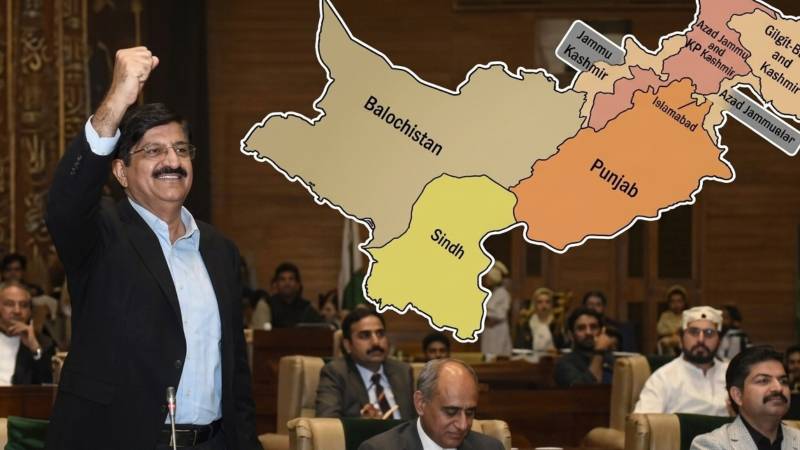
The debate over new provinces, within this context, has emerged for Sindh not as an administrative reform but as an existential threat. While the demand for new administrative units may be constitutionally viable, the question remains: is the objective genuinely better governance? If the goal is to resolve Karachi's issues, why is it not being empowered through a robust local government system and financial autonomy? Why are powers not being devolved from the provincial capital to the districts? Why is the singular solution to every problem always presented as the geographical fragmentation of the province?
When the reaction of the Sindh Assembly is dismissed as "premature" or merely political brinkmanship from the vantage point of Islamabad or Lahore, it betrays a dangerous lack of comprehension. A sentence uttered in Islamabad may be routine rhetoric there, but the same sentence is heard in the interior of Sindh or Karachi through a different historical lens, one where it feels like an assault on provincial honour and identity.
Similarly, if the people of Sindh come to believe that their political resistance is merely a preordained piece of a "backroom deal," the last vestiges of political trust in the state will evaporate. The issue is not redrawing maps; it is about reshaping the model of governance and political respect. If citizens of Karachi are not granted their rights and an empowered local government, a new province will change nothing.
Federation weakens when a province becomes convinced that its questions will be met not with a listening ear, but with force or subterfuge. If the decision regarding Sindh’s identity and future is made not by sitting with Sindh on an equal footing, but in the shadow of Punjab's powerful centres, the issue may cease to be about a new province, it will become about the very survival of the Federation.