

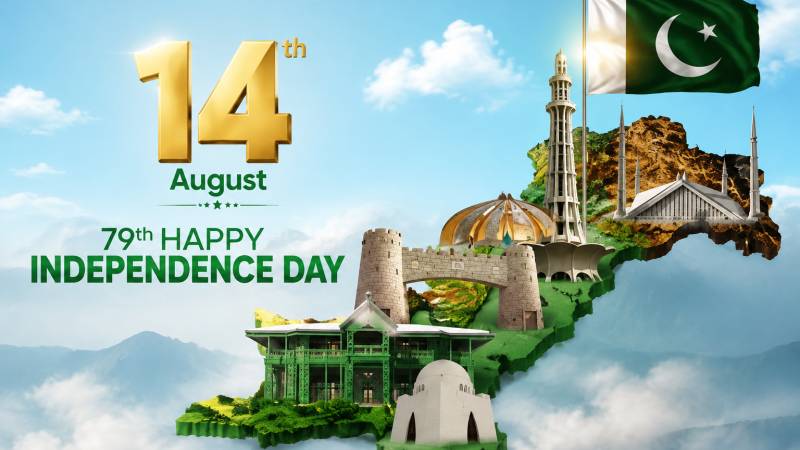
Dear Pakistan, Many happy returns. Seventy-nine years old today, and if birthdays are meant to be occasions for honesty as much as celebration, then this letter is both: the flags are out, the songs are playing from someone's rooftop speaker down the street, and we are, in whatever complicated way a family still gathers around a difficult parent, gathered around you anyway.
We should say, before anything else, that we remember why we love you. Not the version of you assembled from ministry press releases, but the actual, original promise: that a people scattered across a subcontinent, uncertain of almost everything else, could still trust that a border would become a home. Seventy-nine years ago today, an entire generation packed what they could carry and walked toward a country that did not yet fully exist, on nothing but the faith that it would. We did not inherit a flag. We inherited that faith, and most of us, somewhere underneath everything else, still carry it. But we have to tell you some things too, the way you tell a parent things at a certain age not to hurt them, but because the alternative is pretending, and we are tired of pretending.
We remember Faiz. We remember that four years into your existence, you put one of the only voices capable of loving you this honestly into a prison cell for four years, over an alleged conspiracy that had nothing to do with anything he had actually written. We remember, decades later, that when he finally did write the poem that frightened you most, you banned it outright, and a woman named Iqbal Bano had to put on a piece of clothing you had also banned and sing it anyway, to tens of thousands of people who rose to their feet and asked for a revolution you were not prepared to give them. We are still not sure whether that night belongs on the list of things you did to us, or the list of things we are proudest of. Perhaps you gave us the courage to defy you, without ever meaning to. That would be very like you.
And yet, Seventy-nine is not nothing. We have watched you survive wars, a country cut in half, three constitutions, more coups than anyone likes to count in public, and you are still here.
We remember Balochistan's first government, elected honestly, given nine months before you decided it had said something you did not want to hear, and dismissed it. We have been waiting, in various ways, for that government's proper successor for fifty-four years. We remember a bombing on Alamdar Road, thirteen years ago, and the four days after it when a grieving community refused to bury their own children until you finally looked at them. We remember, less than two weeks ago, in a town called Kabal, a crowd that had gathered to beg you for exactly the safety you are supposed to provide, and a man who walked toward them carrying the opposite. Fourteen of them did not go home. We do not know how to say this gently, so we will just say it: they were asking you, on your own soil, to simply be what you promised to be in 1947. We are still waiting to hear you answer.
We remember that when your own census-takers went to Balochistan to count how many of us actually lived there, they found more than twenty million people, and somehow, by the time the number reached Islamabad, six million of them had disappeared on paper, if nowhere else. We have never been able to decide if that was carelessness or something colder, and we suspect you have never quite decided either.
None of this, we want to be clear, is written in anger. We gave up on anger some years ago; it takes too much energy to sustain toward someone you have already decided you are not going to leave. What we feel instead is closer to what a child feels toward a parent who was, by every honest account, capable of so much more than they gave: not fury, but a very specific, very tired kind of grief; the grief of loving something completely and being loved back only in instalments.
What we feel instead is closer to what a child feels toward a parent who was, by every honest account, capable of so much more than they gave.
And yet. Seventy-nine is not nothing. We have watched you survive wars, a country cut in half, three constitutions, more coups than anyone likes to count in public, and you are still here — imperfect and exhausted and somehow still standing, the way certain difficult parents simply refuse to stop showing up no matter how much damage has already been done. There is something almost admirable in that, even when it costs us.
So: many happy returns, truly. We will put up the flags again next year, and the year after that, the way children keep showing up to birthdays for parents who have not always shown up for them, because the alternative — walking away entirely — has never once felt like the real option. We were never going to leave you. We are simply asking, on your seventy-ninth birthday, that you finally notice we are still here.
Love,
Your citizens