

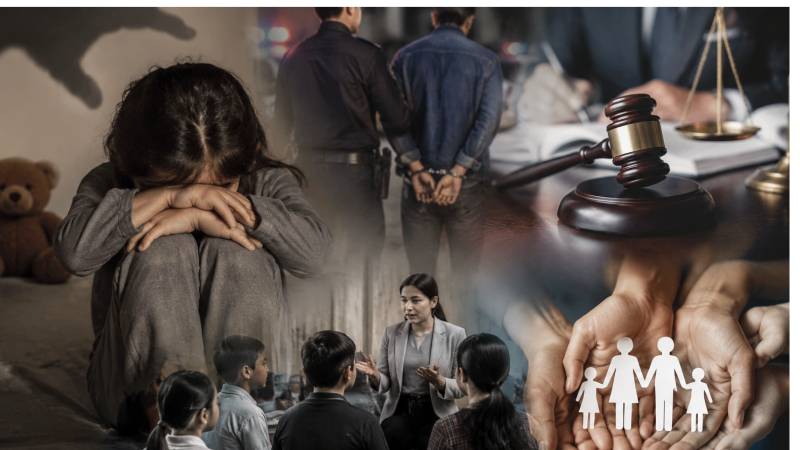
Ghulam Rasool (14), a resident of Sargodha, has not been able to sleep properly for the past three weeks. According to his father, he suffers from an unexplained fear and fever every night. The abuse he suffered and the brutality of being buried alive have left him reluctant to speak with others. The suspects responsible for sexually assaulting him and attempting to kill him have been arrested. However, his parents have no idea when the battle raging in his mind and heart will finally come to an end.
Such incidents are not new in Pakistan. After the rape and murder of Zainab in Kasur in 2018, the Zainab Alert, Response and Recovery Act was enacted. But are the rising numbers of such cases a result of increased public awareness and reporting, or do they reflect the helplessness of state institutions?
According to psychologist Ayesha Ashraf, associated with an NGO Sanjh Preet, every child reacts differently to sexual abuse. Some become completely silent and socially withdrawn, while others display anger, irritability, and unusual behavior. Victims may suffer from low self-confidence, social isolation, loss of appetite, stomach problems, sleep disorders, shame, feelings of inferiority, and fear of the gender of the perpetrator. Many children even distance themselves from their parents or caregivers because they feel they failed to protect them. She explains that recovering from such psychological trauma is a lengthy process, and without timely psychological support, a safe environment for expression, and the presence of a trusted adult, the effects can persist for years or even a lifetime.
According to Sahil, three major factors contribute to the increase in child sexual abuse cases. First, many parents choose not to report incidents because of societal norms and the fear of bringing shame upon the family's honor. Even when parents gather the courage to report a case, they often face discouraging experiences at police stations, including delays in FIR registration, conventional investigative procedures, and pressure from the accused to settle the matter outside the legal system. Third, the conviction rate in child sexual abuse cases remains extremely low, encouraging offenders to continue committing such crimes. Many perpetrators are involved in multiple offenses before being reported in a single case, after which investigators often recover evidence from their mobile phones revealing abuse of numerous other victims. However, prolonged court proceedings and weak follow-up results in very few convictions. This low accountability encourages offenders and contributes to the continued rise in such incidents.
Asiya Arif, Executive Director of the Society for the Protection of the Rights of the Child (SPARC), says that first and foremost, civil societies advocate for legal reforms in the country. After years of lobbying and demand raising, Pakistan enacted several key legislative acts to address and criminalize the sexual abuse of children, notably the Criminal Law (Amendment) Act, 2016 and the Zainab Alert, Response and Recovery Act, 2020. These laws penalize child sexual assault, internal trafficking, and pornography.
State Measures, Limited Results
To provide immediate legal assistance to victims, the Khanewal Police established Victim Support Center earlier this year. This center follows up with complainants within 24 hours of receiving a complaint on emergency helpline 15. If an FIR is not registered due to departmental negligence or other reasons, the entire process from FIR registration to submission of the police challan is monitored by the District Police Office. Kiran Naz SI, the in-charge of the Victim Support Center in Khanewal, says that over the past one and a half months, the center has facilitated the completion of 40 cases of different categories across various police stations. Cases involving rape and violence against women and children are given special priority.
Similarly, Pakistan became a party to the United Nations Convention on the Rights of the Child (UNCRC) in 1990, under which the state is obligated to protect children from all forms of physical, mental, and sexual violence and exploitation. To fulfill this commitment, the National Commission on the Rights of Child (NCRC) was established under the National Commission on the Rights of Child Act, 2017. The Commission is responsible for reviewing laws and policies relating to children's rights, investigating violations, making recommendations to the government, and promoting public awareness.
Trauma is a lengthy process, and without timely psychological support, a safe environment for expression, and the presence of a trusted adult, the effects can persist for years or even a lifetime.
In its Annual Report 2025–26, the National Commission also emphasizes the urgent need to strengthen the child protection system, improve responses to online child sexual exploitation, enhance coordination among relevant institutions, establish effective complaint mechanisms, and ensure stronger implementation of existing laws. According to the report, legislation alone is insufficient; institutional cooperation, timely action, and effective monitoring are essential to provide every child with a safe environment.
According to a spokesperson for the U.S. Embassy in Islamabad, the U.S. Government has supported several initiatives to strengthen child protection in Pakistan. In May 2024, U.S. specialists trained 34 Pakistani law enforcement officers and social workers in child-sensitive interviewing techniques, drawing on international best practices for handling children involved in criminal cases. The Embassy also noted that it previously partnered with UN Women to support crisis centers providing forensic examinations and psychosocial counseling for survivors of sexual assault, including children. The project has since been handed over to the Government of Pakistan.
The report further clarifies that the National Commission is not an executive or service delivery institution. Its primary role is oversight, advocacy, public awareness, and providing policy recommendations to the government for the protection and promotion of children's rights. However, the Commission does have the authority to take notice of complaints relating to children's rights, correspond with relevant institutions, and refer complaints to the appropriate authorities for immediate action.
According to the Commission, this increase reflects growing public awareness of its role and the expansion of the complaint registration system into provinces and districts that were previously underrepresented. The Commission states that it continues to strengthen coordination with relevant institutions to further improve the system.
The psychologist also notes that some unintentional mistakes made by parents can place children at greater risk. These include teaching children to trust every adult unquestioningly, allowing them to play outside without supervision, failing to educate them about good touch and bad touch, and not providing them with basic personal safety training. She believes that schools can also play a vital role in child protection. Regular training should be provided to teachers, parents, and students, while teaching, administrative, and security staff should undergo psychological screening. Schools should also implement effective child protection policies.
Asiya Arif says that SPARC plays a multi-dimensional role in countering sexual violence, abuse, and exploitation against children in Pakistan through policy advocacy, referral mechanism, awareness campaigns, capacity building, and institutional support. SPARC on capacity building initiatives of law enforcement agencies, the first point of contact to come across a victim child. SPARC, till date, continues to provide legal aid to child survivors of sexual abuse.
Article 19 of the United Nations Convention on the Rights of the Child guarantees children protection from all forms of violence. Article 34 further obligates states to take effective legislative, administrative, social, and educational measures to protect children from all forms of sexual exploitation and sexual abuse. Pakistan has committed itself to implementing these provisions. She adds that the numbers were always there but under reporting was a problem. Historically, child abuse (when it comes to boys) remained to be a hidden shame in guise of cultural practices. It is pertinent to mention that taboo cases are hardly brought to the notice of police.
Pakistan already has child protection laws, a sex offenders registry, victim support centers, and various institutions working on child protection. However, the real challenge is not the absence of laws but the lack of effective implementation, timely investigations, weak prosecution, low conviction rates, insufficient support for affected families, and delays in reporting cases. Until these gaps are addressed, even the strongest new laws will fail to achieve their intended impact.