

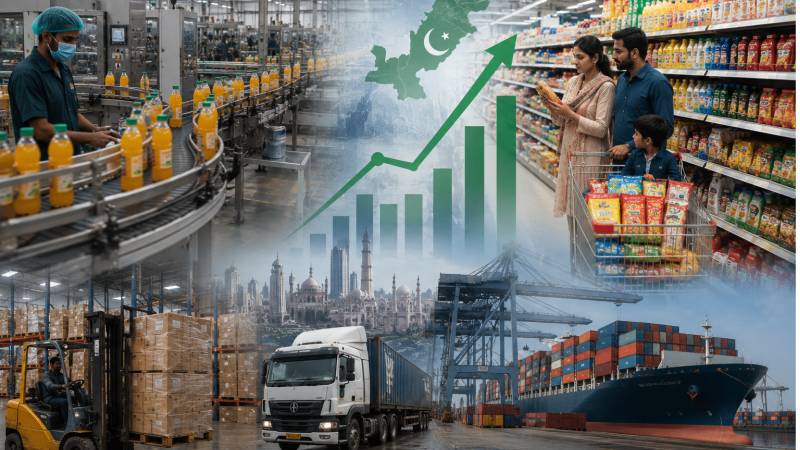
There are industries that dominate headlines, and there are industries that quietly sustain nations. Pakistan’s Fast-Moving Consumer Goods (FMCG) sector belongs firmly to the latter. Every morning, millions of Pakistanis begin their day with products manufactured by this industry: milk poured into tea, bread delivered before sunrise, cooking oil used to prepare breakfast, toothpaste squeezed onto toothbrushes, shampoo bottles opened in bathrooms and spices added to family meals. These everyday purchases appear ordinary, yet together they represent one of the country’s largest manufacturing ecosystems.
Behind every supermarket shelf lies an economic engine that receives remarkably little public attention. It links farmers to factories, manufacturers to retailers and retailers to more than 250 million consumers. It generates billions of rupees in tax revenue, supports hundreds of thousands of direct jobs, creates livelihoods for millions through agriculture, transport and packaging, and contributes significantly to industrial output. Few sectors influence daily life as comprehensively or possess greater potential to drive sustainable economic growth.
Public debate in Pakistan is often dominated by fiscal deficits, exchange rates, IMF programmes and energy shortages. While these issues are undeniably important, they frequently overshadow the productive sectors that ultimately generate wealth. Economies do not become prosperous merely by collecting more taxes or negotiating financial assistance; they prosper by building competitive industries capable of producing, innovating and exporting. The FMCG industry exemplifies precisely that kind of productive capacity.
Although there is no universally accepted measure of Pakistan’s FMCG market, most industry assessments place its annual value between US$18 billion and US$25 billion, making it one of the largest consumer goods markets in South Asia. The sector encompasses dairy products, beverages, edible oils, biscuits, confectionery, spices, bakery products, tea, personal care items, household cleaning products and numerous other essentials that are purchased repeatedly throughout the year. Unlike many industries that depend on economic cycles, demand for consumer staples remains comparatively resilient because households continue to buy food and basic necessities even during periods of economic hardship.
The industry’s significance extends well beyond manufacturing. Every packet of biscuits begins with wheat grown by Pakistani farmers. Every litre of processed milk depends upon thousands of dairy producers. Every carton of juice requires fruit growers, packaging manufacturers, transport operators, warehouse managers and retailers before reaching the consumer. This integrated supply chain creates substantial multiplier effects throughout the economy. In few other industries does value pass through so many hands before arriving at its final destination.
Recent financial statements illustrate the growing scale of organised FMCG manufacturing. Nestlé Pakistan reported revenues approaching Rs199 billionin FY2025, maintaining its position as the country’s largest listed consumer goods company. FrieslandCampina Engro Pakistan exceeded Rs100 billion, while Ismail Industries, National Foods, Mitchell’s, Colgate-Palmolive Pakistan and Unilever Pakistan Foods continued to demonstrate resilience despite inflationary pressures, exchange rate volatility and elevated financing costs. Alongside these listed businesses stand highly successful privately owned enterprises such as Shan Foods, Tapal Tea, Qarshi Industries, Young’s Foods and Dawn Bread, each of which has built trusted brands recognised well beyond Pakistan’s borders.
Collectively, the ten largest FMCG companies in Pakistan generate revenues of approximately Rs845 billion. While impressive in absolute terms, the figure also highlights the scale of the opportunity. Several individual FMCG companies in neighbouring countries generate annual revenues exceeding the combined revenues of Pakistan’s ten largest firms. This comparison is not intended to diminish Pakistan’s achievements but to place them in perspective. India’s FMCG market is estimated at more than US$240 billion, nearly ten times larger than Pakistan’s. Companies such as Hindustan Unilever, ITC, Britannia Industries, Nestlé India, Dabur, Marico and Tata Consumer Products each generate annual revenues measured in billions of US dollars. More importantly, they have transformed themselves into global enterprises, exporting products across continents while investing heavily in research, innovation, branding and distribution.
Economies do not become prosperous merely by collecting more taxes or negotiating financial assistance; they prosper by building competitive industries capable of producing, innovating and exporting.
Bangladesh offers an equally compelling lesson. Despite having a population considerably smaller than Pakistan’s, it has produced internationally competitive companies such as PRAN-RFL, Square Group, ACI and Akij. Their success demonstrates that developing economies can convert domestic consumer brands into global exporters through consistent industrial policy, investment in quality standards and export-oriented manufacturing.
The Gulf Cooperation Council presents another instructive example. Saudi Arabia’s Almarai, the UAE’s Agthia and Savola Group have become regional food giants despite serving populations far smaller than Pakistan’s. Their competitive advantage lies not in domestic demand alone but in regional expansion, operational efficiency and value-added production. They demonstrate that geography need not limit ambition. Pakistan possesses many of the same advantages. It has one of the world’s youngest populations, a rapidly expanding urban consumer base, abundant agricultural resources and a strategic location connecting South Asia, Central Asia and the Middle East. These structural strengths provide an ideal foundation for developing globally competitive consumer brands.
Yet perhaps the greatest untapped opportunity lies not in manufacturing alone but in retail. Pakistan’s retail economy remains dominated by traditional kiryana stores, which continue to account for the overwhelming majority of grocery sales. These neighbourhood retailers perform an invaluable role by serving local communities and extending informal credit to customers. Nevertheless, fragmented procurement, multiple layers of distribution and limited economies of scale inevitably increase costs.
Modern organised retail offers a different model. Supermarket chains such as Imtiaz Super Market, Carrefour Pakistan, Metro Pakistan, Chase Up and Al-Fatah have begun transforming consumer shopping habits through centralised procurement, integrated logistics and sophisticated inventory management. Their continued expansion reflects changing consumer expectations and growing demand for quality, convenience and competitive pricing.
The global benchmark remains Costco Wholesale Corporation. Costco has fundamentally redefined retail economics. Rather than relying primarily on high product mark-ups, it deliberately operates with exceptionally low margins while generating substantial profitability through annual membership subscriptions. In its latest financial year, Costco generated annual revenues exceeding US$250 billion and membership fee income of approximately US$4.8 billion from more than 140 million cardholdersworldwide. Membership income alone accounts for a significant proportion of the company’s operating profit, enabling Costco to pass considerable savings directly to consumers through consistently low prices.
The lesson for Pakistan is not that Costco’s membership model should be replicated wholesale. Rather, it demonstrates how efficient procurement, scale, technology and supply-chain optimisation can reduce prices, improve productivity and strengthen consumer welfare. Organised retail benefits not only supermarkets but also manufacturers, farmers and households. Pakistan’s own corporate success stories prove that local companies are capable of competing internationally. National Foods exports to dozens of countries. Shan Foods has become a recognised global brand within South Asian cuisine. Dawn Bread has established one of the country’s most advanced automated bakery operations. Ismail Industries continues to expand its confectionery footprint, while Tapal Tea and Qarshi Industries have built extraordinary consumer trust over several decades.
Yet significant challenges remain. High industrial energy costs, inconsistent taxation, limited cold-chain infrastructure, elevated financing costs, fragmented logistics and inadequate investment in research and development continue to constrain growth. Pakistan also exports far too much agricultural output in raw form rather than transforming it into premium branded consumer products capable of commanding significantly higher international prices.
This is particularly important because global demand for halal-certified foods, premium dairy products, processed foods, ready-to-cook meals and health-conscious consumer products continues to expand rapidly. Pakistan possesses both the agricultural base and manufacturing expertise to capture a much larger share of these high-value markets. The policy implications are clear. Stable taxation, competitive industrial energy tariffs, investment in cold-chain logistics, internationally recognised food safety standards, export facilitation, support for research and development, sustainable packaging and the expansion of organised retail should form part of a coherent national industrial strategy. These are not isolated policy initiatives; together they create the ecosystem required for globally competitive manufacturing.
Pakistan often measures economic success through macroeconomic indicators alone. Inflation, exchange rates, fiscal deficits and foreign reserves dominate public discussion. Yet the true measure of an economy is its capacity to produce goods, build brands and compete internationally. The FMCG sector embodies precisely these qualities. Every carton of milk, loaf of bread, packet of biscuits and bottle of cooking oil produced in Pakistan represents value added, employment created and confidence in domestic enterprise.
The country’s FMCG industry is no longer an emerging sector. It is a strategic national asset. With the right policy framework, sustained investment and a commitment to innovation, Pakistan can build companies that compete not merely within South Asia but on supermarket shelves from Dubai and Riyadh to London, Toronto and Singapore. The quiet giant of Pakistan’s economy has already been built. The challenge now is to help it realise its full potential.