

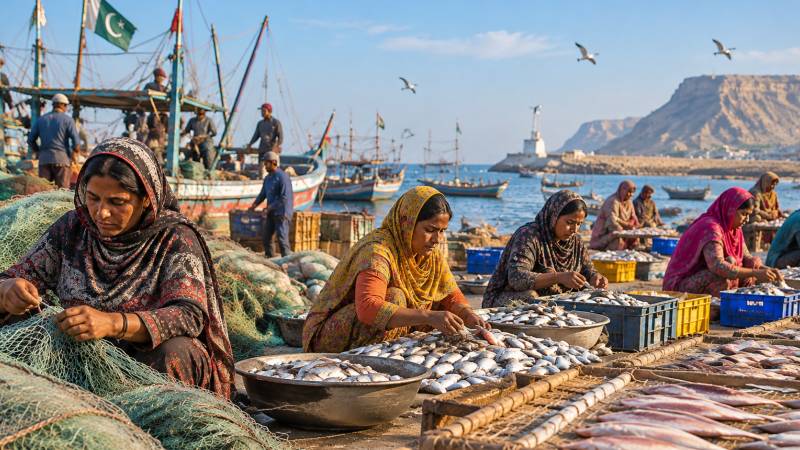
Along Pakistan’s sprawling 1,050-kilometre coastline, the quiet rhythm of the fishing industry depends on a foundation of labour that rarely receives recognition. While men steer wooden boats into the deep waters of the Arabian Sea, thousands of women perform the relentless, uncredited work that keeps the industry functioning: repairing nets, sorting catches on slippery stone docks, and curing fish under an unforgiving sun. This invisible workforce sustains coastal micro-economies from Karachi’s Ibrahim Hydri to Gwadar, yet its contributors remain largely absent from official labour statistics, deprived of economic protections, and overlooked in national policy.
Fishing is commonly perceived as a male occupation because men are more visible at sea. However, fisheries are not limited to catching fish. They represent complex value chains involving preparation, harvesting, landing, processing, preservation, marketing and trade. The Food and Agriculture Organization (FAO) notes that women across the world are particularly involved in pre-harvest and post-harvest activities, including net mending, processing, marketing and trade. Globally, women represent a much larger share of employment in post-harvest activities than in primary fishing. The distinction between a “fisherman” and a “worker” therefore matters. A woman sorting, cleaning, drying or selling fish may not be described as a fisher, even though her work directly contributes to the value generated by the fishing industry.
In Pakistan’s coastal communities, this distinction is particularly evident. A study of women working in fisheries in Ibrahim Hydri, Rehri Goth and Karkanabad examined the types of work women perform, their payment systems and their socioeconomic conditions. Another study of Shams Pir Island in Karachi found that women have historically participated in fishing and related activities while examining the socioeconomic consequences of changes in traditional fishing livelihoods.
Pakistan’s fishing industry does not begin when a boat leaves the shore, nor does it end when the catch is landed. It is sustained by an interconnected workforce, much of it female, whose labour deserves to be counted as part of the economy it helps keep afloat.
These communities demonstrate that fishing is not simply an occupation carried out by men at sea. It is a household and community economy in which women’s labour is deeply embedded. Describing this work as “invisible” does not mean that it lacks economic value. Consider what happens after a fishing boat returns. The catch must be sorted, cleaned, processed, preserved, transported and sold. Each stage influences the value and quality of the final product. Processing and preservation are particularly important because fish are highly perishable. The work performed after landing can determine how much of the catch reaches consumers in a usable and marketable form.
Yet the economic importance of this work contrasts sharply with the conditions in which it is often performed. According to a study by Nasreen Shah, 73.79 per cent of women involved in fish processing reported unsatisfactory hygiene conditions, while 91.91 per cent reported experiencing physical ailments. These findings highlight the occupational risks associated with fish processing and reveal a significant gap between the economic value generated by women’s labour and the conditions under which it takes place.
The FAO has noted that women constitute a substantial proportion of workers involved in fisheries processing and marketing globally. It has also highlighted their potential role in reducing post-harvest losses and improving food quality and safety. Women’s labour, therefore, should not be viewed merely as an extension of household responsibilities. It contributes directly to value addition, income generation and the overall efficiency of the fisheries value chain. There is also an opportunity-cost argument. If family members did not perform this work without wages, households would often need to pay someone else to provide these services. The absence of a salary does not necessarily mean the absence of economic value.
The burden becomes even greater when paid fish processing is combined with unpaid domestic labour. Women may spend long hours processing fish while simultaneously managing household responsibilities such as cooking, cleaning and childcare. Such work remains economically productive even when unpaid because care work sustains households and enables other forms of paid labour to continue. The invisibility of this labour has consequences beyond recognition. When women’s contributions remain undocumented, the economic picture of Pakistan’s fishing industry remains incomplete. Labour statistics that overlook unpaid and informal work can underestimate the sector’s true workforce and obscure the economic dependence of coastal households on women’s labour.
Recognising this contribution requires more than acknowledging women’s work; it requires measuring it. Fisheries surveys should document women’s participation in processing, marketing, net repair and other pre- and post-harvest activities, including unpaid family labour. Such data could help policymakers design targeted interventions in areas such as access to credit, skills training, technology, social protection and market opportunities. This is particularly important as fishing communities face declining catches, rising costs and environmental pressures. When the productivity of the fishing sector is threatened, the burden does not fall solely on those at sea. It extends to the women whose labour sustains the value chain and the households that depend upon it. Pakistan’s fishing industry does not begin when a boat leaves the shore, nor does it end when the catch is landed. It is sustained by an interconnected workforce, much of it female, whose labour deserves to be counted as part of the economy it helps keep afloat.