

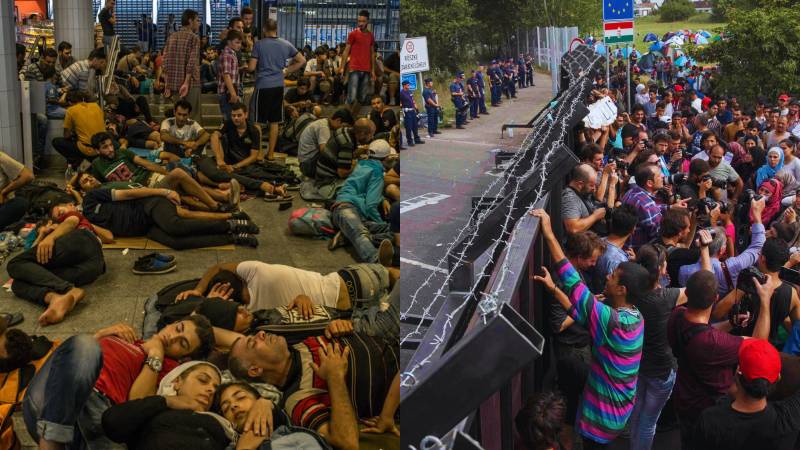
On a cold evening in Budapest, I pulled up to a KFC on my Foodora bike to collect an order. The person who handed me the bag was Pakistani. The riders waiting outside were Bangladeshi, Vietnamese, Indian, and Pakistani. We exchanged a nod, the way people do when they recognise something shared without saying it out loud. This is not an unusual evening. This happens every evening.
What strikes me, a year into living and working in this city, is not that immigrants are here. It is that the country they are working in has spent a decade loudly and constitutionally insisting that it does not want them. And now, even after the most dramatic political change Hungary has seen in sixteen years, the workers delivering food and staffing restaurants are still waiting to see if anything changes. So far, the silence is telling.
Hungary just lived through a political earthquake. In April 2026, Péter Magyar and his Tisza party ended Orbán's grip on power in a landslide. The EU flag, removed from parliament under Orbán, was displayed inside the chamber for the first time in twelve years. Diplomats exhaled. Brussels celebrated. And in the KFC near Keleti station, a Rwandan man handed another order through the counter window.
Hungary's fertility rate sits at approximately 1.5, well below the 2.1 needed to maintain a stable population. An estimated 600,000 Hungarians have left permanently for Western Europe since 2004. The workforce is contracting precisely when the economy needs it to grow. Hungary's unemployment rate hovers around 4%, which sounds healthy until you understand that it signals a scarcity of workers, not an abundance of opportunity. Construction sites cannot find labourers. Hospitals cannot fill nursing positions. The logistics and hospitality sectors are held together by people whom official policy does not want here.
There is a detail that rarely appears in Western analyses. Hungary's Roma population, estimated at between 700,000 and 800,000 people, remains largely excluded from the formal labour market through entrenched discrimination and decades of policy neglect. The jobs being done by Pakistani and Bangladeshi migrants are not jobs that no Hungarian wanted. They are jobs an entire domestic minority was structurally prevented from accessing.
The previous government's response was to spend its way around the problem. Family policy spending reached over 5% of GDP, among the highest rates anywhere, through lifetime tax exemptions for mothers of four children, subsidised housing loans, and child grants. The fertility rate nudged upward slightly. The working-age population continued to shrink regardless.
The deeper story is not about which party holds power. It is about a structural contradiction between what the country says it wants and what its economy quietly, desperately needs.
Meanwhile, the quiet workaround expanded steadily. Hungary issued temporary work permits to Filipinos, Ukrainians, Uzbeks, Pakistanis, and Bangladeshis at growing rates. The government did not call this immigration. It called it a managed labour solution. Hungary already had immigration. It simply refused to admit it, and in refusing to admit it, refused to give those workers rights, permanence, or any honest path forward.
On Eid, Budapest's Foodora network nearly collapses. When the Pakistani and Bangladeshi community takes the day off, the delivery infrastructure of a European capital visibly strains. For one day, the city gets an honest glimpse of who is actually keeping it running. No policy document acknowledges this. The workers are essential and invisible simultaneously, which is precisely how the system is designed.
I am writing this as a Pakistani delivering food in Budapest alongside others building lives in the gaps that Hungarian policy refuses to acknowledge. Many are educated. Many are ambitious. Almost none will ever hold a white-collar job here, not because they are unqualified, but because the work permit structures and quiet institutional resistance make it nearly impossible. They are wanted for what they carry. They are not wanted for what they know.
For Pakistan, watching this should not produce only outrage. It should produce clarity. A country that depends on remittances must be cold-eyed about what these arrangements are. Not partnerships. Transactions. The moment Pakistan mistakes a transaction for a relationship, it loses its negotiating position entirely.
I picked up the order. I delivered it. The KFC was still staffed by people a government built an entire political identity around not wanting. Hungary has not stopped immigration. It has simply made it invisible. And invisibility, it turns out, is the most expensive policy of all.