

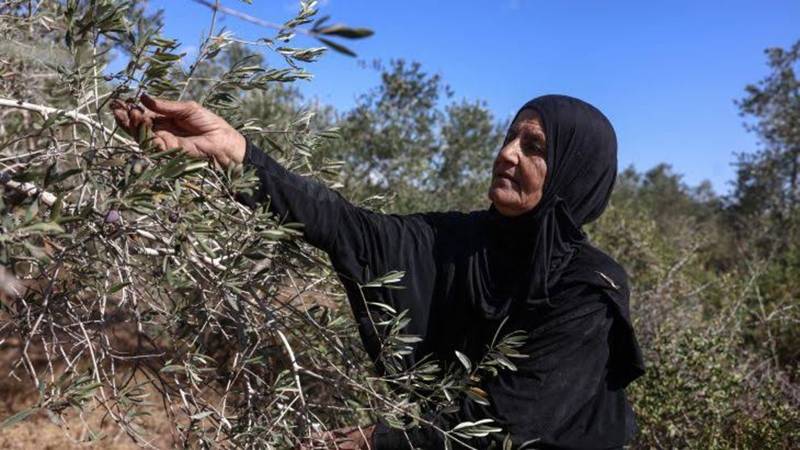
Across the occupied West Bank, the olive harvest, one of Palestine’s most cherished cultural traditions, is underway. Israeli settlers in the West Bank also have a tradition that they religiously enact every October when the olive harvest season sets in: they attack and harass Palestinian farmers and anyone assisting them, disrupting and destroying the harvest and seriously injuring hundreds.
Olive farming supports the livelihoods of roughly 100,000 Palestinian families in the West Bank, while the economic toll of these attacks and military operations has been catastrophic, with millions of dollars in damages incurred to the olive industry last year.
According to Yesh Din, an Israeli human rights group, the first 10 days of this year’s harvest season alone documented 109 incidents of violence and harassment against Palestinian farmers. There are also innumerable incidents of settlers stealing ripe olives from Palestinian olive groves, as reported by rights groups.
Election Politics and Settler Terrorism
Settler pogroms escalate every year around this time, coinciding with the annual olive harvest season in the occupied West Bank. This year, the violence has also coincided with and been stoked by campaign weeks prior to the 27th of October, when Israel goes to the polls.
Observers opine that violence is surging ahead of the bitterly contested elections of the 27th of October, as Netanyahu seeks to shore up his pro-settlement right-wing base. The UN states that settler attacks across the West Bank this year are occurring at the “highest rate ever recorded.” In August this year, Human Rights Watch also dubbed 2026 a “record Year’ for settler violence.
Illegal settlements in the occupied West Bank have sprawled over time, and so has settler-patronised violence. What is accurately termed ‘settler terrorism’ is perpetuated by the menace of unlawful Israeli settlements in occupied territories, including the West Bank.
The long-standing issue of settler terrorism was raised again during a recent UN Security Council debate, with Pakistan asserting that illegal settlements in occupied territories imperil the “viability of a future Palestinian state”. The French delegate denounced it for fuelling further “instability” in the occupied territories.
Without any means of self-defence, Palestinians often rely on a growing network of international and Israeli activists who help with the harvest every year and act as a shield
Though not a recent phenomenon, illegal settlements are known to have grown very rapidly since the 7th of October 2023, when Israel started unleashing its genocidal onslaught against unarmed Palestinians. Illegal settlers carry out rampant ethnic cleansing and blatant land-grabbing in the West Bank under the support of the Zionist regime.
There are over 500 illegal settler communities in the West Bank occupied by hundreds of thousands of inhabitants that mostly comprise terrorising, aggressive, and radical members of Israel’s Jewish population.
Attacks on International Observers
Following a settler attack in the West Bank last week that left a Washington Post photojournalist, Heidi Levine, badly injured with broken ribs and a hand that needed surgery, the US ambassador to Israel strongly denounced the attack as a “despicable act of terror” and called for the arrest and prosecution of the culprits. The American journalist, who lives in Israel, was ambushed by masked Israeli settlers who used clubs and other weapons while she accompanied Palestinian farmers attempting to harvest olives in the West Bank.
Without any means of self-defence, Palestinians often rely on a growing network of international and Israeli activists who help with the harvest every year and act as a shield between Palestinian farmers and violent Israeli settlers.
Though Levine was privileged enough to be donning a flak jacket and helmet while accompanying the farmers, ordinary Palestinians trying to harvest olives on their ancestral land or going about their daily lives have no means of protection, as they face dozens of such brutal attacks every day.
In Levine’s words, “I probably wouldn’t even be here,” if she wasn’t wearing the protective gear, since “they just kept kicking and kicking me.” The journalist was beaten for more than 10 minutes by the settlers, who also stole her camera, passport, and phone.
As condemnations over the attack pour in from Western quarters, one may ask if deniers of Israel’s settler violence in the occupied towns of the West Bank and defiant defenders of Israel’s inculpability realise the extent of settler violence that Palestinians have to constantly endure in the West Bank. Realise they may, but acknowledgement is still dodged by an evasive, inequitable world leadership.
On the heels of the attack on the Palestinian farmers and Levine came another outburst of settler violence that targeted European diplomats the very next day, who were on a visit to the occupied West Bank. Bernard Baudoux, a French mayor, was among those assaulted and knocked to the ground.
“The whole world needs to know what’s happening,” the French mayor told Agence France-Presse after the attack. His words hold a haunting message amid Israel’s disinformation and narrative-nurturing drives that whitewash and distort the truth about its atrocities in Palestine and blockade facts from reaching the world.
A Culture of Impunity
Though Israeli police have arrested 10 people over settler attacks on the American journalist and European diplomats, only around 3% of cases involving settler violence have ever resulted in convictions between 2005 and 2024. Since 2022, the number of police cases opened against settlers after aggressive attacks has also sunk by 70%.
Never will similar reproof be voiced for the Palestinian farmers or the rest of the Palestinian population living in the West Bank and enduring it all 24/7, as the ambushed French mayor Baudoux rightly pointed out: “For me, I’ll go back to my country and everything will be fine. Those who continue to suffer the most are those who are here.”
As Palestinians are repeatedly displaced and thwarted within their own land, settler violence targeting them has intensified gravely, even if the tsunami of Zionist settler terrorism was always there.
On the 6th of October 2026, Israeli settlers beat Palestinian AFP news agency photographer, Jaafar Ashtiyeh, with rifle butts, injuring his head and torso. Earlier in July this year, United States Congressional Representative Ro Khanna and his tour group were detained by rifle-wielding Israeli settlers during his visit to Palestine. Khanna accused the Israeli army of supporting the settlers.
A Canadian and three Italian activists were injured by Israeli settlers in the central West Bank in November last year. The settlers stormed a Bedouin community where the activists were residing and assaulted them, while also confiscating their passports, phones, and belongings.
A 31-year-old Palestinian activist and English teacher Awdah Hathaleen, who contributed to the Oscar-winning documentary No Other Land, was shot and killed on the 28th of July 2025 in the occupied West Bank.
In July 2024, Israeli settlers attacked a group of foreign volunteers helping Palestinian farmers in the occupied West Bank. David Hummel, an American-German, along with eight other American and other volunteers, were working with farmers in an olive grove when settlers assaulted them.
Undermining the Local Food System
Last month, keeping up with their tradition of unrivalled ruthlessness, Israeli military authorities issued orders for the removal of vegetation from 84 acres of Palestinian agricultural land in the northern and central occupied West Bank, including land planted with olive trees. The orders comprised provisions for the uprooting of olive trees and imposed extremely short periods for landowners to pull them out.
Settler violence aimed at olive-harvesting farmers is, in fact, aimed at the attrition of Palestinian communities through undermining their local food systems, agricultural heritage, and food sovereignty.
Olive farming is a reliable source of income for a large number of Palestinian families. Olive trees take years to mature and can sustain families for generations. Hence, their destruction deprives Palestinian families of much more than a single harvest.
This week, UN experts in Geneva urged Israel to guarantee protection for Palestinian farmers and ensure their safe access to their lands as the olive harvest season kicks in; the denunciation only falls on deaf ears as Israel’s impenitence and impunity know no bounds.