

The seventh anniversary of India's abrogation of Articles 370 and 35A passed this week with remarkably little attention in Pakistan's mainstream media beyond official statements and routine expressions of solidarity with the Muslim population in Indian-administered Jammu and Kashmir. In India, meanwhile, official narratives predictably celebrated peace, development and integration, while dissenting voices included Mirwaiz Umar Farooq, Chairman of the All Parties Hurriyat Conference, and a handful of other Kashmiri leaders.
The contrast is striking. While India has continued to implement far-reaching political, legal and demographic changes in the disputed territory since 2019, Pakistan's public discourse remains preoccupied with domestic political distractions, including the unnecessary debate over new provinces or administrative units and the unfortunate demand by the outlawed Joint Awami Action Committee to abolish 12 reserved refugee seats in the AJK Legislative Assembly, a controversy that led to the rare outbreak of political violence ahead of the current elections. Before turning to India's settler-colonial project in the disputed territory, this issue deserves to be placed in its proper historical and legal context.
Pakistan's position has remained consistent since 1947: the former princely State of Jammu and Kashmir remains an internationally disputed territory whose final status can only be determined through the exercise of the right of self-determination in accordance with the relevant UN Security Council resolutions. That position is rooted in the Proclamation of the Provisional Government of 24 October 1947 and preserved under the 1974 Interim Constitution of AJK, both of which recognise the existing constitutional and representative arrangements as provisional pending a final settlement.
Seen in that context, the 12 refugee seats are not merely an electoral arrangement. They embody Pakistan's longstanding constitutional position that the AJK Government represents not only the territory presently under its administration but also the people of the non-liberated parts of the former princely State until the dispute is resolved through self-determination. Mirwaiz also recently echoed this principle from Srinagar, observing that the constitutional and voting rights of displaced Kashmiris form part of the collective rights of the people of Jammu and Kashmir and should not become a matter of political bargaining or exclusion.
Therefore, unless the Jammu and Kashmir dispute is resolved in accordance with the relevant UN Security Council resolutions, or unless Pakistan fundamentally changes its longstanding position on this international issue, the constitutional basis of the 12 refugee seats cannot be altered by the incoming AJK Legislative Assembly. The next government, which the PML-N is expected to lead, likewise lacks the constitutional authority to unilaterally abolish them. This is contrary to assertions by some PMLN leaders amid protests that the matter is a legal and constitutional question to be decided by the AJK Legislative Assembly.
The real issue before Pakistan is not another domestic constitutional controversy but the accelerating transformation of the disputed territory itself. Under the BJP government's declared Hindutva agenda, New Delhi has steadily sought to reshape the legal, political, demographic and cultural character of Jammu and Kashmir. Seven years after the abrogation of Articles 370 and 35A, what began as a constitutional change has evolved into a systematic effort to create irreversible facts on the ground long before the people of Jammu and Kashmir are ever allowed to exercise their right of self-determination.
Pakistan’s position has remained consistent since 1947: the former princely State of Jammu and Kashmir remains an internationally disputed territory whose final status can only be determined through the exercise of the right of self-determination.
The transformation is visible across every sphere of governance. More consequential than the abrogation of Article 370 was the repeal of Article 35A, which dismantled the constitutional protections governing land ownership, public employment and permanent residency. New domicile laws and revised land regulations have since replaced the permanent-resident regime. By April 2025, more than 3.5 million domicile certificates had been issued, including 83,742 to individuals who were not previously recognised as state subjects. Together with the growing presence of seasonal migrant workers, these changes are steadily reshaping the territory's demographic and political landscape.
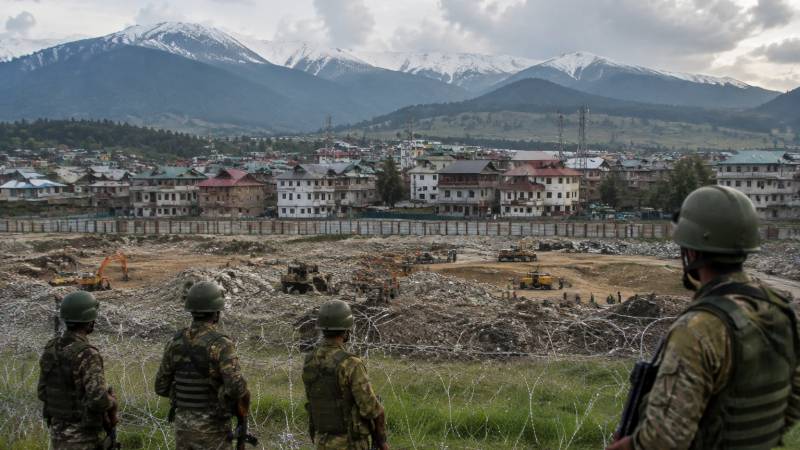
The security architecture has expanded in parallel. For this year's Amarnath Yatra, New Delhi mounted its largest-ever security operation, deploying 670 companies of the Central Armed Police Forces alongside more than 100,000 security personnel. AFSPA and the Public Safety Act remain central pillars of governance. Following the killing of a policeman in Anantnag in July, security forces reportedly detained around 3,000 suspects across the Valley, underscoring that extensive preventive security measures continue alongside the constitutional transformation.
The costs have been borne overwhelmingly by Kashmiris. Estimates place economic losses since 2019 at more than US$5.3 billion, with around 100,000 jobs lost and unemployment reaching 34.8 per cent. Yet the larger issue extends beyond economics. Each domicile certificate issued, each parcel of land opened to outsiders, each new settlement and each year of diminished international scrutiny further entrenches a new reality that becomes progressively harder to reverse.
This explains why an increasing body of international legal and academic scholarship now characterises India's post-2019 policies as a form of settler colonialism. The argument rests not on a single law but on the cumulative effect of measures that facilitate permanent settlement, weaken indigenous protections, centralise political authority and gradually transform the demographic and cultural character of an internationally disputed territory. Whether one accepts that description or not, the direction of travel is unmistakable.
Kashmir is too sacred a national cause to be reduced to an annual ritual of solidarity or allowed to become hostage to avoidable domestic controversies. Pakistan must first rebuild a sustained national consensus around Kashmir through informed public debate, rigorous legal scholarship and consistent media engagement. The real battle today is no longer over rhetoric; it is over preserving the demographic identity, political rights and internationally recognised status of the disputed territory before irreversible facts are created on the ground.
Second, Islamabad should seize the diplomatic opportunity before it. Pakistan's international standing has improved markedly over the past year through its constructive regional diplomacy, particularly during the Iran conflict, while deepening engagement with the United States, China, the Gulf states and other key partners. That goodwill should now be translated into a sustained diplomatic campaign to refocus international attention on Kashmir, highlight the consequences of India's post-2019 policies and reaffirm that the dispute remains unresolved under the relevant UN Security Council resolutions.
Finally, Pakistan should complement its diplomatic outreach with legal action. It should seriously examine invoking the jurisdiction of the International Court of Justice to challenge the legal consequences of India's unilateral abrogation of Articles 370 and 35A and the subsequent measures taken in the disputed territory. The post-May 2025 strategic environment, which has seen a relative weakening of India's regional position and a corresponding strengthening of Pakistan's diplomatic standing, presents a rare opportunity that should not be squandered.
Pakistan should use this favourable moment to consolidate political stability, accelerate economic reform and strengthen national security while simultaneously pursuing a sustained and proactive Kashmir policy. Kashmir is too important a national cause to be confined to annual commemorations. Unless Pakistan matches diplomatic goodwill with consistent legal, political and intellectual engagement, the demographic and political transformation of the disputed territory may become this generation's irreversible legacy.