

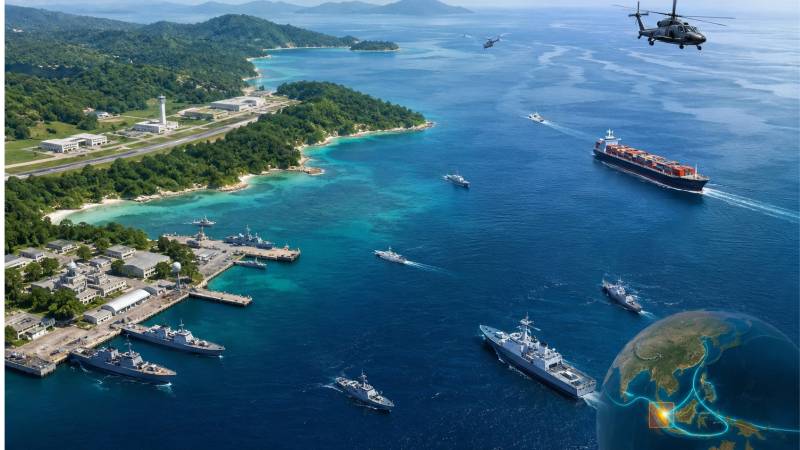
At the entrance of the Indian Ocean Region, the Malacca Strait is present as a strategic chokepoint. Roughly 25% of the global maritime trade passes through it including about 80% of China’s oil imports. The strait lies in Southeast Asia and is the primary shipping channel between the Pacific and Indian Ocean. Along with the Hormuz Strait and Bab ul Mandeb, it is the most important strait in the world.
The area also has strategic importance as it ensures flow of goods from east to west. Trade from China reaches Europe and Middle East through it. Any obstruction on this strait can cause increase in prices of consumer goods globally. Situated in the mouth of Malacca strait roughly 40 nautical miles to the west is the Great Nicobar Island which is part of the Indian territory of Andaman and Nicobar Island archipelago. These islands are closer to Myanmar and Thailand than to actual mainland India.
Due to their proximity to Southeast Asia and to the strategically critical Malacca straits, these islands hold extreme geo political and geostrategic significance for India. They provide India with access to the Southeast Asian states, along with centrality to the Asia-Pacific region. India has long sought closer relationship with the Southeast Asian states as well as a more active and influential role in the Asia Pacific. It is a dialogue partner of ASEAN and a member of QUAD; the Quadrilateral alliance which also includes USA, Japan and Australia.
The Great Nicobar Island or GNI is the largest of the Nicobar Islands and while it has geographical and geo strategic importance, it also holds environmental and cultural significance. Its rainforest and vast greenery is protected under the Great Nicobar Biosphere reserve which covers more than 80% of the island. The area includes mangrove forests, giant leatherback turtle’s breeding sites as well as homes of the local Nicobarese and Shopmen people. The Government of India has proposed a three-phase plan for the holistic development and transformation of the island which in Prime Minister Modi’s words was of strategic, defensive and national importance and aimed to transform the region into a "major hub of maritime and air connectivity”.
The benefits that India aims to have through a transshipment hub include reduction on foreign dependence, capturing economic value and creating jobs and revenue.
NITI Aayog the National Institute of transforming India was the brain behind this plan while the Modi linked Adani group is believed to be interested in carrying it out. According to the plan; GNI will become an economic outpost with the building of an international transshipment hub or entrepôt, a greenfield international airport with both civil and military usage, a power and desalination plant as well as a township. Further plans include a coastal expressway, electric mass transit rail and a river dam.
The project titled the ‘Great Nicobar Island Development Project’ or GNIDP, could cause a 4000% population increase on the island. The Modi government also plans to make the island a tourism and entertainment hub which has a predicted completion date of 2047. Currently a significant number of India’s container cargo goes to Sri Lanka, Malaysia and Singapore for shipping. This adds extra logistical steps to reach their respective ports of call. The proposed entrepot will reduce role of external shipping hubs for India; and give it a stronger position in East- West maritime trade.
The benefits that India aims to have through a transshipment hub include reduction on foreign dependence, capturing economic value and creating jobs and revenue. It will provide more logistic options in case of wars, droughts and blockades. It will also strengthen supply chain resistance. With its geo strategic location and proximity to the Malacca straits, it can enable India to have an effective role in the movement through the straits, resulting in India having a significant and influential role in the Asia Pacific and in the channel between Indian Ocean and Pacific Ocean.
Through GNIDP India can improve maritime domain awareness, support naval logistics and strengthen surveillance. Its value is seen by some in sea denial rather than sea control. India hopes to enable swift response, extend air reach, reduce patrol distance and ensure deterrence. But it is not a chokehold. Rather it is a strategic observatory; along with a geopolitical signal signifying a goal to gain influence in the Asia Pacific and the Indian Ocean Region.
The great Nicobar Island has an area larger than Singapore causing it to have enormous potential, and a significant place in India’s many ventures to gain dominant status in the Indian Ocean Region. Other project with similar design include Vizhinjam , India’s first deep water transshipment port in Kerala with which India aims to attract global trade by making it the preferred international transshipment gateway in the South Asia, boost its blue economy and gain influence in the India Ocean Region.
Another such plan is the ‘India-Middle East-Europe Economic Corridor’ (IMEC). This project aims to connect three regions across Europe and Asia and along with GNIDP is seen by many as a counter to China’s Belt and Road Initiative (BRI). Both these land and port projects ensure India has influence in the global east -west trade. India is already active in the Asia Pacific region due to Quad and having close relations with Southeast Asia due to its Act East policy. With its IMEC it aims to also achieve a central position in trade with Europe while bypassing both Baab el Mandeb and Suez Canal, on the other hand GNIDP ensures it has leverage over the Malacca straits. While Vizhinjam enables India to gain access to trade in the Indian Ocean Region. This island development project is one in a series of bold, strategic moves by India to exert its image as maritime power in the Indian Ocean Region as well as a central economic player in Euro-Asian trade.
However, the GNIPD has its own share of naysayers. There have been primarily environmental concerns especially due to the fact that the GNI Biosphere reserve is threatened by it. The nesting spot of giant leatherback turtles, huge areas of greenery and the local Shopmen and Nicobarese s tribes will all be harmed according to critics who accuse the project of planned ecocide. From the opposition benches Rahul Gandhi has called the project a scam. Congress leader and former Union environment minister Jairam Ramesh pointed out the lack of transparency in the project’s environment monitoring and compliance report which has not been published since march 2024. Similarly, conservation and mitigation plans were unavailable to public domain; with key studies also remaining incomplete. He claimed an "extraordinary level of non-transparency” was being adopted.
Others have labelled the project as a commercial one; which is pitched as one tied with national security to avoid pushback. There have also been questions about the viability of the project due to it being in an area vulnerable to earthquakes and tsunamis. Critics are also pointing out that the project’s strategic benefits are being inflated. They are of the view that despite its proximity to the Malacca strait, India cannot actually block, choke or control it. Rather it can monitor the movement to and from the strait and gain awareness over the scenario within it.
Nevertheless, the project is one that is actively being manifested; it is a part of greater venture of the Indian foreign policy. The Sagar mala initiative which aims for port lead development of India is also forwarded with the GNIDP. Similarly, the Maritime India Vision 2030 is also advanced due to it. GNIDP shows India’s greater confidence in its location, economy, diplomacy and military as it aims for great power status and used geostrategy to achieve it. India does already have military facilities in port Blair the capital of the island chain. Car Nico bar and North Andamans are also being upgraded militarily. India in the past saw Andaman and Nicobar Islands as defense outposts while now it sees them as means to project power. The GNI is emerging as the epicenter of global maritime geopolitics and India is no longer a passive spectator.
Active and enhanced port lead developments of India are seen by many as rivals to Gwadar and the greater BRI initiative. AS India works on GNIDP; Pakistan too should focus on making and keeping BRI operational and relevant. Pakistan should also upgrade and strengthen its navy to maintain the balance of power in South Asia. It should develop its blue economy as well as strengthen relationship with Southeast Asia states to make itself more relevant in the Indian Ocean region as well as Asia Pacific. The GNIDP has caused other states in the region to become more vigilant about their foreign policy as they view each move by India that could result in changing of dynamics of the entire region.