

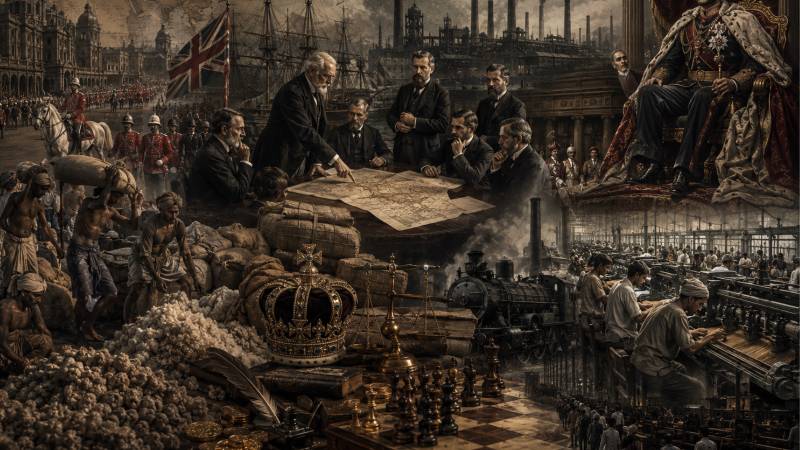
When the merchant prince returned to London, he bought a parliamentary seat, a Palladian country house, and a coat of arms that baffled the heralds at the College of Arms. His neighbors sneered. His wealth, they said, stank of Bengal. He dressed in silks his own ships had carried from Murshidabad, and at dinner parties he told stories of tiger hunts and marble palaces that no one quite believed. In the press he was called a “nabob,” a corruption of the Mughal title nawab, and the word curdled into a term of abuse. This was Britain in the second half of the eighteenth century, and the East India Company had come home.
To understand how a commercial enterprise became one of history’s most powerful colonial corporations, one must start not in London but on the banks of the Hooghly River. The East India Company received its royal charter from Elizabeth I in 1600, a slender grant to trade in spices, silks, and indigo. For a century and a half it operated as a nervous guest on the subcontinent, negotiating permissions from Mughal emperors and regional rulers, building fortified warehouses, and paying for goods with bullion. That dependence reversed with breathtaking speed. The Battle of Plassey in 1757, a skirmish made decisive by the treachery the Company’s Robert Clive engineered, delivered the wealthy province of Bengal into its hands. Seven years later, the Battle of Buxar confirmed the Company’s military supremacy. In 1765, the fading Mughal emperor Shah Alam II granted the Company the diwani—the right to collect the revenues of Bengal, Bihar, and Orissa. A trading concern now exercised sovereign fiscal power over some twenty million people. It had become, in the phrase the historian William Dalrymple uses, “a state within a state,” with its own army, diplomacy, tax collectors, and courts, answerable almost exclusively to its shareholders in Leadenhall Street.
The wealth that poured from this arrangement was staggering. Company servants, drawing modest official salaries, enriched themselves through private trade and the open sale of administrative favors. Fortunes were made not by honest enterprise but by extracting the agrarian surplus of Indian peasants, monopolising the salt and opium trades, and accepting—or demanding—presents from Indian princes whose survival depended on Company goodwill. Men who had left England as junior clerks returned home with colossal hoards, buying estates that rivaled the aristocracy’s. The nabob became a social type, endlessly caricatured in the prints of James Gillray and Thomas Rowlandson, satirized in Samuel Foote’s hit play The Nabob in 1772, and denounced in coffee-houses as a vulgar upstart whose money was tainted by Oriental despotism. The resentment was not merely snobbery. It contained a sharp moral judgment: this opulence had been wrung from the labour and suffering of distant people, and its very magnitude was evidence of systemic abuse.
Colonial rule was a sustained enterprise of organised plunder, often dressed in the garb of reform.
Parliament could not look away. In 1772 a select committee was appointed to investigate the Company’s affairs, and the following year another committee scrutinised Clive himself. Clive, by then Lord Clive of Plassey, defended his accumulation of some £234,000—an almost incalculable fortune at the time—by declaring to the House of Commons, “By God, Mr. Chairman, at this moment I stand astonished at my own moderation.” He was censured but not stripped of his wealth, and within a year he was dead by his own hand. The verdict on his conduct remained murky, but the public interrogation had already shifted the ground. A trading corporation wielding the power of life and death over millions, accountable only to a distant board and its shareholders, began to strike a growing number of Britons as constitutionally monstrous.
No one articulated that horror with greater force or eloquence than Edmund Burke. For Burke, the East India Company’s rule was not merely corrupt governance; it was a profound violation of the moral and legal principles that must bind any holder of political authority. When Warren Hastings, the first Governor-General of Bengal, returned to England in 1785 after a decade of contentious administration, Burke moved to impeach him before the House of Lords. The trial, which opened in Westminster Hall in 1788 and dragged on for seven years, became the great political spectacle of the age. The hall was packed with peers in ermine, gentlewomen in the galleries, and the finest orators of the day. Burke’s opening speech, delivered over four days, laid out an indictment not only of Hastings but of the very idea that a corporation could govern an empire according to the ethics of a counting-house. “We are to govern a large empire upon a commercial plan,” Burke thundered, “and to think of the responsibilities, the duties, the affections, the trusts, the sacred obligations which we owe to the people of India, as things merely commercial, and to be directed merely by the low, sordid, and pecuniary spirit of a counting-house.” He charged Hastings with extorting money from the Raja of Benares, with plundering the Begums of Oudh, with licensing torture and judicial murder, and with systematically degrading the institutions and dignity of Indian society. Burke summoned the notion of a “geographical morality,” the pretension that conduct impermissible in Europe could be perfectly acceptable in Asia, and he rejected it as an affront to universal justice.
Hastings was ultimately acquitted in 1795, the Lords preferring to preserve the veil of imperial respectability, but the trial transformed the political conversation. The historian Nicholas Dirks has argued that the Hastings impeachment, for all its theatricality, forced the British public to confront the scandal of empire and then, in a sense, to domesticate it through the fiction that legal process could tame the rapacity of colonial rule. The acquittal did not restore Hastings’s reputation, and it did nothing to halt the legislative encroachment on the Company’s autonomy that had been underway for two decades.
The first significant intervention had been the Regulating Act of 1773, which established the post of Governor-General and a supreme court at Calcutta, intended to impose some semblance of Crown oversight on Company administration. It proved feeble, and corruption continued virtually unchecked. The true turning point was Pitt’s India Act of 1784, which created a Board of Control consisting of six members of the Privy Council, including the Chancellor of the Exchequer and a Secretary of State, to superintend the Company’s political, military, and revenue policies. The Company retained its commercial monopoly and its patronage, but the dual system established by the Act meant that ultimate sovereign authority over India now resided, in practice, with the British government. Adam Smith, who had published The Wealth of Nations in 1776, had already diagnosed the malignancy at the heart of corporate empire. “The government of an exclusive company of merchants,” Smith wrote, “is, perhaps, the worst of all governments for any country whatever.” Merchants acting as sovereigns have no incentive to nourish the territory under their control; they extract what they can before the lease expires. Pitt’s reforms accepted Smith’s logic by subordinating commercial imperatives to imperial statecraft.
The erosion of the Company’s powers continued across the first half of the nineteenth century. The Charter Act of 1813 abolished its monopoly over trade with India, except for tea and the China trade. The Charter Act of 1833 completed the transformation: the Company lost all its commercial privileges, and its remaining function was purely administrative. It became, in effect, the managing agent of the British Crown, collecting revenues and enacting policies under the supervision of the Board of Control. The last pretense of autonomy vanished after the Revolt of 1857, a cataclysmic uprising that shook British rule across northern India and exposed the fragility of a regime built on mercenary armies and agrarian extraction. In its wake, the Government of India Act of 1858 transferred all powers of the Company directly to the Crown. The Board of Control was abolished, and a Secretary of State for India sat in the British cabinet. Queen Victoria issued a proclamation promising respect for native laws, customs, and religions—a document full of paternalist reassurances that belied the unrelenting violence of the rebellion’s suppression. The Company itself limped on as a shell until 1874, when the East India Stock Dividend Redemption Act dissolved it entirely. Its shareholders were compensated with public funds, a final transaction in which the British taxpayer absorbed the cost of the imperial adventure the Company had launched.
The economic consequences of Company rule had long been the ghost at the parliamentary feast. Contemporaries were certainly aware of the human catastrophe of the Bengal Famine of 1769–70. By the most widely accepted estimates, as many as ten million people died, perhaps a third of Bengal’s population, while the Company’s servants and their local agents continued to enforce land tax collections at rates that left cultivators destitute. The Company’s own records reveal officials acknowledging the devastation even as the revenue assessments remained unchanged. Historians still debate the precise causes—climatic disruption, a breakdown in the grain trade, the Company’s fiscal rigidity—but the weight of scholarship, from the economist Amartya Sen’s classic analysis of famine to the work of P.J. Marshall, demonstrates that colonial policy amplified the disaster and then compounded it with official indifference. In his economic history of early colonial India, Marshall notes that the famine “did not deflect the Company from its determination to extract the maximum possible revenue.”
Extraction was the consistent logic. The Company’s monopoly on salt, a necessity of life, turned a basic commodity into an instrument of regressive taxation. Its opium monopoly produced vast quantities of the drug in Bengal and forcibly exported it to China, leading to two Opium Wars that are among the grimmest examples of state-sponsored narcotics trafficking in modern history. The more lasting structural damage was wrought by the systematic dismantling of Indian manufacturing. Before the Company consolidated its power, Indian textiles dominated world markets. Muslin from Dhaka, calico from Calicut, and chintz from the Coromandel Coast were prized across Europe. By the end of the eighteenth century, Company policy, reinforced by the British state, reversed that flow: Indian raw cotton was shipped to Manchester, spun and woven by machine, and the finished cloth was dumped back into the Indian market under tariff conditions that crushed local producers. Paul Bairoch’s widely cited estimates indicate that India’s share of global manufacturing output fell from around twenty-five per cent in 1750 to under two per cent by 1900. The human dimensions of that collapse are harder to measure, but contemporary travel accounts from the early nineteenth century describe a landscape of skeletal weavers and abandoned textile towns. The deindustrialisation thesis has been contested in some details—economic historian Tirthankar Roy has pointed to regional variations and the survival of artisanal clusters—but the overarching trajectory of decline under colonial pressure is not seriously in doubt.
So much for the civilising mission. The language of improvement was everywhere in British debates about India—in the speeches of Whig reformers, in the missionary petitions that led to the lifting of restrictions on evangelical activity in 1813, in Thomas Babington Macaulay’s notorious Minute on Education of 1835, which called for the creation of “a class of persons, Indian in blood and colour, but English in taste, in opinions, in morals, and in intellect.” Even the most apparently liberal interventions, however, were founded on racial hierarchy, political disenfranchisement, and legal inequality. Englishmen in India were subject to one set of courts; Indians to another, which offered far less protection and applied criminal procedures that were often arbitrary and brutal. The Company state routinely used flogging, penal transportation, and death for offenses that would have been treated with comparative lenity in Britain. The collective punishment of villages was a standard administrative tool. The military conquests that expanded Company territory into Mysore, the Maratha lands, and the Punjab were prosecuted with an indifference to civilian life that horrified even some British officers. In 1791, for instance, during the Third Anglo-Mysore War, the army under Lord Cornwallis—a man celebrated in America and Britain for his rectitude—slaughtered thousands of Tipu Sultan’s soldiers and camp followers, and the destruction of crops and villages was pursued as a deliberate strategy.
The Raj that followed was still a racial autocracy, still an extractive machine, still a regime maintained by coercive force.
The racial contempt that saturated Company rule was documented in a thousand bureaucratic memoranda and private letters. Indians were “effeminate,” “perfidious,” “incapable of impartial justice.” Those stereotypes were not incidental to colonial governance; they were its ideological justification. Without them, the extraction of wealth and the exercise of arbitrary power could not be morally sustained. Shashi Tharoor, in Inglorious Empire, has argued forcefully that the British Raj, far from bringing enlightenment to India, engineered what he calls “the systematic de-industrialisation, de-urbanisation, and immiseration of the subcontinent.” Tharoor’s polemic has drawn criticism from some scholars for aggregating injustices into a sweeping indictment that sometimes elides nuance, yet his central claim—that colonial rule was a sustained enterprise of organised plunder, often dressed in the garb of reform—is rooted in a vast body of British parliamentary testimony, official inquiries, and the writings of Indian nationalists from Dadabhai Naoroji to R.C. Dutt. Naoroji’s “drain theory,” meticulously calculated in Poverty and Un-British Rule in India, demonstrated that India’s revenues were being exported to Britain in the form of home charges, interest on loans, and the salaries of British officials, without any corresponding return. That analysis, presented to a British audience Naoroji was trying to persuade, was built on official statistics and set the terms for the economic critique of empire for a century.
What is remarkable is how many British observers, from the very beginning, said much the same thing. Burke’s impeachment speeches were not the solitary protests of a moral eccentric. Charles James Fox and the Whig opposition built an entire political programme around curbing the Company’s power. William Wilberforce and the evangelicals, for all their missionary paternalism, were genuinely appalled by the abuses they associated with Company rule. Even the philosopher James Mill, who never set foot in India and whose History of British India (1817) is saturated with racial condescension, nonetheless concluded that the Company had “oppressed and impoverished the country.” The radical press, from the Morning Chronicle to Cobbett’s Weekly Political Register, repeatedly flayed the nabobs and their parliamentary allies as a corrupting influence on British politics. The notion that colonialism was essentially a benevolent enterprise that occasionally went astray is a later invention, manufactured by imperial nostalgia in the twentieth century and sustained by selective memory. The historical record shows that, from the moment the Company seized the diwani until its final dissolution, a substantial and influential segment of British political and intellectual life judged its methods to be indefensible.
The Government of India Act of 1858, which finally transferred power to the Crown, was not a repudiation of colonialism. It was a change of management. The Queen’s proclamation promised equal treatment and religious neutrality, yet the Raj that followed was still a racial autocracy, still an extractive machine, still a regime maintained by coercive force. What had changed was that the British state, having learned from the Company’s spectacular failures, centralised the business of empire and shrouded it in the respectable garb of civil service and legal codification. The colonial violence continued, mutating into new forms—the devastating famines of the later nineteenth century, the indentured labour system, the brutal suppression of political dissent, the partition of 1947 that was itself a terminal act of imperial maladministration. To defend the Company’s rule, or any colonial rule, is to defend the principle that some people may govern others without their consent, extract their resources, restructure their economies, and police their cultures, all in the name of profit or a supposed superiority of civilisation. That principle, as Burke understood, is the enemy of any coherent morality.
The East India Company’s story does not end in 1874. It reverberates today because the structure that made it monstrous—a corporation wielding sovereign power, unmoored from democratic accountability, driven by the imperative to maximise returns—is not a historical curiosity. Contemporary multinationals do not raise armies or collect taxes, but the power they exercise over global supply chains, digital public spheres, labour markets, and even the apparatus of the state itself invites careful comparison. When private military contractors are deployed in conflict zones, when technology platforms adjudicate the boundaries of free expression, when agribusinesses dictate the agricultural policies of sovereign nations, the ghost of the East India Company creeps back. These are not simple analogies, and historical naivety should be resisted. The Company was a product of mercantilist charter, not neoliberal globalisation. But the core lesson remains urgent: wherever corporate power escapes the constraints of democratic law and public accountability, the danger of predation, of extraction dressed as enterprise, and of human suffering rationalised as the cost of doing business, becomes acute.
Britain judged the East India Company, and by the end, it convicted it. The parliamentary inquiries, the legislative reforms, the searing rhetoric of Burke, the scalpel of Adam Smith, the popular ridicule of the nabobs, and the final, almost perfunctory act of dissolution in 1874—all of it amounts to a verdict that the corporate empire was a moral and constitutional calamity. That verdict, returned by the very society that had profited from its spoils, is as close to a confession as any empire has ever made. To honour that honesty, rather than to bury it under statues and nostalgia, is to recognise why colonialism in any form can never be defended. The evidence is not hidden in obscure archives; it was spoken aloud in the House of Commons, printed in the newspapers, painted into cartoons, and wept over by the millions whose lives the Company consumed. The question the twenty-first century must answer is whether we are willing to listen.