

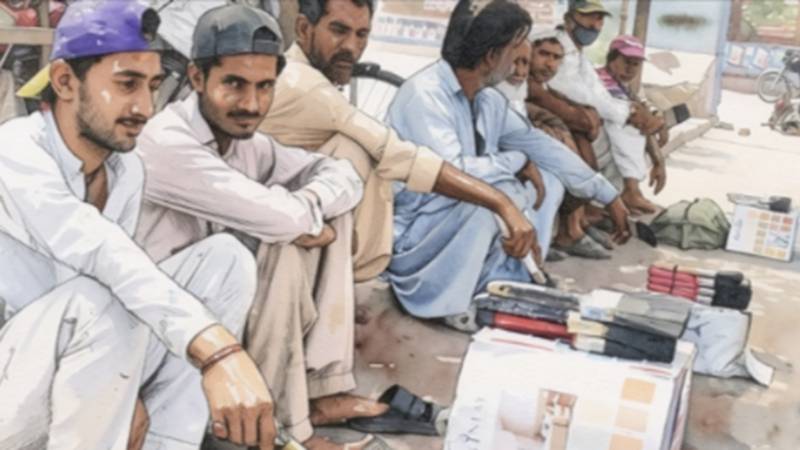
The emerging sights and sounds witnessed across the length and breadth of Pakistan testify to the World Bank’s and the United Nations Development Programme's (UNDP) latest findings. The indicators point to a rancid reality we have conveniently chosen to ignore for decades.
Last week, the Washington-based lending agency stated that Pakistan is home to half of the poorest population in the entire Middle East, North Africa, and Afghanistan-Pakistan (MENAAP) region, while figures released by UNDP this week show that 38.3% of Pakistan’s population is multidimensionally poor.
The verdicts, though, may easily only be the tip of the iceberg, as the lived trials of a people are usually much worse than the listed ones.
Hidden in plain sight all around us, these officially released numbers should have caused a lot of concern, hard-hitting the headlines and the power hubs across the country. Instead, the reports went completely unnoticed and ignored, with no official statements or comments given by our ruling and power elites on the findings. The latter are too engrossed in directing all their prowess in fighting their battles of political and personal survival to care about the common man’s lives.
While governments choose to look the other way, this widespread deprivation and destitution is spotted first-hand every day by observers and citizens—an experience more eye-opening than any quoted numbers and what they signify. The crisis of poverty in Pakistan is, hence, far deeper than what any official indicators suggest.
The Cost of the Wars Within
Pakistan is not at war; yet, more people are in extreme poverty here than in the war-ravaged territories of Afghanistan, Syria, and Yemen combined, according to the World Bank report. Perhaps, it’s the wars within that have been debilitating and have consumed the country and its people. The political tussles, the power tugs, the obsessions to quash oppositions, the resistance against dissent, the government expenditure extravagance, the on-the-streets marches, and the coercive controls, including clamping down on the internet, have together cost the country the equivalent of an active cross-border war.
These perpetual political confrontations and forever government-opposition conflicts, followed by frequent shutdowns and blockades of cities, result in declining public confidence in the country’s economic future, as issues cannot be addressed in a politically volatile milieu.
Relentlessly oblivious to the lives and challenges encumbering ordinary citizens, authorities and policymakers in Pakistan continue to perpetuate a graphic contradiction, where on paper the economy is said to have long stabilised
It is a point of shame that the World Bank no longer ranks Pakistan within South Asia. Instead, it groups us in the MENAAP region, in direct comparison with Afghanistan and countries of Africa, though South Asia also accounts for a substantial share of global deprivation. Even in the MENAAP region almost half—a whopping 48%—of those surviving on less than $3 a day live in Pakistan, making it home to the highest concentration of the poorest among the poor.
A subsequent UNDP report notes that more than one-third of Pakistan’s population confronts “overlapping deprivations in health, education and living standards.” The UNDP’s Multidimensional Poverty Index (MPI), hence, shows that 38.3% of Pakistan’s population is multidimensionally poor, a figure much higher in comparison to neighbouring India at 16.4%, and Bangladesh at 14.9%. The MPI measures overlapping disadvantages in basics like nutrition, child mortality, schooling, sanitation, potable water, electricity, and housing.
The UNDP report also measures the intensity of deprivation among those classified as multidimensionally poor in Pakistan, marking it at 51.7%. Another 12.9% of the population is already susceptible to multidimensional poverty, indicating that a further substantial share of people remains at risk of falling into acute deprivation, according to the report.
The Reality of Stabilisation
Relentlessly oblivious to the lives and challenges encumbering ordinary citizens, authorities and policymakers in Pakistan continue to perpetuate a graphic contradiction, where on paper the economy is said to have long stabilised, with growth projected at 3.8%, deficits being termed “manageable,” and the honour of the International Monetary Fund's (IMF) next tranche about to grace our paltry existence yet again, just around the corner.
But with the numbers on paper appearing to recover just like many times in the past, thanks to repeated boom-and-bust cycles, when will the people behind those numbers begin to recover and recuperate, is the question that needs to be urgently asked.
In fact, the lives and lifestyles of average Pakistanis are fast regressing, and while governments celebrate economic stabilisation, four in every ten Pakistanis suffer from deprivation in overall living standards, as they get sucked further into pits of prolonged, punishing poverty, with an ever-increasing chunk of the population earning and surviving on less than Rs 800 a day.
With petrol and diesel having crossed Rs 400/litre and continuing to affect prices of all essential commodities and services, how is it possible for even a family of two to survive on an Rs 800 income per day? These ground realities need to keep our ruling elites grounded when they tout their economic and development wins. If it fails to stabilise people’s lives in progression, what good is a stint of economic stability or even growth, other than making heady headlines?
Independent estimates and World Bank data also suggest that overall poverty rates in Pakistan range between 39% to 43.5%, victimising over a 100 million people.
This surge in poverty is conveniently attributed to prolonged economic shocks, IMF stabilisation measures, climate calamities like floods, and the Middle East conflict, but Pakistan’s self-initiated, internal drivers of poverty cannot go scot-free for playing their role.
Besides, IMF ‘stabilisation measures’ have repeatedly advocated targeted relief and subsidies. At the staff-level agreement, as the IMF reviewed the country’s $7 billion Extended Fund Facility earlier in October, the IMF again told Pakistan to phase out its fuel support scheme ‘promptly’ as the mission chief, Iva Petrova, urged Pakistan to give only targeted subsidies through the national social safety net programme to deal with the aftermath of the Middle East conflict.
The IMF stated that it opposes sweeping, untargeted price relief, like generalised fuel or electricity subsidies, because they drain public revenue and “disproportionately help affluent consumers” who, as a result, end up using more energy.
Widening Disparities and Rising Inequality
This pattern shows how the privileges of the rich proliferate even in desperate times, endorsing the fact that increasing inflation only victimises the lower and middle segments of the society. It goes to show the rising inequality and how the rich are getting richer and the poor, poorer. Measuring this economic inequality, the national Gini coefficient has increased from 28.4 in 2018–19 to 32.7 in 2024–25. The increase was visible in both urban and rural areas as urban inequality rose from 31.0 to 34.4, while rural inequality increased from 23.4 to 36.6 during 2018–19 and 2024–25 due to wider disparities in income distribution.
Provincial inequality also moved upward over the same period. In 2024–25, the Gini coefficient stood at 32.0 in Punjab, 35.9 in Sindh, 29.4 in KP, and 26.5 in Balochistan. In 2018–19, respective values were 28.4, 29.7, 24.8, and 21.0. Provincial patterns show that inequality surged across all provinces, with Sindh recording the highest level in 2024–25, also indicating that recent financial pressures on households were accompanied by widening disparities in income distribution.
Since disadvantages in different areas reinforce one another, poor health, inadequate education, and substandard living conditions trap families in poverty for generations, making it difficult for them to improve their circumstances without government interventions.
The global price shockwaves and augmented fuel prices resulting from the US war on Iran have begun to bleed into all goods, services, and commodities, as low-income developing countries brace for the disproportionate impact of these shocks. In this scenario, heavily indebted, oil-importing countries like Pakistan may cut public spending to avoid debt restructuring, but unless government expenditures and extravagance are cut on equal footing, economic and social inequality will continue to perpetuate.