

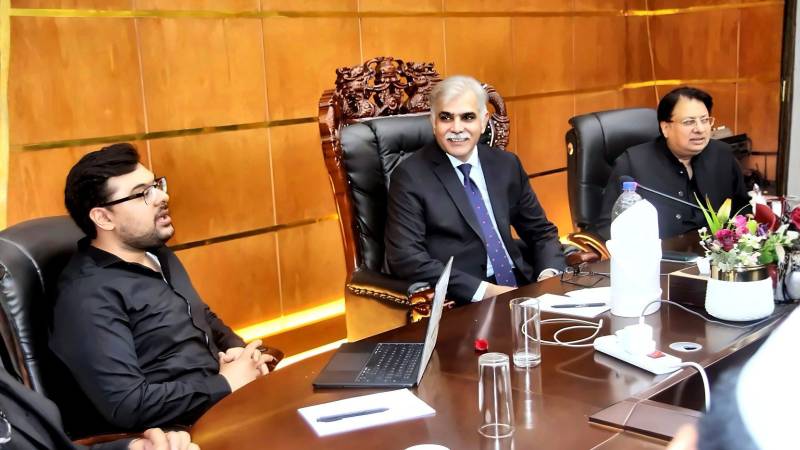
Azhar Publishers on Monday launched MAKTAB, an education technology platform that brings school management and classroom teaching together in one system, at a ceremony attended by educationists, school heads and the company’s sales team from across the country.
The keynote was given by Muhammad Yaqoob, Provost of the University of Central Punjab, a well-known academician who has spent years mentoring young people and encouraging entrepreneurship. Speaking on the role of education in Pakistan, Mr Yaqoob said the country’s future depends less on its universities and more on its primary classrooms.
“The Pakistan of tomorrow is being built today, in the early years of a child’s schooling,” he told the gathering. Primary education is where reading, numbers and the habit of thinking are either set properly or missed altogether, he said — and later investment can never fully make up for what is lost at that stage.
He was honest about the problem this creates for higher education. Too many students reach university without the basic skills their degrees assume, he said, so institutions spend the first years fixing gaps that should have been closed much earlier. “Students need to be ready before they come to us,” he said, adding that schools should treat skills — speaking, thinking, solving problems — as the real goal, not something that happens by accident alongside the syllabus.

He also spoke about reading and writing in the age of artificial intelligence. Every technology takes some skills away, he said: when computers arrived, handwriting suffered, and a generation grew up typing rather than writing by hand. AI will do the same to many more skills, and far faster. But reading and writing are not skills a child can hand over to a machine, he said, because they are how the mind itself is trained — the muscle memory of thinking. A student who has never worked through a page of text, or struggled to put an argument on paper, will not be able to judge whether a machine’s answer is any good.
He welcomed platforms such as MAKTAB, saying good ed-tech is a practical way to lift classroom quality on a large scale, especially where teacher training and office capacity are stretched. Technology does not replace a good teacher, he added — but it gives a good teacher a much longer reach.
Educationist and communications expert Haider Miraj told the gathering that education in Pakistan today is being driven forward by private enterprise. Where public investment has struggled to keep pace, he said, it is legacy-driven private entrepreneurs who are building the schools, publishing the books and now bringing technology into classrooms — putting their own capital at risk to do it. Innovation like MAKTAB, he argued, is exactly what that kind of enterprise makes possible, and the sector’s future depends on giving such initiative room to grow.
Azhar Publishers Chief Operating Officer Ali Azhar said MAKTAB was built to fix the everyday mess school staff deal with. “The purpose of MAKTAB is to bring school management and teaching under one roof, in a seamlessly integrated ed-tech platform,” he said. Instead of running separate registers, files and systems for admissions, attendance, fees, exams and lessons, a school can run all of it — and teach from it — in one place.
The platform combines office tools with a digital teaching library, where Azhar Publishers’ printed books come alive as flipbooks, interactive lessons, teaching slides and ready-made exam papers. It runs on ordinary computers and keeps working when the internet drops — something the company says came from what it saw in schools outside the big cities.
Development lead Farooq Iqbal, speaking after the live demonstration, said the first priority is partnership rather than numbers. “We want to partner with schools across Punjab and Khyber Pakhtunkhwa to ensure the platform genuinely aids teaching, alongside the school textbooks teachers already use,” he said. MAKTAB is meant to support classroom material, not replace it, he added, and staff training is included when a school joins.
The event, held under the auspices of Azhar Publishers, also included a laptop distribution ceremony for the company’s team, followed by hi-tea and networking.
Founded in 1972 in Lahore’s Urdu Bazaar, Azhar Publishers has served schools across Pakistan for more than five decades. The house publishes school textbooks, past papers for local examination boards, pre-school children’s books, and early-years Quranic titles.