

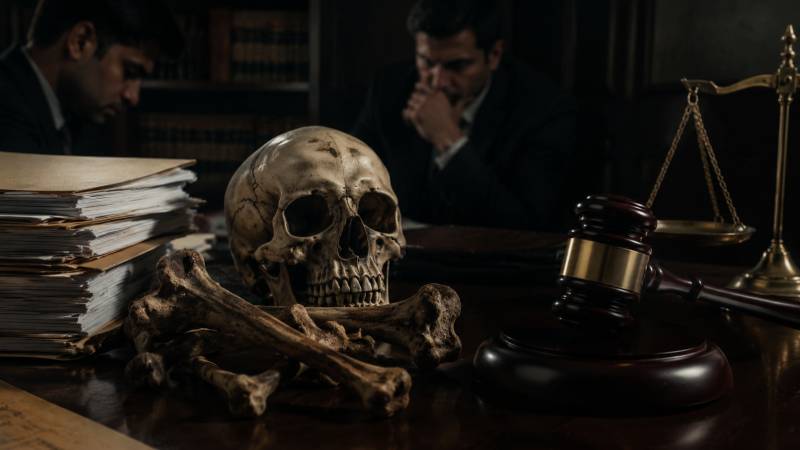
Few acts provoke the same visceral revulsion as cannibalism. It sits at the outer edge of human transgression, conjuring images more suited to horror fiction than courtroom proceedings. Cannibalism refers to the act of consuming the body matter of another human being. This can involve eating flesh, organs, or other bodily substances, regardless of whether the consumption was consensual or not. Yet a curious gap exists in Pakistani criminal law: nowhere does the Pakistan Penal Code, 1860 (PPC) name cannibalism as a distinct offence. The statute is silent on the act of consuming human flesh, organs, or other bodily matter, silent, too, on whether that silence changes depending on consent. This is not to say the law is powerless in the face of such conduct. Rather, the acts that make up cannibalism- killing, mutilating a corpse, causing grievous injury- fall within the reach of several existing provisions of the PPC, each addressing a fragment of the act without ever naming the whole.
Where an act of cannibalism entails the killing of a person, the offender shall be liable for homicide under the relevant provisions of the PPC. Where the act is committed after death, the law nonetheless affords protection to the dignity of the deceased. Section 297 of the Pakistan Penal Code criminalizes the offering of indignity to a human corpse, the disturbance of any funeral ceremony, or trespass upon a place of burial with the intent to wound the religious or societal sentiments of any person. Section 295-A for deliberately outraging religious feelings. Similarly, Section 201 PPC may be invoked where a dead body is mutilated, concealed, or destroyed for the purpose of causing the disappearance of evidence relating to the commission of an offence.
Pakistani Ali Brothers Jailed 12 Years in Cannibalism Case
In the village of Khwawar Kalan, tucked near Darya Khan in Punjab's Bhakkar district, the smell reached the neighbours before the truth did: a thick, wrong odor drifting from the home of Mohammad Farman Ali and Mohammad Arif Ali brothers who had once already been cast out by the community's suspicion and had spent years since trying to disappear into silence. It was April when the villagers, unable to ignore it any longer, called the police, and what the officers found inside would confirm the fears that had quietly followed the brothers since their first arrest back in 2011: the skull of a two-year-old child, and an admission, once questioning began, that the pair had dug the small body from a nearby grave and cooked it into curry. No law in Pakistan named what they had done no statute for cannibalism itself so when the anti-terrorism court in Sargodha finally delivered its verdict, it did so through the only legal language available: desecration of a grave, the spreading of fear, the destruction of property, charges borrowed from anti-terrorism legislation to carry the weight of a crime the penal code had never thought to name. Twelve years each, the court ruled, with the right of appeal still open before the Lahore High Court, and in the space between the sentence and the silence of the statute books, the case became something larger than the brothers themselves: a quiet, uncomfortable reminder of how far Pakistani law still has to go before it can call an act like this by its true name.
Where an act of cannibalism entails the killing of a person, the offender shall be liable for homicide under the relevant provisions of the PPC.
Comparative Jurisprudence: How Other Legal Systems Have Addressed Cannibalism
Other jurisdictions, despite more developed criminal codes, have faced the same absence and relied on adjacent offences to prosecute cannibalism. In R v Dudley and Stephens (1884), four shipwrecked sailors were stranded without food or water; when one fell into a coma after drinking seawater, Dudley killed him, and the survivors consumed his body before rescue. Tried for murder, the defendants invoked necessity as a defence, but the English court rejected it outright, holding that survival does not justify taking an innocent life. This ruling remains foundational to common law and carries direct weight in Pakistan, whose penal code inherited this same legal tradition. In the United States, Jeffrey Dahmer was tried in 1991 for 17 murders committed between 1978 and 1990; although his consumption of victims' remains was part of the factual record, it was never charged as a distinct offence. He was instead convicted of murder and abuse of a corpse across Wisconsin and Ohio, receiving 16 life sentences, before being killed by a fellow inmate in 1994.
Germany's Armin Meiwes case adds a further dimension: consent. Meiwes located a willing participant through an online forum, killed him with his agreement, and butchered and froze the body for later consumption. Because German law had no dedicated cannibalism offence, prosecutors initially secured only a manslaughter conviction criticised as inadequate before a retrial resulted in a murder conviction and life sentence, confirming that consent does not reduce culpability for killing. Together, these cases show a consistent global pattern: cannibalism is prosecuted not as itself, but through the offences that surround it murder, necessity's rejection as a defence, and abuse of a corpse reinforcing the argument that Pakistan's reliance on the PPC's existing provisions, while workable, leaves open questions about consent and premeditation that courts may eventually have to confront without dedicated statutory guidance.
The Urgent Need for Dedicated Legislation: Pakistan and the World
Pakistan's gap mirrors a near-universal one. Comparative legal scholarship confirms that English law does not treat cannibalism as a separate offence at all; at most, it functions as an aggravating factor in sentencing, reflecting an offender's lack of remorse rather than any distinct culpability attached to the act itself. The same is true of Singapore, and of most Commonwealth jurisdictions that inherited British-derived penal codes, including Pakistan's.
In the United States, the picture is similarly threadbare: Idaho is the only one of the fifty states to specifically criminalise cannibalism, with a 1990 statute punishing willful ingestion of human flesh with up to fourteen years' imprisonment, and even that statute carries a built-in necessity defence for extreme, life-threatening survival situations. Every other U.S. state, along with federal law, prosecutes only through murder and corpse-desecration statutes. The United Kingdom follows the same approach, addressing cannibalism indirectly through instruments such as the Human Tissue Act 2004, which criminalises possessing human tissue without consent rather than the act of consumption itself. Germany, as discussed above, had no cannibalism-specific provision at all at the time of the Meiwes caseT.
The Void in International Criminal Law
The gap becomes starker still at the international level. Despite the existence of well-developed international criminal law covering genocide, war crimes, and crimes against humanity, no provision in international criminal law explicitly prohibits cannibalism as such, and national criminal codes addressing the topic remain scarce worldwide. This omission is not merely academic: cannibalism has surfaced as a factual element in real international tribunals. During proceedings before the Special Court for Sierra Leone, which prosecuted violations of international humanitarian law during the country's civil war, witnesses gave testimony describing acts of cannibalism yet the tribunal had no standalone charge available to address the conduct directly, forcing prosecutors, as in the domestic cases above, to fold it into broader charges of war crimes and crimes against humanity.
Why This Matters Now
Taken together, these gaps in Pakistan, in leading common-law and civil-law jurisdictions, and in international criminal law itself point to the same structural weakness: cannibalism is treated everywhere as a symptom of other crimes rather than as conduct meriting its own legal definition, elements, and penalty. This creates three recurring problems that this article has already traced through case law:
(a)Consent is not settled doctrine. Meiwes shows how courts can initially under-punish consensual cases by defaulting to manslaughter rather than murder, precisely because no cannibalism-specific framework exists to guide sentencing independent of consent.
(b) Necessity is judge-made, not statute-based. Dudley and Stephens settled that necessity cannot excuse killing, but this remains common-law doctrine rather than codified statute in most jurisdictions, including Pakistan, where courts would have to import English precedent rather than apply domestic legislation.
(c) Evidentiary gaps persist. Without a defined offence, prosecutors must stretch existing provisions for grave desecration, mischief, and evidence tampering that were never drafted with cannibalism in mind- producing the kind of premature releases seen in the Sargodha case.
Given this consistent global pattern, Pakistan's 2020 bill, however imperfect, represented a rare legislative attempt to close a gap that most nations, and international law itself, have left unaddressed. Its stalling in committee leaves Pakistan's courts exactly where English, American, and German courts have historically stood: improvising justice through adjacent offences rather than applying purpose-built law.
Across every jurisdiction examined Pakistan, England, the United States, Germany, and even international tribunals like the Special Court for Sierra Leone cannibalism is never prosecuted as a crime in its own right. It is instead folded into murder, necessity's rejection as a defence, corpse desecration, or public-order offences, none of which were drafted with this specific conduct in mind. Pakistan's experience makes the cost of this gap concrete: offenders in the Sargodha case were released after roughly two years for want of a specific statute, and a 2020 private member's bill proposing to amend Section 297 of the PPC stalled in committee and was never enacted.
This is not a uniquely Pakistani problem; it is a near-universal legislative blind spot, extending even into international criminal law, where no provision explicitly addresses cannibalism despite its having surfaced as evidence in real war-crimes proceedings. As forensic capability and cross-border criminal cases grow more sophisticated, this absence will keep forcing courts to improvise through ill-fitting statutes rather than apply clear, purpose-built law. Closing this gap through a properly drafted amendment in Pakistan, and through coordinated attention at the international level, is no longer a theoretical legal question but an urgent and overdue reform.