

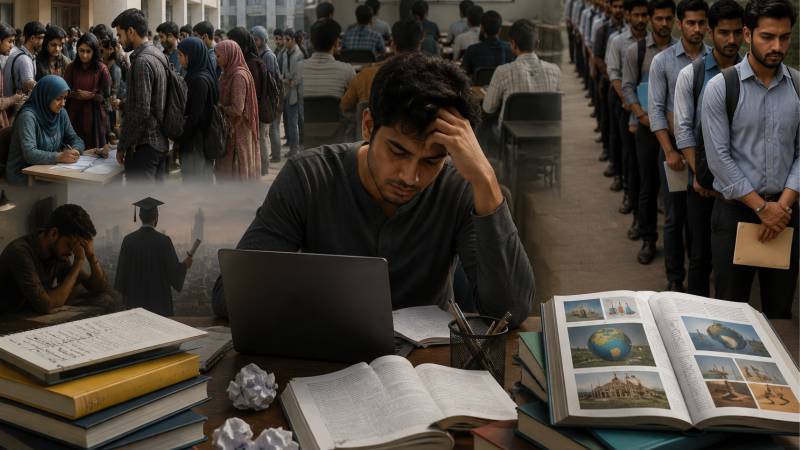
The cycle repeats every year. Universities open admissions. Students enroll. Parents invest. Hundreds of thousands of young Pakistanis begin their university journey believing a bachelor's degree will translate into a respectable career. They spend four years earning that degree. And then graduation arrives. Not with opportunity, but with uncertainty.
We call it graduate unemployment. Fair enough. But unemployment is only the ending we notice. The bigger problem begins years before the first rejected job application lands in a graduate's inbox. We ask students finishing college to pick degrees. But we rarely ask them what those degrees lead to. What careers do they open up? How many opportunities actually exist? What skills do employers actually want? What salaries can graduates realistically expect? For many students, these questions never arise. Instead, career choices emerge from a familiar collection of voices.
Abbu thinks engineering is respectable. Chachu says CSS is the future. Friends are applying somewhere. Merit closed here; seats were available there. Didn't get into your first choice? No worries. Take whatever is left. A degree is a degree, after all. Universities rarely challenge these assumptions. Their competition isn't for informed students. It's for admissions. So, thousands of students spend four years studying subjects they neither understand nor particularly care about.
A political science student who couldn't care less about politics. A history student who has never voluntarily opened a history book. Sociology because the merit list said so. Literature because nothing else worked out. It's difficult to fall in love with a subject you never really chose. And when curiosity disappears, education becomes exactly what you'd expect: mechanical.
When universities prioritise enrollment over employability, and when career guidance remains little more than an afterthought, disappointment becomes inevitable.
Students attend lectures without ever inhabiting the ideas. Reading becomes an obligation rather than a pleasure. Passing examinations become the objective, and learning quietly disappears. Universities respond the only way they know how: by lowering expectations rather than confronting the fact that many students entered programmes they neither understood nor wanted in the first place.
Then comes graduation. Everyone smiles for photographs. Parents celebrate. Success, we're told. Except graduation isn't success. It's simply the moment reality starts asking questions the university never did. The labour market has a nasty habit of caring about things campuses often don't. Can you communicate? Can you solve problems? Can you analyse information? Can you work with digital tools?
Graduation isn't the end of the surprises. You are one of thousands carrying exactly the same degree, chasing exactly the same handful of vacancies. Who could have guessed? Some graduates take jobs completely unrelated to what they studied. Others spend years preparing for government examinations that may never materialise. Some enroll in another degree—not because they desperately need more education, but because education has become a refuge from unemployment.
Meanwhile, families continue supporting graduates who did everything society asked of them except ask the one question that mattered: Was this degree actually preparing them for a career? And before we blame graduates for everything, let's spread the responsibility around a little.
Parents: We know you want the best for your children. We know you want security and respect for them. But prestige does not pay bills. A degree that sounded impressive twenty years ago does not automatically create opportunities today.
Universities, too, must look beyond the moment of admission. Their responsibility cannot end when a student walks across the stage holding a degree. Graduation is not the outcome. What happens afterwards is.
Do graduates find meaningful work? Do they build fulfilling careers? Do employers value the education they received? Does the university know where its graduates go? More importantly, does it care? And then there is career counselling. Or, more accurately, its spectacular absence.
Students receive endless guidance about examination dates, admission deadlines, and merit calculations. Wonderful. But when it comes to the question that shapes the next forty years of their lives—"What kind of career actually suits me?"—silence. Career counselling has been reduced to an annual seminar, a motivational speech, or a colourful admissions brochure. That is not guidance. That is marketing.
Real career counselling should begin before students ever fill out a university application. Students deserve aptitude assessments. They deserve honest conversations. They deserve labour-market information. They deserve professionals who can explain where opportunities are growing—and where they aren't. Most of all, they deserve facts before investing four years of their lives.
Better career guidance will not create jobs where none exist. Pakistan's economy still needs stronger private-sector growth and greater demand for skilled graduates. But helping students make informed educational choices is one problem we can solve today. It would spare thousands from investing years in degrees that leave them unprepared for the realities of the labour market.
Because when students choose degrees without understanding them, when universities prioritise enrollment over employability, and when career guidance remains little more than an afterthought, disappointment stops being unfortunate. It becomes inevitable. Pakistan doesn't simply need more graduates. We have become rather good at producing them. Pakistan needs graduates who understand why they chose a discipline, what skills they need to develop, and where those skills can create value.