

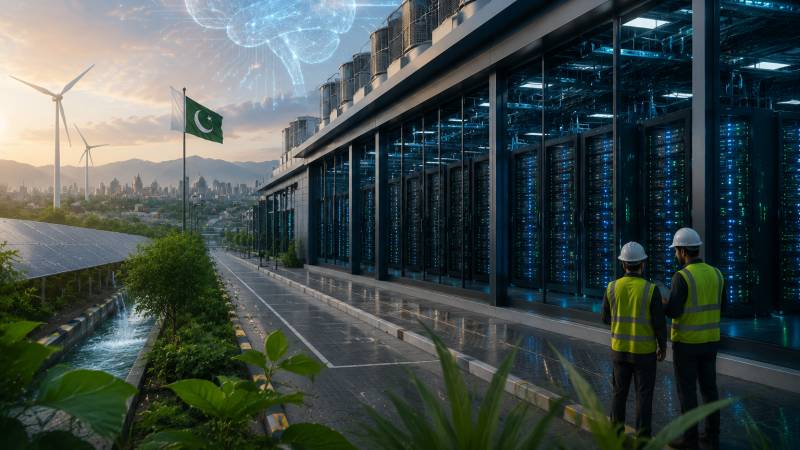
Data centres are the backbone of IT networks across the globe. These are important for the storage and processing of information, for financial systems, for cloud services, for machine learning, and for artificial intelligence. The recent spike in the development of these data centres around the globe is primarily due to the spread and extreme usage of Artificial intelligence in our daily lives. The chatbots like ChatGPT, Claude AI, Notebook LM, Google Gemini, all these are owned, powered and built by tech giants and multi-billion dollar companies who have little or no interest in benefitting the public. When these data centres started, they were seen as employment opportunities and as a catalyst for industrial development, attracting investment to the country. But with the passage of time, the jobs created by construction opportunities vanished after the completion of these data centres. These data centres mostly operate independently. They don’t need an active staff or hundreds of workers to maintain them. These data centres are a trap for the public to support their development due to temporary advantages, but in the long run, they prove to be the infrastructure supporting the giant tech companies and making billions in profits for them, while the general public bears the snags and hindrances in their daily lives.
These data centres are energy-hungry entities that are here to drain the resources of the public without paying any price. Data centres are the central nervous system of the 21st century as the world goes digital entirely. It contains comprehensive mechanical and electrical infrastructures to support the storage, management, processing, and exchange of digital data.
These data centres also require efficient mechanisms to cool down their large servers, GPUs (Graphics Processing Units) and CPUs (Central Processing Units). Large data centres that rely on evaporative cooling can consume approximately 5 million gallons of water per day, which is equivalent to the water use of a small town of 10,000 to 50,000 people. This technique is cost-effective and energy-efficient, but it raises serious sustainability concerns. The other cooling methods, which are direct-to-chip (D2C) cooling, single-phase immersion cooling, and multiple-phase immersion cooling, offer an effective and sustainable solution, but their implementation costs can significantly exceed evaporative cooling.
These data centres are a trap for the public to support their development due to temporary advantages, but in the long run, they prove to be the infrastructure supporting the giant tech companies and making billions in profits for them.
Now, after the development of around 700 data centres in the USA, there is a massive protest against these centres operating in residential areas and near the homes of residents who have lived there for decades. These data centres were supported in the early years because people didn’t know what the outcome would be of having them in the neighbourhood. The consequences of these centres are on a macroscale. They not only impact the energy consumption costs and use land of the localities they are built in, but also create air and noise pollution and affect water quality.
The analysis shows that 17 data centre projects were cancelled and 18 were delayed due to opposition against their development between 2023 and 2025. 14 states are seriously considering an outright ban on data centres due to the most frequent public concerns about noise and quality of life. There will definitely be opposition from multinational companies operating these data centres and the billionaires who benefit from them, as they also control governments in the shadows.
Due to these movements against data centres in the USA, the technological hub of the world, they are now coming to developing countries that are already thirsty for foreign investment to grow their economies and would take any opportunity to achieve their financial targets. These multinational corporations see the developing countries and the global East as their dumping sites. They play with the law and create situations in the commercial world in which parent companies are not even held responsible for the violations and damages they cause in countries like Pakistan, Kenya, and South Africa.
A news report circulated after the Quantum Global Data Centre (QGDC), a company backed by the Gul Ahmed Energy Group, announced plans to build Pakistan’s largest Tier III data centre, alongside the other 30 data centres currently operating in the country. The company claimed that this project will attract around $600 million in investment to the country in the span of the next 3 to 4 years. This can be seen as an achievement for the business sector in Pakistan, but the government must implement rules and regulations governing how such projects will be brought about. A decent amount of data is available that shows the negative impacts of having these data centres near residential areas. With the boom of AI, the spread of these data centres cannot be stopped, but it can be regulated. The policymakers have to take the necessary steps to ensure that these data centres do not deplete Pakistan's public resources.
We are desperately in need of investment, and more than that, we need clear, strong regulations to direct and manage these projects that attract investment, especially those that pose a clear environmental hazard to the country, which is already facing the effects of climate change. People’s quality of life is deteriorating day by day. The government needs to pay close, constant attention to the modern inevitable threats the country faces. Policymakers have to keep pace with the digital AI world.