

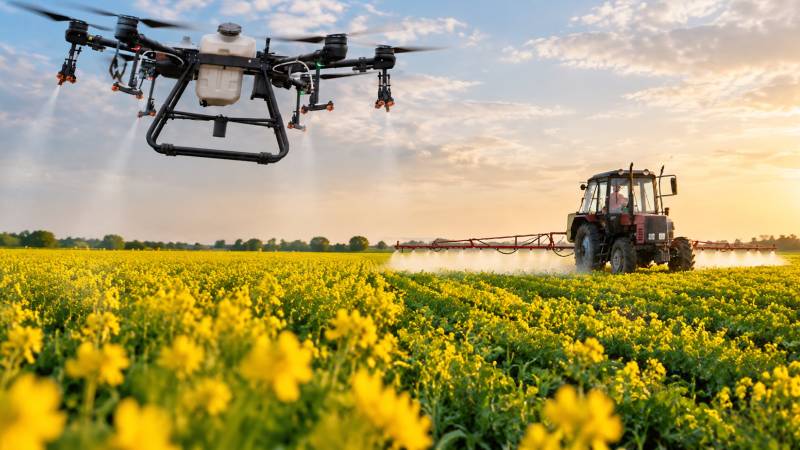
Before the day’s heat settles over a field, a farmer may already have made decisions that could shape the entire growing season. When to irrigate. Where to Plant. Whether a crop is beginning to struggle. How much fertilizer is needed? Yet much of what determines those decisions cannot be seen from the ground. Soil conditions can change within the same field. Water does not always reach every part of a field equally. Crop stress can begin before visible symptoms appear. Weather can alter growing conditions within hours while pest outbreaks can spread across farm boundaries.
Farmers have navigated this uncertainty through experience and observation for generations. Today, another source of knowledge is changing that equation: data. 9.1 million hectares (11.43% of Pakistan’s geographical area) of Pakistan’s land is culturable waste. This land is of a suitable quality for farming but left uncultivated. It raises a larger question: how well can the country understand its agricultural land at scale and how quickly can that understanding be converted into better decisions? The Land Information and Management System (LIMS) is one attempt to answer that question.
There’s the principle behind data-driven agriculture. It never treats an entire field as uniform. Instead, farmers and agricultural experts can identify differences in soil, water, and crop conditions and response more precisely. And that for Pakistan, this also opens the possibility of understanding agricultural land at a much larger scale.
Satellite imagery can visualize all the variations in vegetation. Remote sensing can identify changes in crop moisture and plant health. Geographic information systems can place those observations within precise locations, while weather, soil and water data can add context to what is happening and why.
LIMS describes its approach as integrating satellite data, sensor technologies, remote sensing, geospatial information and analytics to support decisions ranging from what to grow and where to grow to how crops can be monitored during cultivation. Its broader work includes agricultural monitoring, weather analysis, land evaluation and decision-support systems. Some of the clearest examples of that approach have emerged outside the boundary of an individual farm.
Pakistan’s farms are increasingly becoming part of a larger digital landscape in which land can be monitored, mapped and understood in new ways.
During Punjab's large-scale canal desilting campaign 2023-2024, LIMS and the Green Pakistan Initiative worked with the irrigation department to monitor operations through satellites and drones. According to government reporting, the campaign covered around 22,000 miles of canals, with irrigation associated with approximately 1.3 to 1.4 million acres of land.
During a federal government briefing at LIMS in August 2025, officials said its agri-tech advisory services were reaching more than two million farmers and cited automated pest-attack mitigation during the 2023 whitefly outbreak, reporting savings of more than Rs5 billion.
LIMS is adding another layer to farmers’ existing knowledge of agriculture through information systems. The question is therefore not whether technology will replace the farmer. It is whether the farmer can make better decisions with better information.
In 2025, officials demonstrated Agri Stack, described as a broader digital agricultural ecosystem which is intended to connect farmers with services including land information, subsidies and agricultural advice. The federal IT ministry has also emphasized smartphone accessibility so that land and agricultural services can move closer to the user rather than remain confined to specialized systems. The farmer remains at the center of this process. Technology provides a broader view but it is the farmer who understands the land and weighs the information to make the decision.
For LIMS, the main concern is food security. That concern becomes more urgent as agriculture faces pressure from water constraints and changing weather where balance is needed to produce more efficiently. The conversation around agriculture ultimately comes back to one question: Can Pakistan produce enough food, sustainably, from the resources it has? Answering this matters as Pakistan faces growing pressure on its agricultural resources. The country's agricultural future cannot depend simply on bringing more land into production. It will also depend on making wiser use of what is already available.
That requires knowing more about the soil beneath a crop, the water reaching it, the weather surrounding it, the threats emerging around it, the changes are taking place over time. More importantly, it requires connecting that knowledge so that it can inform decisions. Water, seeds, fertilizer and machinery have always been agricultural inputs. Data is becoming one too.