

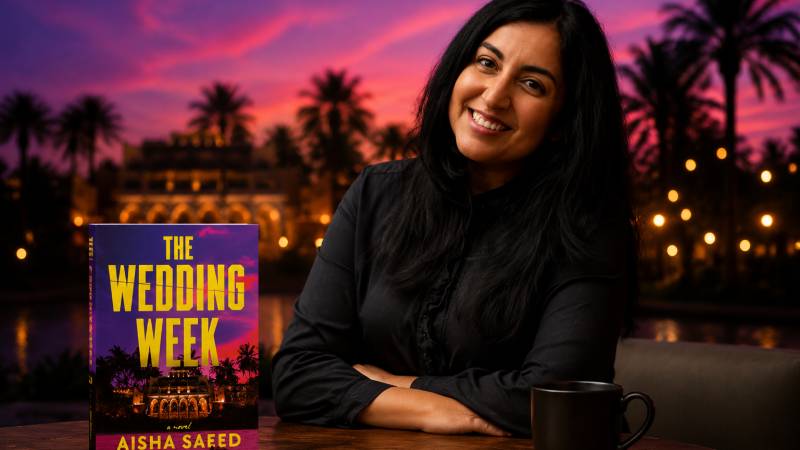
Aisha Saeed’s The Wedding Week turns a lavish South Asian wedding into chaos of family secrets, communal gossip and buried trauma, asking how easily suspicion can become identity. A wedding is supposed to bring people together. In Aisha Saeed’s The Wedding Week, it does something more unsettling: it exposes the fault lines beneath a family’s carefully constructed facade. I was immediately struck by the novel’s opening observation: “If I were contemplating murder, there really wouldn’t be a better place to get away with it than Florida.” The Everglades, with its alligators, pythons, and tannic waters that “can dissolve just about anything,” becomes more than a backdrop; it is a silent, menacing witness to the drama unfolding on the manicured lawns of a luxury resort. The glossy veneer of the Mirza family’s wealth versus the murky, dangerous truths lurking beneath; this is the tension that powers Saeed’s latest novel.
Hena Mirza, an interior designer who has fled her South Florida family for San Francisco, receives an unexpected call from her younger sister, Lulu. Their mother is dying, and Lulu is getting married, in three days. The complication is immediate: Hena’s former fiancé, Nasir Wahidi, disappeared without a trace on the morning of their own wedding three years ago, leaving her the subject of vicious community gossip and police suspicion. Saeed wastes no time establishing the stakes. The compressed timeline—a single, event-packed week is a useful structural mechanism for intensifying suspicion and forcing confrontations. The multiple ceremonies; mehndi, mayoun, dholki, nikkah, trap the characters in a pressure cooker where heightened emotions, family expectations, and relentless social scrutiny create a powder keg.
In The Matchmaker, Saeed treated marriage as a social institution through which romance had to negotiate family expectation and community pressure. The Wedding Week darkens that vision: the wedding itself becomes a site of surveillance, judgment, and accumulated secrets. The move signals a more confident use of suspense, though Saeed retains the cultural specificity that has always marked her fiction. Her portrayal of the South Asian community is both affectionate and unflinching. She captures the way gossip can become a weapon and how the weight of log kya kahenge (what will people say) can shape lives. The novel asks a compelling question: how do you navigate a world that has already decided your guilt?
The novel uses the conventions of a wedding thriller to examine a more unsettling form of crime: the communal act of turning suspicion into identity.
The novel’s strongest asset is its heroine. Hena has built walls around herself after years of trauma, a violent, abusive father; a cold, unyielding mother; and a fiancé who vanished, leaving her to bear the brunt of a community’s scorn. Her return to the family fold is a journey of both physical and emotional peril. Saeed writes Hena with a nuanced hand, allowing readers to feel her justified anger, her lingering love for the missing Nasir, and her desperate hope for reconciliation with her sister.
The supporting cast is equally well drawn. Lulu, the bride-to-be, carries the weight of her mother’s dying wish while trying to build a life for herself. Reza, a handsome groomsman with an easy charm, and Haris, Nasir’s best friend and Hena’s first kiss, complicate her already tumultuous week. The romantic tension is palpable, but Saeed never lets romance overshadow the mystery. Every glance, every whispered conversation, is laced with potential menace.
Saeed is particularly skilled at rendering the South Florida landscape. Growing up on the edge of the Everglades, she brings an intimate knowledge of the region’s beauty and danger. The resort, Vista Del Sol, is a Moroccan-inspired palace with an indoor lagoon and swans flown in from Scandinavia, a spectacle of excess. But it is the untamed marshlands beyond the manicured gardens that truly captivate. The Everglades, with its alligators and exotic pythons, becomes a character in its own right, a reminder that nature and danger are never far away. One of the novel’s most memorable scenes involves a python encounter that forces Hena to confront her own fears and demonstrates her capacity for decisive action.
The novel’s interstitials; short, gossipy chapters from various wedding guests are among its most effective formal devices. These segments add a layer of meta-commentary, showcasing how quickly narratives are shaped and reshaped by community speculation. They are sharply observed, sometimes funny, and always unsettling in their reflection of how easily a person’s reputation can be dismantled. As one character notes, “when enough people say a thing is true, it becomes true.” That sentiment resonates far beyond the novel’s pages. Saeed also engages with themes of class and reputation within the South Asian diaspora. The Mirzas’ wealth, built on a hotel empire, sets them apart, but it also makes them targets. The wedding is a stage, a performance of success and unity, and the pressure to maintain the facade is what ultimately makes the family vulnerable.
Saeed’s exploration of domestic violence and its long-term effects is sensitive and unflinching, grounding the thriller elements in emotional realism. The novel gradually complicates Hena’s understanding of her father and, more importantly, of the mother whose emotional distance she has long struggled to understand. The relationship between Hena and Ammi, her dying mother, is the emotional heart of the novel. Saeed makes their fraught history central rather than using it as mere backstory, and one of the book’s most powerful moments comes when Hena is forced to re-evaluate the choices her mother made. The novel does not offer easy forgiveness, but it does allow for a more complicated reckoning.
The novel’s greatest tension is not between its characters but between its two modes: psychological family drama and genre thriller. Saeed is more persuasive when she slows down to examine Hena’s damaged relationships with her mother and sister than when the plot accelerates toward another revelation. The mystery supplies momentum, but it is the family history that gives the novel its emotional weight. The brisk pacing, one of the novel’s pleasures, is also occasionally its limitation. Some emotional discoveries arrive before the characters have had sufficient space to absorb them. Yet Saeed’s skill at misdirection is undeniable; the reveals, while shocking, are carefully prepared, rewarding attentive readers.
The Wedding Week will appeal to readers of both romance and mystery, but it is ultimately a story about survival and the women who refuse to be victims. Hena’s journey is one of reclaiming her own narrative, of refusing to be defined by others’ perceptions or the sins of her family. In the end, the novel uses the conventions of a wedding thriller to examine a more unsettling form of crime: the communal act of turning suspicion into identity. That is its most lasting achievement.