

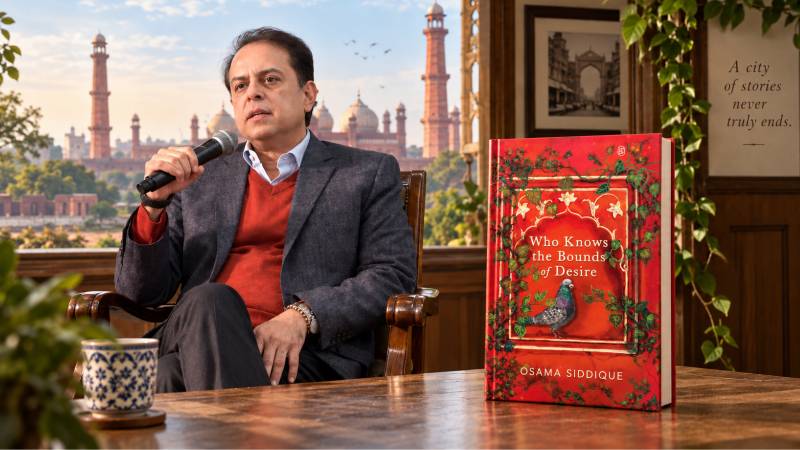
Dr. Osama Siddique’s monumental novel Who Knows the Bounds of Desire, published in 2025, is a deeply meditative work on the city of Lahore, oscillating between a realisation of its doom and the possibility of its revival. The title itself is borrowed from Noon Meem Rashid’s poem “Hassan Koozagar,” and the choice is telling. Like Rashid’s potter, Siddique too, takes the clay of his intensely lived experiences as a practicing lawyer and legal policy expert, together with his scholarly pursuits, and wide reading, and throws his well fermented clay upon the wheel of creative imagination. What emerges is a compelling literary artefact: a world suspended somewhere between wakefulness and sleep, reality and dream, history and myth. The novel draws upon the great storytelling traditions of South Asia, Persia, and Arabia, creating a magical world populated by sorcerers, deceivers, lovers, tricksters, victims, and resisters. Yet beneath its fantastic surface lies an intensely contemporary political and ethical reality.
Most captivating is its alluring paratextual appeal, anticipating a work of passion and ambition. The red hard cover, laced with green leaves, and the iconic pigeon perched within a niche are not merely decorative elements but seem to inform the novel’s central preoccupations. Red evocative of life, while the pigeon is suggestive of beauty, grace, freedom, desire, and the possibility of love, similarly the niche invokes a rich cultural heritage. The writer’s fascination with the night sky is also materialized in the dark separators that divide the novel into sections, marking shifts in temporality and spatiality.
Most significantly, the novel is composed of ninety-nine distinct fragments or sections. Their connections are associative, thematic, atmospheric, and symbolic rather than conventionally causal. Time and space repeatedly dissolve as the reader moves through memories, dreams, conversations, historical moments, and shifting states of consciousness. The ninety-nine fragments may also resonate with the ninety-nine Names of Allah, suggesting that beneath apparent multiplicity lies a desire for unity and coherence. Fragmentation thus becomes a way of representing a world that has lost its coherence while retaining the human desire to recover meaning.
The novel refuses to let civilisational decline become nihilism; its deepest hope lies in preserving the desire for beauty, justice, love, ethical integrity, spiritual meaning and cultural renewal even when the present seems incapable of containing them.
The fact that Who Knows the Bounds of Desire is a trans-creation of its Urdu version is equally important to its aesthetic and cultural character. The English text carries the textures, rhythms, sensibilities, and literary associations of its Urdu matrix. Its engagement with Urdu, Persian, and Arabic traditions, local diction, Lahore’s architecture, food, music, flora, and classical dastan traditions allows a deeply localized imaginative world to enter English without surrendering its cultural particularity.
This movement between the fantastic and the real is central to the novel’s critique of power. References to Tilism-e-Hoshruba and other classical worlds are juxtaposed with contemporary Lahore, suggesting that the sorcerers of old have merely changed their costumes. Political leaders, bureaucrats, lawyers, media figures, and other intermediaries manufacture illusion through modern institutions. The ancient talisman becomes the state, legal system, media network, property market, and technological apparatus through which power circulates.
Lahore consequently emerges as an “empire of smoke” and sometimes an “empire of carbon.” Pollution is both literal and metaphorical: the poisoning of air and water mirrors the corruption of politics, law, public discourse, and moral imagination. Agricultural land, trees, rivers, and open spaces are sacrificed to concrete and speculative development. The destruction of the landscape becomes an index of civilizational decline. Gulmohar, baqain, shahtoot, birds, gardens, and rivers are not picturesque details but elements of the city’s cultural memory. Lawrence Garden, Khalid’s refuge after tedious legal proceedings, offers an alternative to the suffocating machinery of the modern city. Lahore becomes both Wonderland and Wasteland, a place of extraordinary cultural memory being simultaneously poisoned, commodified, and emptied of its soul.
At the centre of Khalid’s journey lies a desire for stable ethical and spiritual ground. His bewilderment is not merely political but moral: what does it mean to remain principled when institutions themselves normalize compromise? The practice of law becomes trickery, constitutional principles are selectively invoked, and the doctrine of necessity becomes an instrument for legitimizing power. Judges, lawyers, bureaucrats, politicians, and media figures participate in systems that frustrate justice. The recurring opposition between appearance and reality exposes the process: those who present themselves as saviours may be predators, those who invoke religion may pursue worldly interests, and those who speak the language of law may undermine justice. Even moral language can be appropriated and emptied of meaning. “Oxygen jihad,” for instance, becomes an emblem of such manipulation. The novel’s critique is therefore directed not at faith but at its instrumentalization. Religion, which should generate love, humility, and responsibility, becomes destructive when appropriated by the sorcerers of power.
Nasir Kutianwala represents the extreme form of this moral degeneration. His cruelty toward animals reverberates with the violence surrounding women, children, and other vulnerable beings. His inability to recognize another being’s suffering becomes a symptom of a civilization that has lost its ethical centre. Yet Siddique refuses to let dystopia become nihilism. Tayyeba Khala, forced to resign from her research position because of departmental politics, refuses bitterness and turns instead to teaching children and establishing a library. Sitara Bano represents intellectual independence within the legal system. Mian Imran Hameed, despite lacking Khalid’s privilege, possesses generosity and moral courage; his resistance to the land mafia becomes a genuine jihad in the ethical sense. Sharif Sahib similarly embodies spiritual and ethical independence. Khalid himself is less a conventional hero than a consciousness moving through bewilderment. His encounter with the shrine of Ali Hajveri (RA), particularly through Sharif Sahib, opens a space of spiritual awakening. The spiritual does not erase worldly suffering; it offers a possible orientation within it.
Love extends this meditation on desire. Khalid’s failed romances mirror the exhaustion of the city, while haze, mist, and monsoon create liminal spaces where boundaries become uncertain and renewal seems possible. His nostalgia for an older culture of courtship marked by restraint, patience, subtlety, and imagination also becomes a critique of relationships shaped by instant gratification and technological performance. Love, like air, water, land, and language, has become polluted. The novel’s classical allusions consequently become restorative, reconnecting the present with literary and cultural resources displaced by colonial and postcolonial modernity.
Humour and irony sharpen this critique. The contemporary sorcerers are frightening but also absurd, and their claims to wisdom and authority are repeatedly undermined by their own contradictions. The novel can therefore be regarded as an “honest archive” of a transforming city. Yet this archive is not neutral. It is animated by attachment to Lahore, its trees and gardens, birds, literary memory, ordinary people, food, music, architecture, and disappearing forms of conversation and courtship. The meticulous recording of what is vanishing becomes an act of preservation and a residual faith that knowledge, kindness, beauty, and ethical attention still matter.
The novel’s cosmic dimension enlarges this local vision. Khalid’s repeated gaze toward the stars places human corruption against the scale of the universe. Human beings desire permanence and recognition, yet the stars confront them with transience. Their immense distance and cycles of birth and death humble the human ego while provoking wonder. Khalid’s somnambulance therefore becomes more than a psychological state: it reflects a civilization unable to wake fully from its ethical sleep. He moves between dream and reality, past and present, despair and hope, spiritual connection and cosmic silence.
Yet the novel ultimately refuses despair. Empathy, resistance to injustice, responsibility toward nature, preservation of beauty, intellectual independence, and spiritual humility become forms of ethical resistance. The stars provide an image of renewal: civilizations decay, cities change, institutions fail, and human beings remain transient, yet new stars are born. Khalid’s renewed capacity for love completes this movement. Desire becomes not an answer but an orientation; a refusal to accept the impoverished boundaries imposed by the present.
Reading Who Knows the Bounds of Desire is ultimately an encounter with a mind troubled by civilizational deterioration but unwilling to surrender wonder. The novel fragments time while searching for coherence; exposes corruption while desiring justice; mourns the loss of love while remaining open to its renewal; and records a dying city while continuing to love it. Its deepest faith may lie not in the certainty that beauty, justice, love, or spiritual meaning will prevail, but in the conviction that the desire for them is itself worth preserving. The bounds of desire remain unknowable precisely because desire reaches beyond what the present world can contain: toward beauty, love, justice, ethical integrity, spiritual meaning, cultural recovery, and renewal.