

Rock art has always fascinated me. For thousands of years, people have left their marks on rocks across Pakistan, depicting scenes from their daily lives, beliefs, and surroundings. These ancient images offer valuable insights into the culture, economy, and myths of the communities that once inhabited these landscapes.
My interest in documenting ancient and ethnographic rock art in Pakistan dates back to 1998. Since then, I have travelled extensively through Sindh, Gilgit-Baltistan, Balochistan, the Pothohar region of Punjab, and Azad Kashmir, where I have discovered and documented many rock art sites. In addition to discovering new sites, I have visited those previously documented by other researchers to learn more about the diversity of rock art traditions in Pakistan. During my visits to different regions of Pakistan, I spent considerable time searching for and documenting rock carvings and paintings to understand their place in the cultural history of these landscapes.
Exploring the Talang Valley
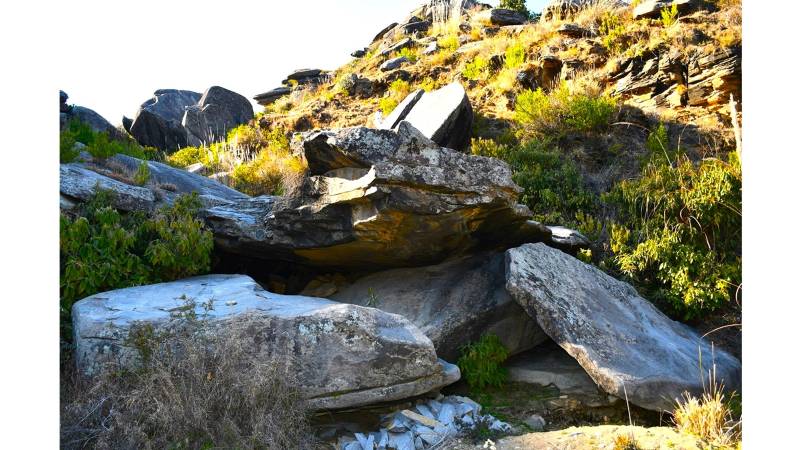
During my visits to Swat and Malakand in 2019 and 2020, I explored several rock art sites, including those around Talang village. Located about 10 km from Barikot town, Talang is known for its picturesque landscape and rock art. Several sites in and around the village were discovered and documented by Luca Maria Olivieri. One of these is a painted rock shelter near a spring, about 1 km west of Talang village, which Luca Maria Olivieri first discovered in 2005. He has made significant contributions to the documentation and study of rock art in Swat and other parts of northern Pakistan.
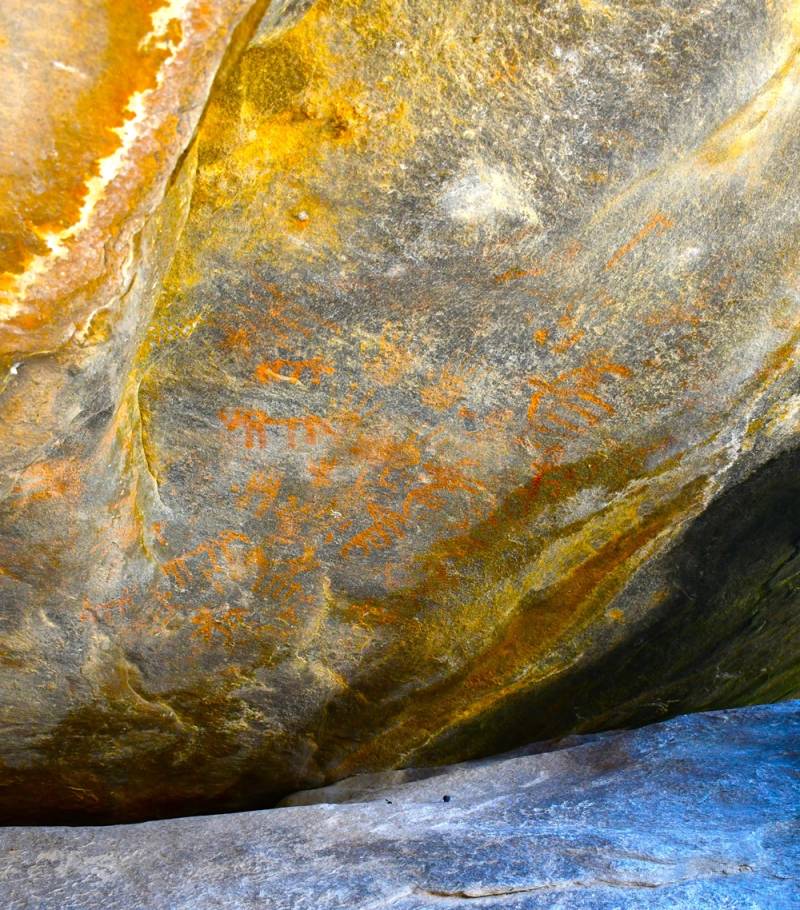
The spring near the rock shelter may have attracted people to this location: the handprints and representations of bulls also suggest that the shelter may have held sacred significance
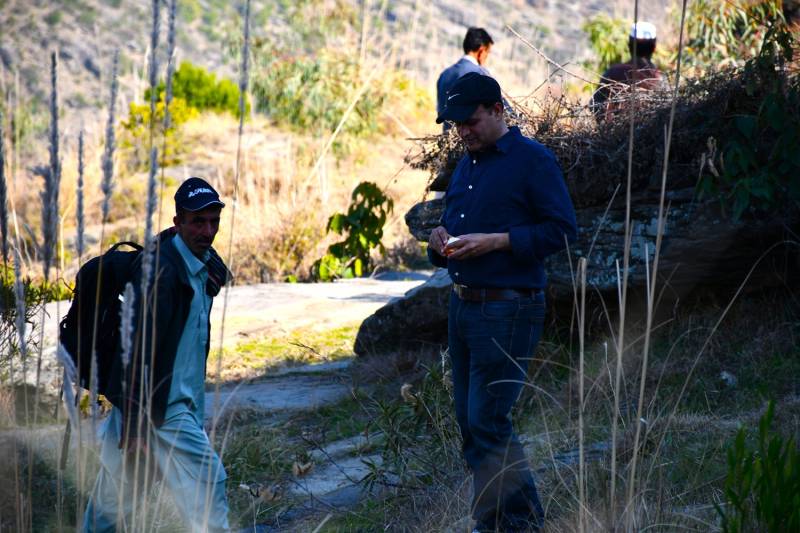
During my visit to Talang village, I was particularly interested in the Kamal Cheena painted rock shelter and the nearby cup-marks. I wanted to see the depictions of bulls, handprints, and cup-marks. Fazal Azeem, associated with the Italian Archaeological Mission, and my student, Muhammad Abbas Akhon Khail, from Saidu Sharif, accompanied me to the site. Some residents of Talang village also joined us and shared their local knowledge.
The Murals of Kamal Cheena
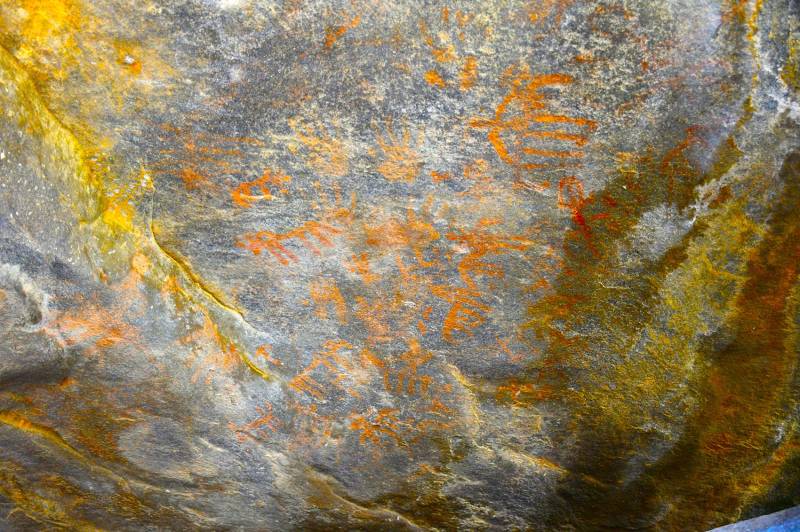
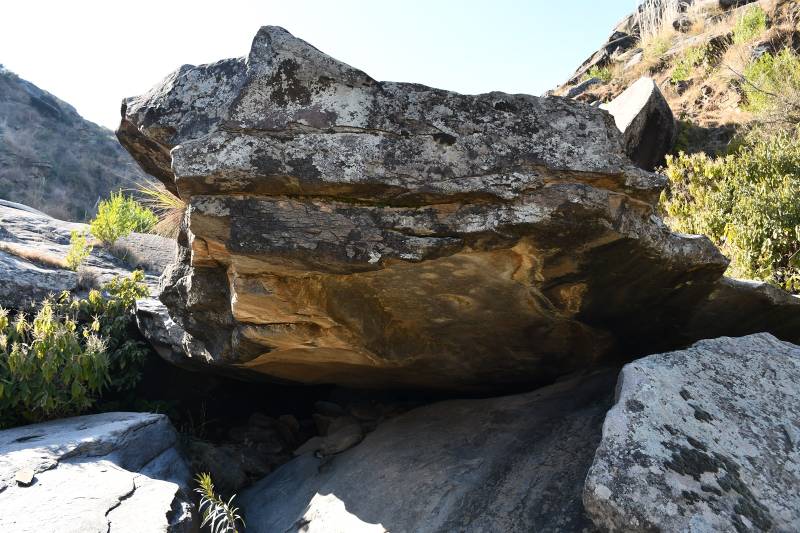
The paintings, executed in red, are found on the underside of an overhanging rock at Kamal Cheena. They depict horse riders, humped bulls (zebu), axes, handprints, and a few other figures. Of these, the representations of bulls particularly attracted my attention.
Depictions of bulls are found at several rock art sites in Pakistan, but they are especially numerous in Sindh. In the Khirthar region, I have documented carvings of humped bulls in the Nali, Gaj, Khashani, Seeta, Mazarani, Chhanhar, Sallari, and Makhi valleys. Beyond the Khirthar region, bull representations also appear at several rock art sites in Balochistan. After crossing Lohi Lak toward Khuzdar, one can see numerous rock art sites between Lohi Lak, Zaidi, and Pallimas in Wadh tehsil, Khuzdar district. Depictions of humped bulls (zebu) occur in the painted rock shelters of Pallimas and in petroglyphs at other sites in Khuzdar. Some of the finest examples of painted bulls can be seen at the Tharia rock shelter in Pallimas, Wadh tehsil. Bull representations are also found at other rock art sites across Balochistan.
Representations of bulls are also found at several rock art sites along the Indus, from Bagh Neelab in Attock and Mandori in Nowshera to Diamer in Gilgit-Baltistan. In Khyber Pakhtunkhwa, bull paintings occur in several rock shelters, some of which have been discussed by Luca Maria Olivieri in his book Talking Stones: Painted Rock Shelters of Swat Valley (2015).
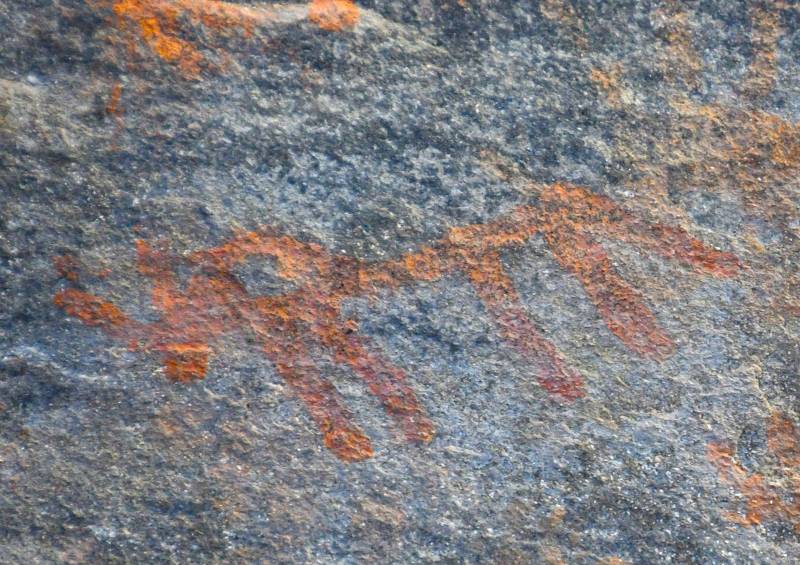
During my visit to Lal Kamar in the Loi Banda area of Malakand, I also noticed a bull painting in one of the rock shelters. Luca Maria Olivieri has documented similar representations at Kwar-patai and Allahdan-dheri, while bull carvings at Gogdara I were systematically studied by him in 1998. The zebu also features on painted potsherds from Swat. According to Luca Maria Olivieri, this animal held an important place in the Chalcolithic and Bronze Age cultures of Swat. The zebu was also significant in the Indus civilisation and appears in prehistoric rock art in Sindh, Balochistan, and Gilgit-Baltistan.
Handprints, Axes, and Cup-Marks
Apart from zebu depictions, the handprints at the Kamal Cheena rock shelter are particularly noticeable. At least four handprints appear in the shelter. Similar representations are found at rock art sites in other parts of Pakistan, particularly Sindh and Gilgit-Baltistan. The paintings of horse riders are equally interesting and seem to belong to a later period than those of bulls and handprints. Another striking figure is that of a human holding a banner. Two battle axes are also represented in the shelter.
Ahmad Hasan Dani (1983) discussed similar depictions of battle axes at Chilas in his book Chilas: The City of Naga Parvat (Dyamar). I have also discussed representations of axes in my books Symbols in Stone: The Rock Art of Sindh (2018) and The Rock Art of Karachi (2020).
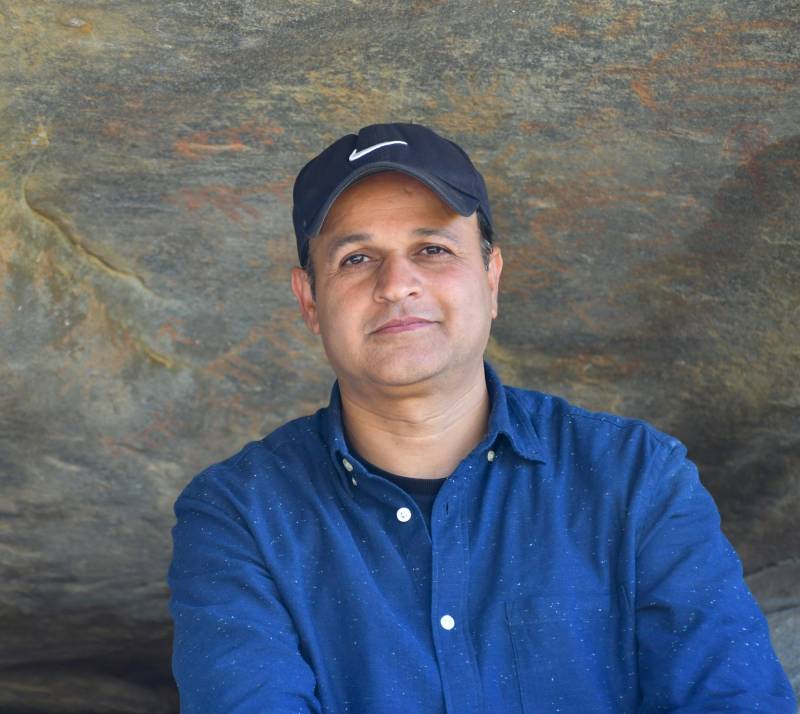
The spring near the rock shelter may have attracted people to this location, where they left paintings on the rock surface. The handprints and representations of bulls also suggest that the shelter may have held sacred significance for the communities who visited it in the past.
If one climbs up from the painted rock shelter and walks a little farther to the right toward the end of the ridge, one comes across several cup-marks on a boulder's surface. The most striking among these are those connected by grooves. The boulder also offers a panoramic view of Talang village. I have always found cup-marks with interconnecting grooves particularly fascinating. These marks may have represented the surrounding landscape or served as receptacles for certain rituals.
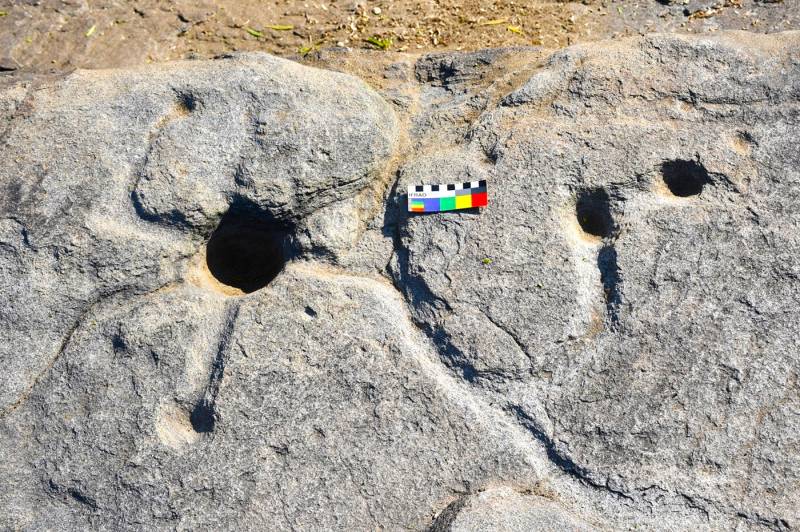
I have documented similar cup-marks with grooves at several rock art sites in Sindh. Interestingly, cup-marks have received little attention from Pakistani scholars, although Italian researchers, particularly Luca Maria Olivieri and Massimo Vidale, have studied them. I have also written several articles on cup-marks found in Sindh and Islamabad.
The Kamal Cheena painted rock shelter and other rock art sites reflect the Swat Valley's rich rock art traditions. I believe that Kamal Cheena should be developed into a rock art park, which would not only help preserve these sites but also promote rock art tourism and create economic opportunities for local communities.