

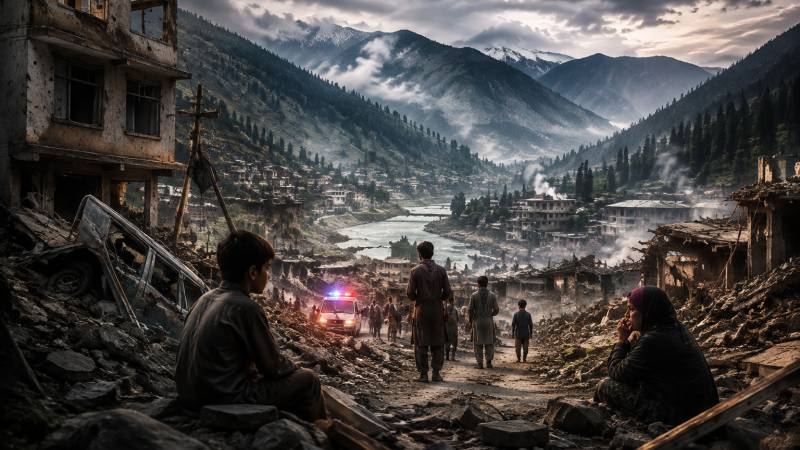
Back in 2009, I was six years old when I first heard the word "terrorist" during a horrific tragedy, the horror of which still haunts me even after more than 17 years. The horrific Taliban era was breathing its last terrifying breaths in the Valley of Flowers and Blossoms, a valley often called the Switzerland of Pakistan. That day, I was travelling with my father from Mingora city to my hometown, Bahrain, which is now Upper Swat. When we reached Bagh Dheri, the terrifying sounds of gunfire erupted around us. We were caught in the middle of an ongoing battle between the Taliban and the Armed Forces. Everyone started shouting, women and children began crying, and an old man advised everyone to remain calm, recite Ayat-e-Karima, and urged the driver to keep going.
When the firing intensified, the driver told all of us to hide between the seats of the vehicle. He continued driving along the main highway amid heavy gunfire from both sides until we reached Fatehpur village, where Army officials stopped the car and told the driver not to go any farther. Some of the passengers took shelter in nearby houses, while others decided to continue their journey on foot, using the narrow, uneven trails through the fields along the riverbed of the mighty Swat River. Among us was a policeman who was terrified because law enforcement personnel were the Taliban's primary targets. My father told him not to worry and said that if we encountered the Taliban, he should not reveal his identity. It was from that policeman that I heard the word "terrorist" for the first time.
A few days after that incident, the situation worsened for the locals of Madyan and Bahrain as the final military operation against the Taliban began in those areas. We were among the two million helpless people who were displaced to other regions. I still remember the day when my grandfather gathered the most important belongings from our house and decided to leave the valley for the neighbouring valley of Chail Dara, where our ancestral home was located. The journey was not easy because we had to cross a high-altitude mountain to reach the other side, and the mountain was far from free of dangers and wild animals. My mother cooked enough food for about two days, and just as we were about to leave, one of our closest relatives arrived unexpectedly and pleaded with us not to go, saying that we should not leave him alone during the darkest period of his life.
The people of Swat have sacrificed countless lives over the years and have proven themselves to be among the most resilient communities in the face of militancy and terrorism. Time and again, they have rejected terrorism through large public gatherings and peaceful uprisings.
We decided to change our plan and take shelter in his home, which was located in a beautiful village south of Bahrain. This way, we avoided the dangers of crossing the mountain south of Bahrain town. This unusual village was built on a hilly area, with all the houses constructed in a vertical line, one above another. I still wonder what those people would do in the event of a natural disaster or an earthquake because there was no proper way to escape—just houses built above the roofs of other houses. But then an even more horrific era began. As the Armed Forces advanced, clearing the lower areas of terrorists, the terrorists were pushed backward and eventually came closer to us.
From then on, we witnessed cannon and tank fire in front of us, while helicopters carried out aerial strikes. Those days were simply unimaginable. Every morning, our elders would gather all the villagers to recite Ayat-e-Karima and Surah Yaseen, seeking help from Almighty Allah. Then I clearly remember the day when the Taliban were driven out and the Armed Forces arrived in the village. Everyone welcomed the proud Pakistan Army with bottles of juice in their hands and kettles filled with tea. People were overjoyed and thanked Almighty Allah for restoring peace to the valley of lush greenery and natural beauty. These horrific memories from that era of darkness came rushing back when the Swat Valley was struck by yet another deadly terrorist attack on the evening of August 2 at Kabal Chowk in Swat, which claimed the lives of 17 innocent people during a peaceful protest.
As the saying goes, beauty attracts evil eyes, and the Swat Valley seems to prove this proverb. My heavenly region remained peaceful for several years after the 2009 military operations against the terrorists. However, over the last five years, the situation has gradually begun to change during the summer months. With each passing summer, militants have reappeared in the mountains of Swat, particularly in Matta Tehsil, spreading fear among the peaceful people of Swat and threatening its paradise-like beauty. The people of Swat have sacrificed countless lives over the years and have proven themselves to be among the most resilient communities in the face of militancy and terrorism. Time and again, they have rejected terrorism through large public gatherings and peaceful uprisings. Peace must remain the highest priority for the heavenly Swat and its warm and welcoming people.
The TTP, which claimed responsibility for the deadly Kabal blast, warned the people of Swat in a brutal way not to gather again in the name of peace. This attack spread widespread fear among the people of Swat and also dealt a severe blow to the tourism sector. The blast was one of the most significant militant attacks in Swat after a long period of peace, especially compared to many other areas of Khyber Pakhtunkhwa. Swat has been among the province's most peaceful districts, and such incidents indicate that militancy's grip is strengthening in the province.
The same day also witnessed another attack on a police mobile in the provincial capital, Peshawar. Another attack targeted a convoy carrying the Deputy Commissioner (DC) and District Police Officer (DPO) in Waziristan, while another assault was carried out on a police check post in Mohmand District. Meanwhile, the provincial and federal governments continue to blame each other for the worsening security situation in the province. However, no serious action is being taken. Every day, brutal attacks occur, people lose their lives, others bury them, and then wait for another, perhaps even more horrific, tragedy the next day.
For how long will this deadly suffering continue?