

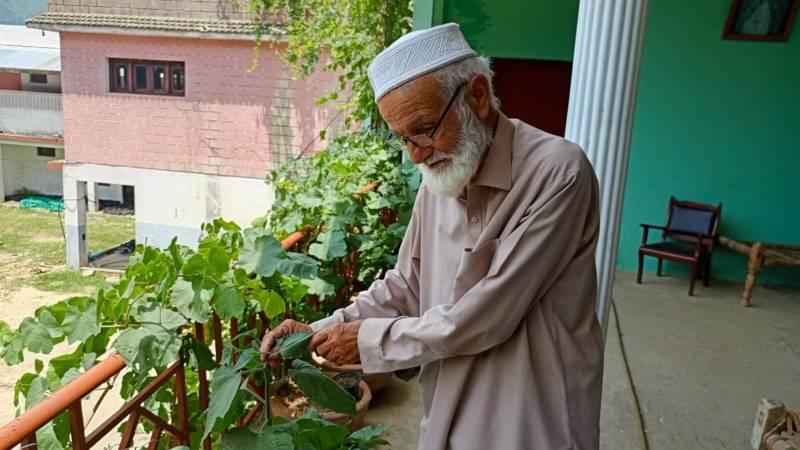
In the remote hills of Swat, where Chir pine forests whisper ancient secrets, lives an elderly personality whose closest companions are not people — but plants.
Although his official state records and ID card bear the name Muhammad Alam, if you visit his famous village in the Swat Valley and ask any local landowner or farmer about this senior member of the Mian family, hardly anyone would recognise him by that name. In fact, he himself might feel like a stranger to it, because everyone in the area, young and old, calls him 'Kadada'. This is derived from Khadada, which means "Good elder", but today it has become a symbol of greenery in our valley.
Most people who cross six decades of life wish for rest, but Kadada's hands, now in his eighties, are stained with soil and hardened by continuous hard work. Even at this age, he stays active like a young man.
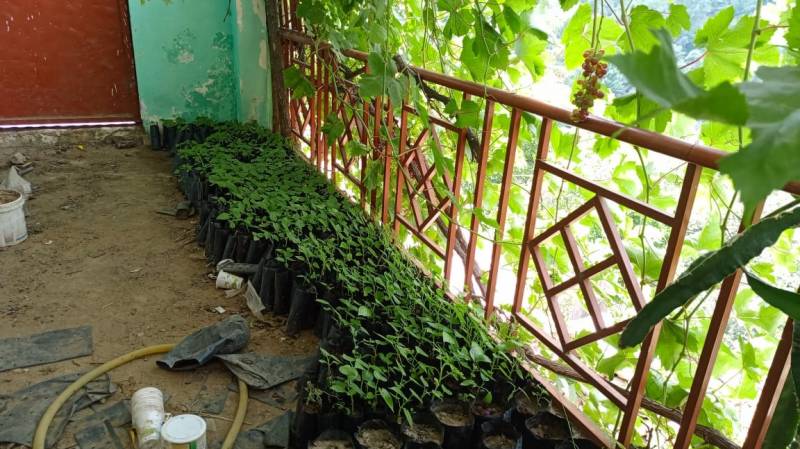
He has turned his home, his hujra (guesthouse), and even his brother's hujra into a plant nursery. In Kadada's eyes, no hujra is truly a guest place unless its flowers and plants bow in welcome, offering their fruits and shade as gifts, and wrapping visitors in a sense of spiritual calm.
Guests here are not welcomed by just a host, but by different families of young plants. He seats his guests among the greenery, right alongside the plants. He never tires of talking about plants, because this connection between humans and nature keeps the peace. Most of the time, Kadada and his plants talk to each other just like family members chatting at home.
A Spiritual Bond
Between Kadada and his greenery lies a bond of pure spiritual communion, a quiet understanding that goes far beyond ordinary gardening. When he is away from the area, a loneliness falls over the plants' surroundings, as if the leaves and branches are waiting in quiet longing for their companion. But the moment he returns and takes his daily rounds, a sudden wave of life sweeps through the garden. It is a wonder to witness. Even without a drop of water, the plants glow and bloom simply at the sight of him, as if his presence is the nourishment they needed most.
"I am nothing, and I am doing nothing. These hands were given by God, and He is the One using them... this work, these trees, and this soil will stay forever"
While the world runs endlessly after honour, fame, and money, Kadada stays far away from greed, quietly and selflessly serving his plants. Over the last forty years, he has lovingly cared for and freely given away more than fifty thousand wild and fruit trees to local farmers, yet he still tries to stay away from the spotlight.
The plants he has raised and the rare seeds he has gathered are not limited to Swat anymore; they have reached Shangla, Chitral, Peshawar, Gilgit, and Quetta. Wherever there is a plant lover in our region, they surely know Kadada, and a gift of his plants has already reached them. Among these are rare species whose true benefits local farmers are still learning about.
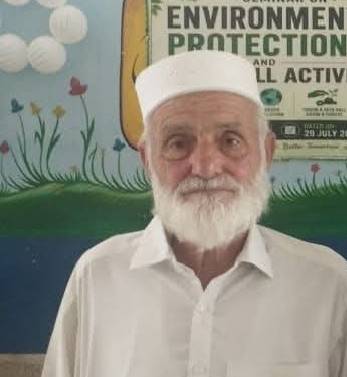
When his daughter calls from Spain and asks what she should send her elderly father, he never asks for luxuries. His only wish is: "just send olive, lemon, or orange seeds and saplings from there." Similarly, he stays in touch with friends in Quetta to bring the best grape varieties and test them in Swat's soil. Experts from Swat's agricultural institutions also stay in regular contact with him.
Kadada's effort is not limited to his nursery. He also acts as a protector for the natural forest near his home. No one is allowed to cut wood or hunt there. The forest, in return, shelters him with its cool shade and fills his mornings with birdsong. Local birds chirp happily, making their presence felt. He has transformed his home environment into a dense sanctuary of fruit trees and forest, where many types of birds live.
Seeing Kadada's love and passion, a nature lover and guest, Mr Arshad Durrani, once said so beautifully:
"People like him, who quietly work in remote parts of the country, are the true sons of this soil. They should be recognized as national heroes."
A Legacy of Rare Seeds and Saplings
Kadada has a unique passion for collecting rare seeds and plant varieties. He generously gives them to others for free so that rare plants can be preserved and introduced to more areas. He has sent chestnut plants and seeds to different areas of Khyber Pukhtunkhwa for trials. He is also playing a key role in growing tree tomatoes, varieties of pecan, and walnut, etc.
Now, as the younger generation wishes to modernise the family hujra into a modern place, a greenhouse right in front of the hujra is being dedicated to his nursery so that this work never stops.
Practical Environmental Wisdom
On one hand are soil-stained hands, and on the other, practical environmental wisdom! Kadada offers a very simple and realistic solution to the biggest environmental crisis of our time.
He says that if we want to save forests, local people living near them should be named "Guardians of the Forest" and given monthly LPG gas cylinders at a 50% discount so they don't cut wood for fuel. In his words:
"Until you give the poor an alternative to burn their stoves, saving the forest is impossible."
Similarly, his ideas to reduce the impact of destructive floods and climate change are no less than those of an environmental expert. He suggests building check dams and small water reservoirs in the mountains to trap rainwater, reduce flood damage, allow water to be absorbed into the soil for farming, and ensure food security for the country.
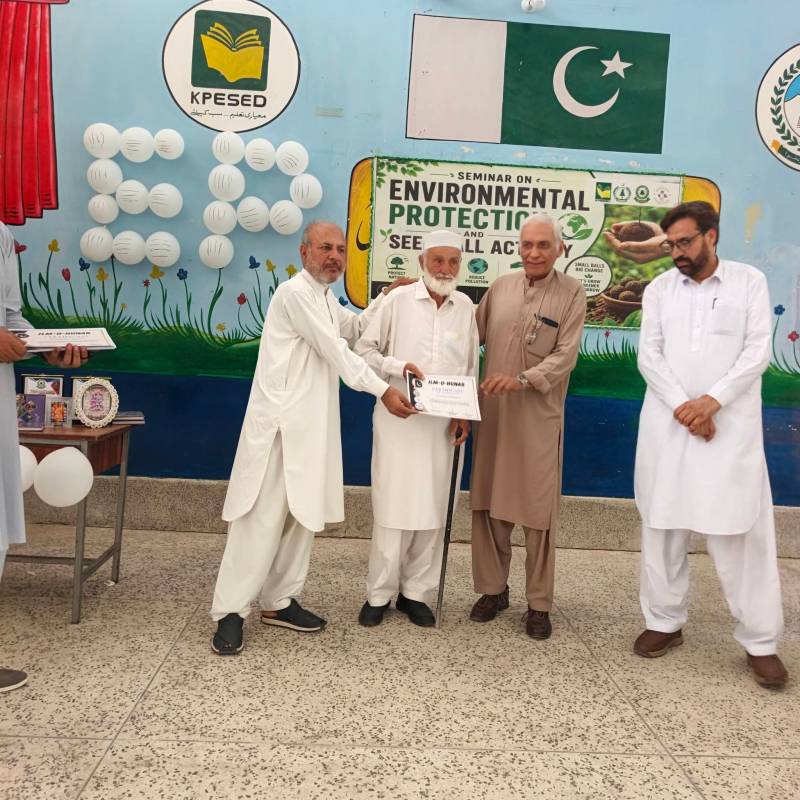
When people praise him for his great service to the environment, giving away thousands of free plants, and his environmental insight, he simply smiles with humble quietness.
"I am nothing, and I am doing nothing," he says softly. "These hands were given by God, and He is the One using them. We will all leave this world... but this work, these trees, and this soil will stay forever."
He adds:
"This soil is a trust for our future generations and the guarantee of their fresh air. Cutting a tree takes a moment, but growing it takes a lifetime. Plant at least one sapling on the edge of your field, in your yard, or in front of your hujra, and raise it like your own child. If we don't respect the earth and keep cutting trees blindly, future generations will struggle for every drop of water and will never forgive us. Give greenery to the earth, and it will give you life, food, and shade in return. Stay connected to the soil; our survival is in it."
Kadada is not alone in caring for the connection between soil and shade in our region. True sons of the soil like Qari Fazal Wahab and others have also planted hundreds of shady trees along the Fizaghat Bypass on the Swat River, caring for them lovingly for the last four years.
Many people love plants, but in Parona, a lush green village in Swat bordering Kalel Buner, the plants themselves seem to love Kha Dada, Mohammad Alam Khan. They grow for him, bloom for him, and whisper among themselves about our blindness and careless approach to nature.