

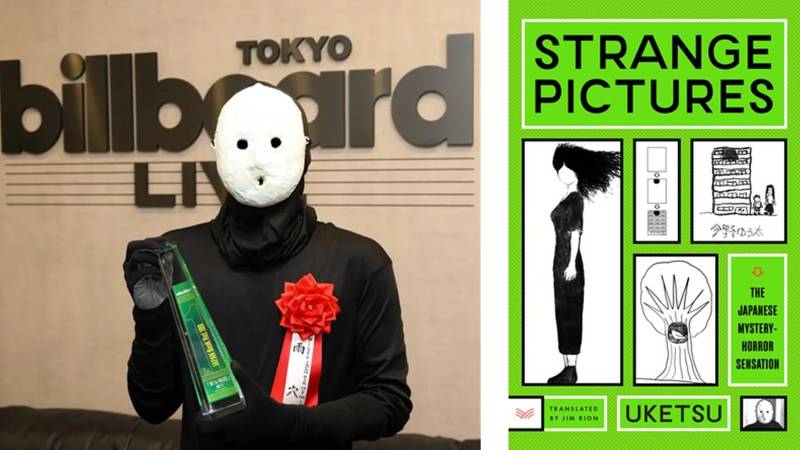
Strange Pictures is an international bestselling mystery-horror novel written by the masked Japanese YouTuber and author Uketsu. Uketsu specialises in horror and mystery and has exploded onto the literary scene in Japan, where his books have sold millions of copies. He only ever appears online, wearing a mask and speaking through a voice changer. His true identity is unknown. First published in Japanese in 2022 and translated into English by Jim Rion in 2025, the book explores a series of unsettling, childlike drawings that hide dark, interconnected criminal secrets in plain sight. Jim Rion, on the other hand, is an American translator and writer, living in the beautiful western Japan prefecture of Yamaguchi with his wife, son, and cats of unusual size.
The novel uses interactive storytelling. It treats the reader as a detective, using visual puzzles where composition, smudges, layering, and line direction provide vital clues to a psychological thriller. It deals with disturbing artwork, as the story is constructed around eerie illustrations, including a young girl's floral dress sketch linked to an abusive household murder, a child's bizarre smudged drawing of an apartment building, and finally, a desperate etching by a dying victim. The plotlines are all interconnected. While it reads like a collection of standalone creepy vignettes or short stories, the vignettes gradually converge into a unified, non-linear overarching conspiracy. The drawings are the clues that eventually connect everything.
The novel begins with Dr Tomiko Hagio, a psychology professor, discussing a disturbing childhood drawing made by an 11-year-old girl known only as “Little A.” Little A had killed her mother. Hagio believes the girl’s drawing shows that, despite her violence, she still possesses the capacity for love and can be rehabilitated. You’ll have to read the novel to find out if this is actually true or false because the book then moves through several apparently separate mysteries.
The best part about the book is that the pictures themselves are pieces of evidence: a drawing that initially looks completely innocent can contain information about a murder, a relationship, or someone’s psychological state
First is the story of the pregnant woman and the blog. A university student discovers a blog written by a man about his pregnant wife, Yuki. Yuki makes several rather strange drawings during her pregnancy. After her death during childbirth, her husband eventually realises that the drawings contain a hidden message about what happened to her. The drawings basically reveal that Yuki was purposely killed rather than dying naturally.
Second is the child’s strange drawing. We are shown this drawing is made by a boy named Yuta. At first, it looks like an innocent picture of his home, but the strange details—particularly what is concealed or absent—contain information about the terrible things happening within his family. This story connects Yuta to the previous one.
The last case is that of the murdered art teacher. A high school art teacher, Yoshiharu Miura, is murdered while hiking. Before his death, he manages to make a drawing. A journalist and others attempt to decipher it because it appears to contain a clue identifying his killer. The investigation reveals that the drawing was made under extraordinary circumstances and is really Miura’s final message.
You’ll have to read the book to connect the dots and find out who the murderer really is.
The best part about the book is that the pictures themselves are pieces of evidence. A drawing that initially looks completely innocent can contain information about a murder, a relationship, or someone’s psychological state. By the end, you realise that the apparently unrelated stories were different pieces of the same family tragedy. I’d recommend Strange Pictures to all mystery buffs as it’s a very clever, unusual mystery, although I think its plot is stronger than its character development.
The biggest strength is the concept. The book doesn’t merely have pictures—the pictures are part of the investigation. You’re told to examine them and notice things the characters may initially miss. That makes you feel like you’re solving the mystery yourself. It has an interactive and puzzle-like quality.
The structure is also excellent. At the beginning, you get many apparently unrelated stories: a pregnant woman whose drawings are disturbing after her death, a child’s strange picture, and a murder victim’s final drawing. Slowly, tiny details begin connecting them. The effect is very much “oh, all those things weren’t a coincidence!”
The mystery part is where the book really glows. Uketsu gives you enough information that, theoretically, you can solve parts of the mystery yourself. That’s something unusually likeable about Japanese mystery fiction: the author isn’t simply hiding data until the final chapter and then announcing the solution. The drawings contain genuine clues, so when the connections finally come together, there is a satisfying ‘ah, yes’ to them.
Strange Pictures is a wonderfully inventive mystery that makes you an investigator rather than just a reader. It’s short, fast-paced, and incredibly easy to binge. I finished it easily in just four days. I would recommend you read the physical edition if you can. This is because the drawings contain actual clues, and being able to flip backwards and study them again is part of the joy of reading the book.