

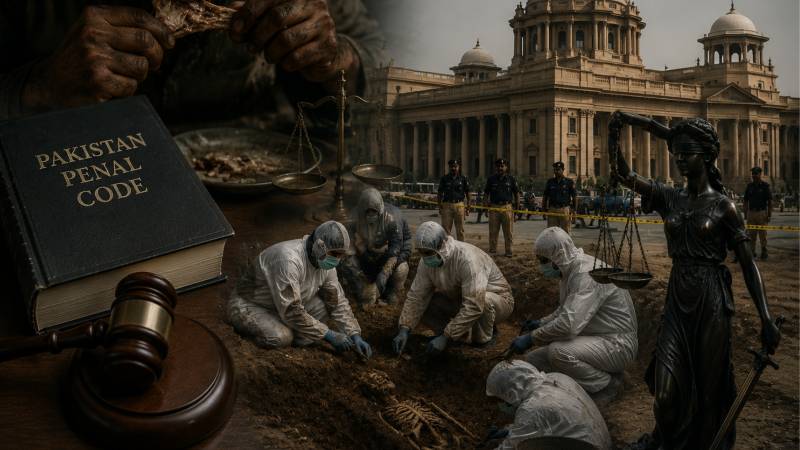
The foul stench grew too strong to go unnoticed. For weeks, people of the village complained of it. Come April 2014, the police forced their way into the door, found the freshly exhumed body of a two-year-old, and a pan used to cook human flesh into curry.
The two resident brothers of the house were no strangers to the police. Muhammad Arif Ali and Muhammad Farman Ali had earlier served two years in prison. They were found guilty of digging graves, exhuming over a hundred bodies, and consuming their flesh. The brothers were released in 2013, but were back no less than a year later.
This time was different. The courts were cautious, and certainly more punitive. The brothers were sentenced to a total of twelve years in prison on multiple similar charges. By July 2026, their sentences ended. News broke that they were out and reportedly headed towards a psychiatric facility to keep them away from a community which was still to forgive them for what they had repeatedly done.
The story should end there, right? It didn’t. Within hours of this news, a familiar, but more popular verdict spread across Pakistani social media. Netizens believed that the cannibal brothers had “gotten away with it”. That they successfully played the law. That people could dig up corpses, eat them, and walk as free men in Pakistan.
It is a beautiful story but is it the correct one?
Nobody got away with anything. The cannibals were arrested, investigated, charged, tried, and convicted by the law. They paid for it in years. The story is more nuanced than it seems to the layperson. It’s beyond just a loophole in the law— a story far more uncomfortable to sit with. Cannibalism appears nowhere in Pakistan’s criminal law. Not as an oversight, not a gap, most definitely not a loophole. It just does not exist. The Government of Punjab issued a response to a Right to Information letter in 2022 which clearly confirmed this position: there is no law that bars the consumption of human flesh in Pakistan.
So what do you charge a man with, when the law has no word for what he did?
You charge him with what you can. The prosecution team tactfully charged the brothers under Section 297 of the Pakistan Penal Code for desecrating a grave, 295-A for deliberately outraging religious feelings and 201 for destroying evidence by, quite literally, eating the evidence. The prosecution charged them with every provision of the code they could stack to maximize the sentence. But were the brothers ever charged for what they actually did? The one thing that made this case infamous is the one thing no court in Pakistan was ever equipped to punish.
Call it a loophole if it pleases you. I’d protest the word. It flatters Parliament with an intention it never had. A loophole necessarily means that the legislature knew of the danger and left the door ajar, carelessly or conveniently. No door was left open here. There was no door in the first place. In legal terms, this is classified as a lacuna, not a loophole. The difference between the two is key, and it helps us decide who is to blame.
Let us remember that this unearths a question far more important than two random men eating human flesh: would we rather live in a state where judges can invent crimes when something disgusts them enough? As appealing as it may sound in our case, the law does not work on an ad hoc basis. Such a power doesn’t stay confined to punishing man-eating monsters. The court that starts making law to punish a morally repulsive action today could punish anything it deems fit to be punishable tomorrow, purely on the basis of how repulsive it may sound to the one with the gavel.
The principle of nullum crimen sine lege exists precisely to foreclose this. Written into Article 12 of the Constitution, it means that there exists no crime without law. It serves as the wall between justice and mob instinct wearing a robe.
The Bhakkar case, then, isn’t actually about the failure of our legal system. It is about the system hitting its ceiling and stopping where it’s supposed to stop by prosecuting all that it legally could and refusing to manufacture new offences. This refusal shall not be read as leniency. It is the courts doing what they are supposed to do, and letting Parliament pull its weight.
The stench out of the house in Kalam Kalan was great. The stench of a system where law comes from the bench, and moral horror creating criminal offences would have been worse. Somewhere between the actions of the brothers and the legal response to it, Pakistan learned a lesson. As frustrating as it may sound, the law can’t operate on moral whims and perceived repulsion to certain acts, and that is exactly what the rule of law is.