

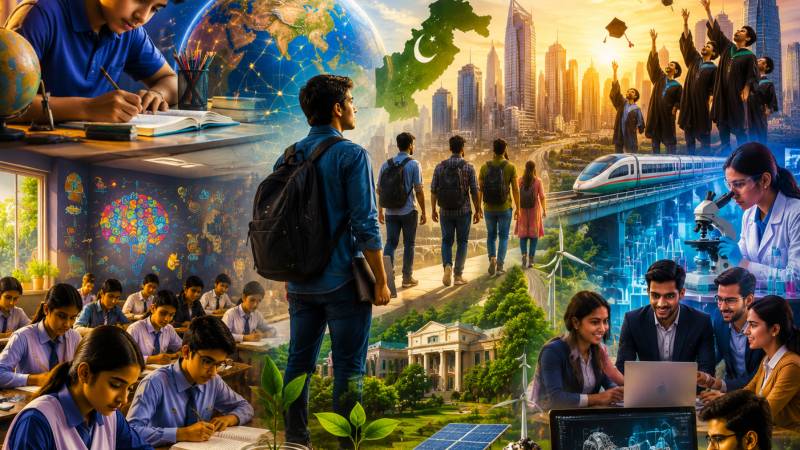
For every nation, there comes a defining moment when it must decide what kind of future it wishes to build. For Pakistan, that moment is now. While public debate continues to revolve around economic crises, political uncertainty, and governance challenges, the country's greatest challenge lies elsewhere. It lies in the quality of education it imparts to its children and young people. History offers an unmistakable lesson: no nation has achieved enduring prosperity, scientific excellence, institutional strength, or social progress without first building an education system capable of unlocking the potential of its people. The destiny of nations is shaped not in their corridors of power but in their classrooms.
The remarkable transformation of countries such as Singapore, South Korea, Finland, China, and Ireland demonstrates a common truth. Despite differences in geography, culture, and political systems, they all recognised that their greatest national resource was neither minerals nor military strength but educated and skilled citizens. By investing consistently in quality education, competent teachers, scientific research, technical training, and innovation, they converted human potential into economic prosperity. Education became the foundation upon which every other national achievement was built.
Pakistan possesses similar potential. Nearly two-thirds of its population consists of young people, providing the country with an enormous demographic advantage. Yet a youthful population becomes a national asset only when it is equipped with knowledge, skills, discipline, and creativity. Otherwise, it risks becoming an economic and social burden. The future of Pakistan will therefore depend not on the size of its youth population but on the quality of education it provides.
Recruitment, training, evaluation, and promotion should be based on merit, competence, and performance rather than routine seniority or administrative convenience.
Unfortunately, the national debate has focused largely on expanding educational facilities rather than improving educational standards. More schools, colleges, and universities are undoubtedly important, but buildings alone do not produce excellence. The real measure of an education system lies in the quality of its graduates. Do they possess analytical ability, intellectual curiosity, communication skills, professional competence, and ethical values? Can they solve problems, create knowledge, and compete internationally? These are the questions that should define educational success.
The reality is that Pakistan faces a crisis of educational quality rather than merely educational access. Employers frequently report that many graduates lack critical thinking, problem-solving ability, effective communication, and practical skills. Universities continue to award thousands of degrees every year, yet comparatively few graduates emerge as researchers, innovators, scientists, entrepreneurs, or leaders capable of driving national development. The challenge before Pakistan is therefore not simply to educate more people but to educate them better.
This quality deficit begins in the classroom. Too many schools continue to rely upon outdated teaching methods that reward memorisation rather than understanding. Curiosity, creativity, independent thinking, and scientific inquiry often receive inadequate attention. Colleges frequently fail to cultivate analytical reasoning, while universities have yet to establish themselves as internationally recognised centres of research and innovation. Pakistan has produced exceptionally talented individuals who have excelled across the world, but too often they have succeeded despite the system rather than because of it.
No education system can rise above the quality of its teachers. Every successful nation has invested heavily in attracting talented individuals into the teaching profession, providing rigorous professional training, continuous capacity building, and merit-based career progression. Teachers do far more than transmit knowledge; they shape character, inspire confidence, and cultivate the habits of disciplined thinking. Pakistan must therefore restore teaching to one of the country's most respected professions. Recruitment, training, evaluation, and promotion should be based on merit, competence, and performance rather than routine seniority or administrative convenience.
Educational reform also demands professional leadership. The Ministry of Education and provincial education departments should increasingly benefit from distinguished educationists, accomplished academics, and experienced professionals capable of designing evidence-based policies and providing continuity of purpose. Education is too important to national development to be administered without specialised knowledge, long-term vision, and professional competence.
Educational excellence, however, cannot be achieved without sustained public investment. Every country that has successfully transformed its economy has first made education a national priority. UNESCO recommends that countries allocate between 4 and 6 per cent of GDP to education. Pakistan's investment has remained well below this benchmark for much of its history and lags behind several countries in the region. The consequences are visible in inadequate educational infrastructure, underfunded research, poorly equipped laboratories, limited teacher development, and uneven educational outcomes. No nation can aspire to compete in the global knowledge economy while treating education as a residual claim on public resources.
The history of the Iqra Surcharge offers an important lesson in public policy. Introduced in 1985 specifically to strengthen educational development and withdrawn in 1994, it generated approximately Rs. 65 billion. Yet these resources were reportedly used for budgetary adjustment rather than educational improvement. Whatever the fiscal compulsions of the time, the episode illustrates how Pakistan has too often viewed education as an expenditure to be managed rather than as the most productive investment in its future. Had those resources been invested in schools, teacher training, libraries, laboratories, and universities, their dividends would have been felt for generations.
Another challenge demanding urgent attention is the continuing migration of highly qualified Pakistani academics, scientists, engineers, physicians, and researchers to universities and research institutions abroad. Their achievements demonstrate that Pakistan does not suffer from a shortage of talent; it suffers from a shortage of opportunities and an environment that consistently rewards merit and excellence. Rather than viewing this phenomenon solely as a brain drain, Pakistan should actively engage its academic diaspora through visiting professorships, collaborative research, online teaching, curriculum development, and participation in national policy formulation. Their international experience represents a valuable national asset that should be harnessed for the country's educational transformation.
Rather than viewing this phenomenon solely as a brain drain, Pakistan should actively engage its academic diaspora through visiting professorships, collaborative research, online teaching, curriculum development, and participation in national policy formulation.
Higher education must also undergo fundamental reform. Universities should become centres of research, innovation, entrepreneurship, and technological advancement rather than institutions concerned primarily with awarding degrees. Stronger collaboration between universities and industry, increased investment in scientific research, modern laboratories, internationally competitive faculty, and greater emphasis on postgraduate education are essential if Pakistan is to participate meaningfully in the global knowledge economy. The fact that no Pakistani university currently ranks among the world's leading institutions should not merely be viewed as a matter of prestige; it should serve as a national call for academic renewal.
These reforms require continuity of vision and professional leadership. Pakistan should establish an Independent National Commission on Education Reforms, comprising eminent educationists, vice chancellors, distinguished professors from diverse disciplines, scientists, representatives of industry, and accomplished members of the Pakistani academic diaspora. Working through broad national consultation, the Commission should prepare a comprehensive twenty-year roadmap for educational transformation, with measurable targets and periodic review, while ensuring continuity of policy irrespective of changes in government. Education must become a permanent national agenda rather than a shifting political priority.
History leaves little room for doubt. No nation has achieved lasting prosperity, scientific leadership, technological excellence, or institutional strength without first investing in the education of its people. Economic growth, industrial productivity, good governance, judicial excellence, and national security ultimately depend upon the knowledge, skills, values, and creativity of a country's citizens. Education is therefore not merely another sector of government; it is the foundation upon which every other national aspiration rests.
Pakistan possesses immense human potential. Its greatest resource is neither its geography nor its mineral wealth but the intelligence, resilience, and creativity of its people. Unlocking that potential requires vision, political commitment, sustained investment, and an unwavering determination to make educational excellence the nation's highest priority.
The choice before Pakistan is both simple and profound. It can continue to treat education as another item of public expenditure, or it can recognise it as the single most productive investment in its future. The nations that transformed themselves made that choice long before they became prosperous. Pakistan must now make the same choice. For the future of our country will not be determined by the wealth beneath its soil, but by the knowledge cultivated in the minds of its children. The destiny of Pakistan will not be shaped in its corridors of power; it will be shaped in its classrooms.