

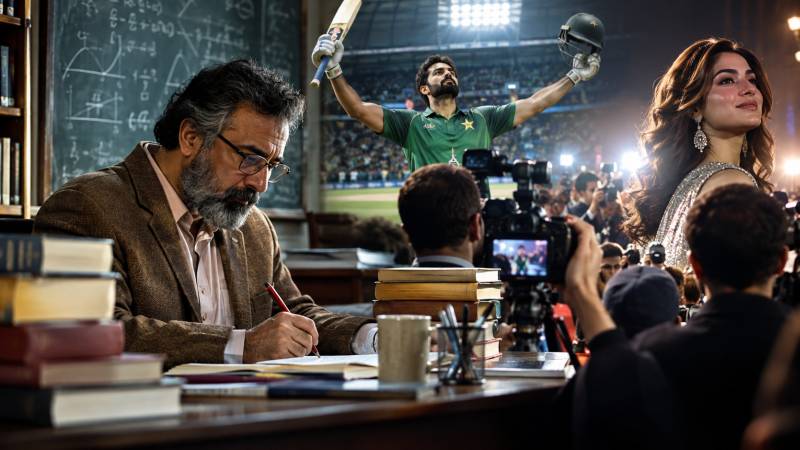
“Nowadays people know the price of everything and the value of nothing”— Oscar Wilde
Those who grew up in our part of the world will remember a little rhyme that was almost a parental commandment:
Parhoge likhoge banoge nawab,
Kheloge kudoge hoge kharab.
(Study hard and you will prosper;
Spend your time playing and you’ll end up a pauper).
Generations of children were raised on this philosophy. Books represented the road to advancement. Education was an investment in one's future. Teachers were respected because they possessed knowledge. Scholars commanded admiration because scholarship represented years of intellectual discipline. A doctorate was an achievement. A professor was someone to whom one listened. Scientists, writers, jurists and researchers occupied a certain moral and intellectual height even when they were not wealthy.
O’ but how dramatically the world has changed!
Today, the child looking around him may reasonably ask why he should believe what his parents continue to tell him. He sees footballers, cricketers, wrestlers, actors, entertainers and social-media celebrities earning fortunes that distinguished professors, scientists and researchers could scarcely imagine. A successful athlete may earn in a single commercial endorsement what a teacher will not earn after decades in a classroom. An entertainer with millions of followers can command greater attention than a Nobel laureate whose work may have changed human understanding itself.
The old equation has not merely weakened. In many respects, it appears to have been reversed. This is not an argument against sport. Nor is it an attempt to belittle artistic ability. Excellence in professional sport requires extraordinary discipline, years of training, physical endurance and sacrifice. Great acting, music and other creative pursuits are genuine forms of talent. Very few people who enter these professions ever reach the summit, and those who do often deserve admiration for what they have accomplished. The question is something quite different.
Why has intellectual excellence ceased to command anything approaching the material and social recognition that we confer upon entertainment? The answer lies partly in the distinction between value and price.
A market does not ask what is most useful to civilisation. It asks what people are prepared to pay for. Millions will watch a football match simultaneously. Television companies will purchase broadcasting rights. Advertisers will pay enormous sums for access to those millions of eyes. Sponsors will attach their brands to famous players. Stadium tickets, merchandise, endorsements and digital audiences convert attention into money. Knowledge operates differently.
A scientist may spend twenty years investigating a disease. A researcher may work quietly in a laboratory for decades. A teacher may educate thousands of children during a lifetime. A scholar may produce work that influences generations long after his death. Yet the benefits of these activities are dispersed across society. They cannot always be packaged into ninety minutes of prime-time viewing. The footballer sells attention tonight. The teacher creates capacity for tomorrow. And modern economics has found attention far easier to monetize.
Perhaps this explains the money. It does not explain the reverence. That is the more disturbing transformation. Societies have always had entertainers, athletes and celebrities. But somewhere along the way celebrity itself became a qualification. We began asking actors for opinions on subjects entirely unrelated to acting. Sportsmen became authorities on matters far beyond sport. The number of followers acquired on a digital platform became a curious substitute for intellectual standing. Visibility started masquerading as wisdom. Meanwhile, the academic who has spent thirty years studying a subject may struggle to attract an audience outside his classroom.
The old equation has not merely weakened. In many respects, it appears to have been reversed: entertainment commands fortunes while intellectual excellence struggles for recognition.
There is an irony here bordering on the absurd. We tell children that education is the foundation of civilisation and then pay many of those entrusted with delivering it barely enough to live comfortably. We insist that scientific research is essential to national progress while researchers struggle for funding. Universities speak grandly about knowledge economies while contractual teachers worry about their next appointment. Governments celebrate innovation while frequently treating education as expenditure rather than investment.
Then, with complete seriousness, we wonder why the brightest young minds are attracted elsewhere. Children learn not merely from what adults tell them. They learn from what society rewards. They notice who arrives in motorcades. They see whose wedding becomes national news. They know whose photographs dominate newspapers and television screens. They see who is offered enormous advertising contracts and who receives standing ovations. They also see their teachers. No lecture on the importance of education can completely erase that comparison.
There is another danger. When financial reward becomes our principal measure of accomplishment, the distinction between success and significance disappears. A person may be commercially successful without making any lasting contribution to human advancement. Another may transform an entire field of knowledge while living relatively modestly. History contains innumerable thinkers, scientists, writers and philosophers whose influence vastly exceeded their bank balances.
Money is remarkably good at measuring demand. It is remarkably poor at measuring worth nor should the solution be to impoverish sportsmen or entertainers. That would be pointless and unjust. If the market generates enormous revenues from their abilities, there is every reason why they should share in them. The problem lies at the other end. Why should teaching remain poorly rewarded? Why should researchers spend their lives competing for modest grants? Why should universities lose brilliant minds because scholarship cannot provide financial security? Why should intellectual achievement command less public recognition merely because it does not generate advertising revenue?
A society reveals its priorities not through speeches but through its allocation of resources and admiration. There is something profoundly wrong when we applaud the products of knowledge while neglecting its producers. We want sophisticated hospitals but inadequately reward those who teach medicine. We demand technological advancement but undervalue scientists. We expect competent judges, lawyers, engineers and economists while steadily diminishing the social standing of the scholars who educate them.
Civilisation itself is an intellectual inheritance. Every stadium illuminated at night depends upon engineers. Every match broadcast across continents relies upon scientists and technologists. Every multimillion-dollar sporting contract requires lawyers and accountants. Every injured athlete depends upon medical professionals whose knowledge took years to acquire. The celebrity economy stands, quite literally, upon foundations built by people who may never become celebrities themselves.
Perhaps, therefore, the childhood rhyme was wrong in one respect and right in another. Playing was never the enemy of learning, and education was never a guarantee of riches. However, our elders understood something we risk forgetting: knowledge possesses a value beyond its immediate market price.
A healthy society should celebrate the athlete, enjoy the actor, admire the musician and appreciate the entertainer but it should also know the difference between applause and achievement. For once a civilisation begins valuing only what attracts attention, it may eventually discover that the people capable of advancing knowledge have quietly stopped choosing the path of scholarship. And then the price of neglecting knowledge will be far greater than the fortune we ever paid for fame.
We built our world on learned minds,
Then crowned the ones who drew the crowds;
The scholar labours out of sight,
While fame is measured out in shouts.
One dazzles brightly for a night,
One keeps the dark from settling on;
We spend our fortunes on the spark,
And starve the flame that lights the dawn