

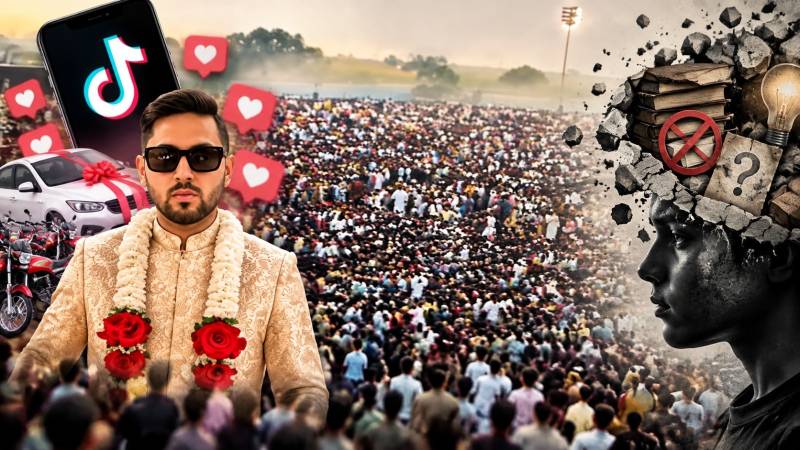
The stampede at a TikToker's mehndi ceremony in Sialkot, reported by Dawn on October 31, left one man dead and more than 14 injured. Hundreds had converged on a cricket ground on Daska Road for Muhammad Ansar Jatt, known as “Mr Patlu”, drawn by a lucky draw promising motorcycles and a car. When the gates opened, the crowd surged. Muhammad Aqeel, 30, was trampled and died on the way to hospital. The district police officer blamed the organisers for opening the gates early. The rescue service, its district officer said, had not even been told the gathering would take place.
A man died trying to win a motorcycle from a stranger whose only distinction is that he is watched. It would be easy to dismiss this as another bizarre episode in the age of social media. But the incident raises a more disturbing question: what happens to a society when the pursuit of attention becomes an aspiration, spectacle substitutes for achievement, and the capacity for independent thought steadily erodes?
Journalist Asad Toor's reaction on X captured the anxiety:
جب سوچنے سمجھنے اور اہلِ دانش پر پابندیاں لگاؤ گے اور مُقدمے بناؤ گے تو نوجوان نسل ایسے بندروں کے ہاتھ ہی لگے گی اور سماجی و عقل و شعور کی جس پستی کی طرف پوری محنت سے قوم کو دھکیلا جارہا ہے مُستقبل کا سوچ کر خوف آنے لگا ہے۔۔
Translation: Ban thinkers and intellectuals, file cases against them, and the young generation will fall into the hands of such monkeys. I am frightened when I think of the future, of the social and intellectual abyss into which this nation is being pushed with such diligence.
His observation goes to the heart of a much larger malaise. Pakistan is not merely experiencing an educational crisis or a decline in public discourse. It is undergoing a deeper transformation in which intellectual conformity, moral compromise, crass materialism and political repression reinforce one another. The result is a society increasingly incapable of distinguishing knowledge from information, conviction from prejudice, success from enrichment, or authority from competence.
The problem is not simply that too many Pakistanis are uneducated. It is that even those who are educated have often not been taught to think independently. Kant defined enlightenment in 1784 as emergence from self-imposed immaturity, attributing its cause not to a shortage of intelligence but to a shortage of courage. Pakistan has refined the arrangement. Here, immaturity is not merely self-imposed. It is manufactured by the syllabus, the ban and the charge sheet, and then mistaken for the national character.
The statistics are appalling, but they are the symptom, not the disease. The Economic Survey 2024–25 put public spending on education at 0.8 per cent of GDP for the first nine months of the year, against 1.5 per cent in 2022–23. ASER Pakistan 2025 found that only about half of Class 5 children could read a Class 2 text. The World Bank puts the share of ten-year-olds unable to read and understand a simple text at about 78 per cent. Yet ASER finds more than nine in ten children aged six to sixteen enrolled in school. They are in the classroom. The classroom is not teaching them to read, let alone to reason.
The intellectual crisis extends far beyond these numbers. An education system that rewards memorisation, discourages questioning and treats prescribed answers as knowledge does not cultivate independent minds. It produces people trained to reproduce information, defer to authority and avoid intellectual risk. History becomes an exercise in absorbing approved narratives. Complex political and social questions are reduced to ideological certainties. Contradictions are concealed rather than examined.
This conditioning does not end at school. It is reinforced by families, workplaces, religious institutions, the media and politics. Hierarchy is rarely questioned. Deference is confused with respect, obedience with discipline, and conformity with virtue. The ability to please those in authority often matters more than competence or integrity. A person may acquire impressive credentials without ever developing the intellectual independence that education should make possible.
What does a student learn when cheating is routine, rules are negotiable and credentials matter more than competence? The lesson is that success lies not in mastering a subject but in finding a way around the rules. That lesson is reinforced at every level of society. The same inversion of values is visible in Pakistan's political economy. Wealth has increasingly become the principal measure of social worth, irrespective of how it is acquired. Conspicuous consumption is celebrated, influence commands admiration, and ostentation is mistaken for achievement. The extravagant lifestyles of the politically connected provoke outrage on social media, but rarely a sustained examination of the economic system that makes such accumulation possible. An economy that pays for access rather than invention has no use for a thinking public. It needs a public that queues.
There is nothing wrong with wealth or ambition. The problem is a society in which the acquisition of wealth is increasingly detached from productive achievement, while corruption, tax evasion, rent-seeking and access to state patronage are widely perceived as routes to prosperity. When public office is treated as an opportunity for private enrichment, corruption becomes more than an institutional problem. It becomes a social value.
The moral consequences are profound. A student cheats because everyone else does. A professional looks the other way because speaking up could jeopardise a career. A journalist repeats an unsubstantiated claim because it serves a political narrative. An educated person forwards fabricated information because it confirms a prejudice. A citizen condemns corruption in public but seeks a favour from a politician, bureaucrat or police officer in private. The same person who rails against injustice may defend it when perpetrated by someone belonging to their own political, ethnic or ideological camp.
This is not simply hypocrisy. It is the erosion of the capacity to apply principles consistently, independently of personal advantage or group loyalty. Morality becomes contingent; truth becomes tribal. What matters is no longer whether an act is defensible, but who committed it and whose interests it serves. Social media has magnified these tendencies. Platforms such as TikTok and YouTube operate on an attention economy in which sensationalism, outrage and emotional gratification are rewarded. The influencer economy is not inherently objectionable, but when visibility becomes a principal measure of worth, society's aspirations are progressively distorted. The Sialkot incident was not an aberration from this culture; it was an extreme expression of it.
Yet technology is not the original culprit. Social media also provides access to knowledge, facilitates political mobilisation and exposes abuses that traditional media may suppress. The critical issue is the capacity to use information intelligently. A society that has neglected education, critical thinking and intellectual freedom is particularly vulnerable to manipulation. Algorithms exploit existing weaknesses; they do not create them from nothing.
Neil Postman, writing in 1985, set two dystopias side by side. Orwell feared a state that would ban books. Huxley feared a world in which there would be no reason to ban them because no one would want to read them. Most countries have to choose. Pakistan has built both. The state supplies Orwell: the notice, the summons, the blocked channel. The market supplies Huxley: the lucky draw, the viral clip, the crowd at the gate. Each makes the other cheaper to run.
This brings us to political repression and the rise of the so-called “hard state”. Pakistan's ruling establishment increasingly treats social and political problems as questions of control. Dissent is criminalised, journalists intimidated, academics constrained and digital platforms restricted. The expanding use of the Prevention of Electronic Crimes Act and the prosecution of political critics have narrowed the space for public debate. Section 26A, added to the Act in 2025, punishes the spread of “false or fake” information with up to three years in prison and a fine of up to two million rupees. It defines neither “fake” nor the unrest the information must be likely to cause. That decision is left to whoever holds the file. Reporters Without Borders reported in October 2025, citing the Information and Interior ministries, that at least nine journalists had been prosecuted under the Act since the start of that year.
The implications extend beyond the immediate victims. When people learn that certain questions cannot be asked, they eventually stop asking questions altogether. When intellectuals are silenced, society loses not only their contributions but also the example they set. Self-censorship becomes habitual. Intellectual timidity becomes a survival strategy.
Nor is the absence of thought on campuses an accident. General Zia banned student unions in 1984 to quell uprisings. The ban stood for 38 years before Sindh lifted it in 2022, and, four decades on, no government has kept its promise to restore them nationally. A campus stripped of politics does not become calm. It becomes a vacuum, and something fills it. A lucky draw. A sermon. A mob.
The sermon needs its own accounting. The state has used religion, and the clergy it cultivated, as a second instrument of conformity: gentler than the file and the ban, and more effective. Not faith itself, which is between a person and God, but its management. Since the Objectives Resolution of 1949, the state has presented itself as the guardian of religion. Under General Zia it became its policeman. The lesson for every citizen was plain: some questions are dangerous to ask, and the state decides which. Piety was then made compulsory by order. In 2020, the Punjab government decreed that no degree would be awarded in its universities without reading the Quran with translation. A requirement to read is not a habit of reflection.
Pakistan is not merely experiencing an educational crisis or a decline in public discourse. It is undergoing a deeper transformation in which intellectual conformity, moral compromise, crass materialism and political repression reinforce one another.
The result is a gap between what the country proclaims and what it does. The 2023 census counted more than 600,000 mosques in Pakistan, against some 242,000 schools and 23,000 factories. In November 2024, following a letter from the Ministry of Religious Affairs, the Pakistan Telecommunication Authority said it had blocked 844,008 pornographic websites and was turning back an estimated 20 million attempts a day to reach them at international gateways. A state that has blocked 844,008 sites has not blocked the demand. It could not. Virtue is a judgment exercised when no one is watching, and the system never allowed that faculty to grow. Where conscience is replaced by supervision, behaviour follows the supervisor. When the supervisor looks away, or a VPN is found, it follows appetite.
None of this is an argument against faith. The Quran asks, again and again, whether people reason, reflect and ponder. It is an argument against a state that took a religion that commands reflection and made it an instrument of conformity, and against the habit that follows. A people taught that questions are sins will bring the same habit to politics, to the textbook and to the powerful. Obedience in the pulpit becomes obedience everywhere, and a society that cannot question its sermon will not question its rulers.
Parliament’s intellectual bankruptcy is perhaps the clearest sign of this decline. Debates on constitutional amendments, fundamental rights or the economy should be about ideas, arguments and the future of 250 million people. Instead, we get abuse, slogans, political point-scoring and empty theatrics. Many of our elected representatives cannot even explain the issues on which they are legislating, let alone argue them intelligently. The mainstream media gives them a platform every evening to expose their ignorance to millions. Instead of questioning them, it turns their nonsense into entertainment. Parliament is not just a reflection of Pakistan’s dumbing down. It is one of its driving forces.
The hard state and the intellectually diminished society are not separate phenomena. They reinforce each other. A population conditioned to defer to authority is easier to govern through coercion. A coercive state further discourages independent thought. The erosion of intellectual independence facilitates repression, and repression accelerates intellectual erosion. The tragedy is that the state increasingly demonstrates its capacity to control citizens while failing to develop their capabilities. It can monitor communications, restrict political activity and deploy coercive force, yet cannot ensure that children acquire foundational skills, that universities produce knowledge or that public institutions function competently. A state can be hard without being strong. Coercion is not capacity; obedience is not legitimacy.
Pakistan's extractive political economy compounds the problem. The privileged have no need of the public school, the public hospital or the public university, so they have stopped caring whether any of them works. They buy education, healthcare and access to international opportunities for their children. Everyone else pays for the failure: in the classroom that teaches nothing, the clinic with no doctor, the degree that leads nowhere. This produces not merely economic inequality but an unequal distribution of intellectual opportunity. A narrow elite acquires the skills to navigate the modern world, while millions are denied the foundations of meaningful participation.
For this elite, more than 240 million people do not matter. In its calculations they barely exist. They are not citizens to be educated but a surplus to be managed and, when they cannot be managed, shipped out. The plan is not to build a society in which they can live and thrive. It is to export as many of them as possible, and to call the remittances development. Emigration is the safety valve: it removes the angriest and the ablest, and the dollars they send home keep the failing system afloat.
This elite has no intention of leaving. Abroad it would be ordinary. Here it commands land, office and the machinery of the state, and no other country will give it that. The broken country is not an obstacle to its privilege. It is the source of it. Why would it fix what it lives on? The country's large youth population could be an extraordinary asset. But a demographic dividend requires education, skills, health and productive employment. A youth bulge without intellectual development or economic opportunity is not a dividend. It is potential being squandered on a monumental scale. The central tragedy is not that Pakistan lacks intelligent, capable or principled people. It has many. The tragedy is that its institutions increasingly marginalise them, its incentives discourage independent thought, and its social environment rewards conformity and opportunism.
A society's capacity for self-correction depends on its willingness to question itself. That requires intellectual independence, ethical consistency and the courage to confront uncomfortable truths. Without these, public debate becomes a contest of assertions, politics a struggle of personalities, and governance an exercise in coercion. The Sialkot tragedy should not become an occasion for contempt towards young people. They are products of the society they inhabit, not its architects. The more pertinent question is what that society has been teaching them, rewarding them for and denying them.
The ultimate achievement of a system that discourages independent thought is not that people stop questioning authority. It is that they lose the habit of questioning altogether. Eventually, conformity begins to resemble conviction, wealth becomes indistinguishable from worth, and spectacle is mistaken for achievement. Pakistan is not merely being dumbed down. It is being shaped into a society in which intellectual impoverishment and moral conformity have become increasingly compatible with the exercise of power. That is a far more consequential crisis than any single viral video, and a far more dangerous one than the state seems willing to acknowledge.