

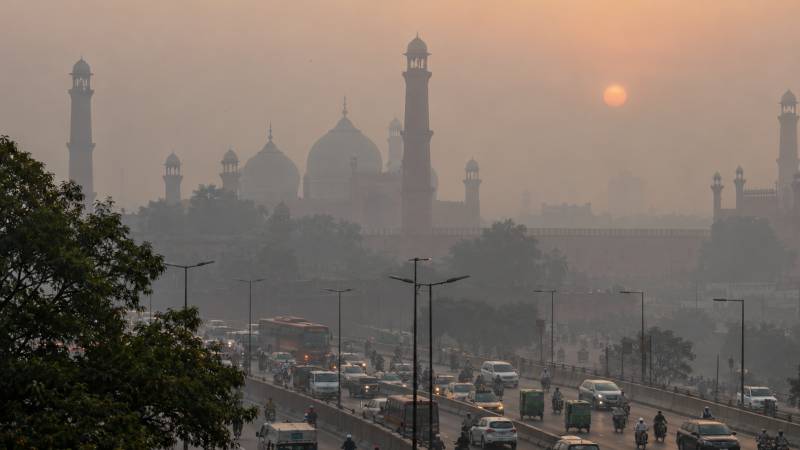
On 22 October 2026, Lahore stood among the three most polluted major cities in the world on IQAir's live ranking, with an air quality index of 258, in the "very unhealthy" band. Nothing about that day was unusual. It was the ordinary air of a city of many millions, where children walk to school and grandparents sit outside in the evening, and where hardly anyone is told that the haze they breathe is, by the World Health Organization's yardstick, an emergency. I write this with sorrow rather than anger, and with a request to those who lend and advise: the World Bank, the Asian Development Bank, the United Nations and UNDP. Lahore's air has not improved while large sums have been committed in the name of clean air, and the people who will repay those sums are the people who breathe it.
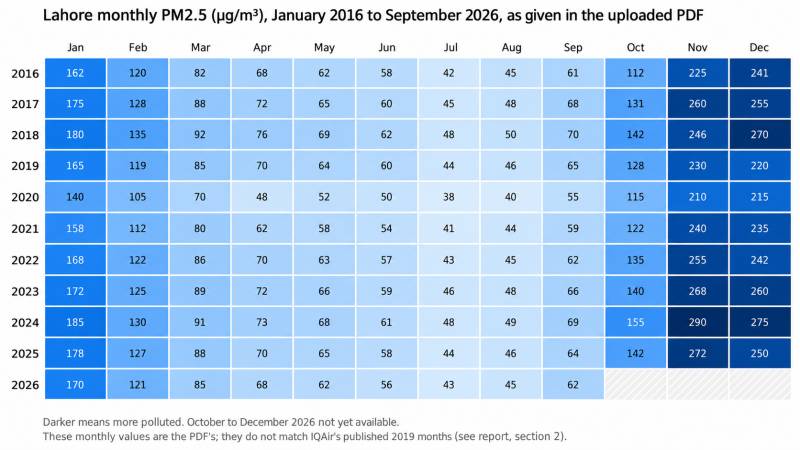
A ten-year record of monthly fine-particle pollution, PM2.5, from January 2016 to September 2026 tells the story plainly. Summers are tolerable, winters are brutal, and the winters are not getting better. November 2024 reached 290 micrograms per cubic metre, nearly sixty times the WHO annual guideline of 5. Not one of the 129 months in the record met that guideline. In the October to December season, the one that matters most for health, the 2025 average was 14.8 percent higher than in 2016. On IQAir's own published annual figures, 2025 (88.9) is no better than 2019 (89.5). The one large fall came in 2020, when a lockdown emptied the roads and closed the factories. The annual figure dropped by about a quarter, and within four years it had climbed back above where it began. A national shutdown did more than any scheme, and it showed how much of Lahore's air is made by human activity and how quickly relief disappears when emissions return.
Meanwhile the money has been considerable. Punjab's environment department approved about Rs 20.7 billion of selected schemes between 2021 and 2024. Its development programme lists Rs 38.7 billion across 30 schemes, of which Rs 11.05 billion had been spent by June 2025. The budget announced for 2026-27 carries a headline figure of Rs 17.2 billion. Where does it go? About half of the approved money buys monitoring stations and laboratories. Monitoring is necessary, because we cannot manage what we cannot measure, but a monitor does not clean the air. An estimate in the source report, which cites no source for it, puts transport at 43 percent of Lahore's fine particles, yet the only transport-related item among the listed schemes is a proposed fuel-testing laboratory at Rs 0.56 billion, not yet approved. The most visible anti-smog purchase, truck-mounted fog cannons, rests on a method whose effect on fine particles is contested and which uses large amounts of water.
A ten-year record of monthly fine-particle pollution, PM2.5, from January 2016 to September 2026 tells the story plainly. Summers are tolerable, winters are brutal.
In March 2025 the Board of Directors of the World Bank Group approved a USD 300 million loan from the International Development Association for the Punjab Clean Air Program. It supports the province's Smog Mitigation Action Plan across transport, agriculture, industry, energy and municipal services, and aims to cut PM2.5 by 35 percent over a decade for the 13 million residents of Lahore Division. The Bank has also supported monitoring schemes under the Punjab Green Development Program. This is a serious loan with a serious target, and it is only about eighteen months old. I do not say that it has failed. I say that Lahore's air this month shows that results cannot be assumed from approvals.
Let me be exact about what I am not saying. Nothing in my report establishes corruption or embezzlement in any fund dedicated to air quality, and I make no such charge. The failing the numbers describe is one of design: money committed without a scientific and engineering basis that ties every rupee to a measurable reduction in PM2.5. This matters because Pakistan can least afford it. By the World Bank's own estimate, 44.7 percent of Pakistanis live below its US$4.20-a-day poverty line, and IQAir's 2025 report named Pakistan the most polluted country in the world for that year. A concessional loan is not a gift. It is a promise made by the poor to the future, and every rupee spent without effect is a debt without a benefit.
I have worked on air pollution control for some three decades. On 31 October 2024 I offered the Senior Minister of Punjab free advice by email, with copies to Imtiaz Gul and Idress Abbasi for the record: manage air quality through measurement, source apportionment and engineering design, not seasonal bans and symbolic operations. Two winters later, the same question stands. I respectfully ask the Chief Minister of Punjab to look at this state of affairs as a whole, to reset how funds are used on scientific and engineering grounds, and to find out who advised that these projects be designed as they were. The aim is not blame but learning, so that the next rupee is better spent. The federal government should apply the same discipline of value for money. To the World Bank, the ADB, the United Nations and UNDP, I make five requests.
First, let the World Bank carry out an independent performance audit of the Punjab Clean Air Program and its monitoring schemes against their stated targets, and publish the findings. Second, tie disbursement to measured results, using reference-grade monitors, open data and a published baseline year for the 35 percent target, which the Bank's announcement does not state. Third, publish spending by component and by year, so that results can be set against money spent. Fourth, fund source apportionment and engineering design aimed at the largest sources, namely transport and fuel quality, industry and crop residue, together with regional airshed coordination, because Lahore lies downwind of crop-burning zones and cannot solve this alone. Fifth, evaluate the fog cannons with before-and-after readings at matched control sites, and report the water they use.
If a lender is unsure what to ask of its partners, let it ask this: by how much did the air improve, and how do we know? If any figure in my report is wrong, I invite the Government of Punjab to say so, because the cost estimates come from several published sources, and I would gladly correct them. Air pollution is not only an engineering failure. It is a standing health hazard in Lahore and every other city of Punjab, paid for each winter in hospital beds, lost school days and shortened lives. Lahore is tired of leading a list that nobody wants to lead. The world has the means to help. It should insist that help be measured in clean air, not in approvals.