

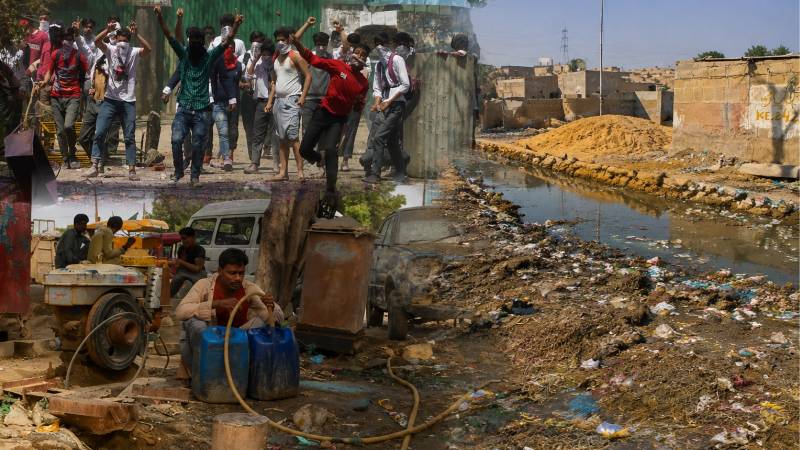
Politicians in recent days have been stirring up claims about who owns Karachi and whom it belongs to in the wake up of the debate surrounding the creation of new provinces. Every so often when this debate surfaces, ethno-nationist sentiments are stirred up with different political groups laying ignorant claims of inheritance to the city based on ethnicity. They feel entitled about taking ownership of a city that is carved out of much history and complexity. It is rather simplistic and convenient to lay political claims on mere ethnic basis over a city whose genesis and emergence are steeped in multiculturalism and diversity. Just because Karachi happens to be a city that geographically falls under the province of Sindh, does not entitle any one ethnic group to lay claim upon it by default.
When ethno-nationalistic claims are made over Karachi, it feels rather ignorant and self-indulgent. During the empire, General Charles Napier (as Governor) and Sir Bartle Frair (as Commissioner) in the 1850’s gauged the potential of Karachi and laid the foundations of its infrastructure and trade development. They ensured that a regular supply of water was conveyed to the city from Malir river, developed housing, roads and infrastructure - all which served Karachi well into the next century. The installation of a lighthouse at Manora Point, the widening of the entrance into Karachi harbour, construction of the Cantonment and Saddar town areas, the railway and tram systems of Karachi, the construction of the docks and the connecting of Keamari island to the mainland were just some of the feats owed to their administration and time in office.
Fast forward 50 years, the first city Presidency and Mayorship were handed over to Karachiites in the 1910’s who decided that Karachi would be led in turn by leaders from the three main communities; the Hindus, Parsis and Christians. This pattern remained up until partition alongside rule and order being maintained in the city. These were Karachi’s glory days where trade and industry grew and Karachi carved out an international reputation for itself.
Fast forward a further 50 years, soon after the British packed their bags and departed and with the passing away of M.A. Jinnah, the city began experiencing a huge influx and increase in population which it was not equipped to handle. In the years following partition, Karachi by the 1950’s was now at the mercy of a Government of Sindh headed by incompetent corrupt administrators who were out to line their pockets and to grab land and property left behind by Hindus rushing across the border. Nevertheless, during the era which followed, Karachi’s diverse civil society with a strong civic sense and an educated urban class always looked to protect the interests of the city in the face of corrupt government, growing religious intolerance and successive military regimes. Institutions, places, economy, trade, culture, people - all continued to thrive and the common man gained traction and representation with socialist politics beginning to emerge both at national and city level. Karachi despite its challenges, continued to thrive culturally and economically and maintained its status as the City of Lights and as Paris of the East.
Karachi was now also ranked the most unsafe city in the world and was among the most congested cities globally with no overall traffic and transport management plan in place.
Fast forward another 50 years, Karachi by the mid-2000’s had earned two global accolades. First, that of being the most polluted city in the world by way of air quality, and second, that of being a city to host the largest slum in Asia. Orangi Township had officially surpassed Dharvi slum in Mumbai as the biggest slum of Asia. By 2007, the state of affairs across the country was that 74% of the urban population in Pakistan was living in slums as opposed to 56% in India. As for Karachi, by this stage, besides being the world’s most polluted city and host to the biggest slum in Asia, Karachi was now also ranked the most unsafe city in the world and was among the most congested cities globally with no overall traffic and transport management plan in place. The City Administrator at the time (Director of KEE) and Mayor at the time (a certain young chap with a goatee beard and a Malaysian connection) were least bothered or phased by the city’s standing or its state of affairs, since they had their own political agendas and nexuses to manage. The former being a Canadian citizen who was special to the Bhai of London, and the latter who took directives from the Bhai of London and ensured support for ‘remittances’ to be headed London’s way.
It was around the same time and under the auspices of Sindh Government’s leadership, that the City Council in 2009 for instance passed resolutions under the “I own Karachi” slogan to convert the status of parks, playgrounds, public buildings and amenity spaces for residential and commercial use. The city was under siege by various mafias by this point and despite numerous petitions to the high court and interim stay orders, more than 24 locations across the city amassing to over 600 acres of land had been viciously eyed up and cornered by various mafias under the watch of (and in conjunction with) elected provincial and city government officials.
Besides this being illegal, it was morally criminal as pointed out by Enrique Penalosa, the well-regarded mayor of Bogota Colombia who visited Karachi in early 2009. Penalosa, who upon noting the lack of green spaces in Karachi, asked his hosts what future generations would think and do when they find that the parks, playgrounds and open spaces in the city were selfishly and greedily occupied and converted for the purposes of profiteering. Penalosa during that visit rightly pointed out that wealth and assets for any city can always be created in the future, but open spaces meant for the benefit and use of citizens once eaten up could never be re-acquired or re-created.
By then, various mafias in partnership with corrupt provincial and local governments had spread their tentacles, amassing wealth, power and influence over the city over the course of the 1990’s and 2000’s. Some examples here include: A three acre land plot meant to be for a public park in Block 8 KDA scheme No 5 being sucked up for the establishment of a Degree College to be leased to the Sindh Government Department of Education for 30 years on Schedule VIII of CLA Rules against a token rental payment of Rs1 per annum and free cost of land vize premium and development charges with the sanction of the competent authority; Then there was also the attempt by the City Council Treasury at illegally commercialising a 2.5 acre space at Clifton beach to be used for developing a 5-star hotel-cum-shopping complex. Adverts at the time announcing the auction of this beach space set a reserve auction price of Rs119 crore. The attempt was blocked by Justice Gulzar Ahmed of the High Court of Sindh following a seven-member petition on the rightful basis that Clifton was the only beach promenade in the city and that the beach and its environment should be protected for the use of citizens; Another case is the monstrosity of an enclaved complex built around Bilawal House which cuts through Block 2 and 3 of Clifton as you enter from Bilawal Chowrangi onto Khayaban-e-Saadi, is another shameful example of elite public space grabbing and residential area capturing under the guise of security.
Whether Karachi should be made autonomous or remain part of Sindh province should ofcourse be debated and carefully examined. But this must be done on resource- administrative-capability grounds, not on ethnic-tribal-language grounds. It really does not matter if provinces will retain their existing structure, or that more new provinces will be created or that new local government structures will emerge. The debate in favour of or against the creation of new autonomous provinces and devolution will carry on since there are advantages and disadvantages to be had in any given structural setup. Britain with a 1000-year history of political governance and public administration continues to debate and refine its political structure, its national electoral system, its decentralisation and devolution mechanisms.
There can never be a perfect political system. Public Administration and Governance are essentially ‘wicked problems’ that can never truly be solved and at best can only be efficiently managed. But the least we can do as citizens of Karachi is to be honest with ourselves about the city’s history and legacy which help explain its present-day challenges and its administrative shortcomings. It would be disingenuous of us if we do not accept and recognise the contribution that different groups have made to Karachi. The fact is that many shoulders and communities have carried this city through time. The truth is that Karachi belongs to everyone and no one. To carry on making claims and stakes over Karachi based on mere ethnicity lacks merit. And to resist political reforms on the basis of ethno-nationalist sentiments is ignorant of history and a disservice to the forebearers and successors of the mega metropolis that is Mai Kolachi.