

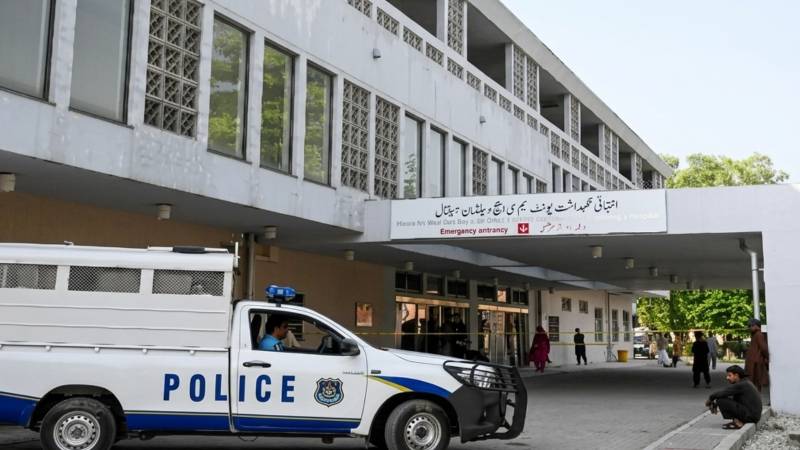
There are accidents, and then there are disasters that are allowed to happen. The fire at the Pakistan Institute of Medical Sciences (PIMS) in Islamabad, which claimed the lives of newborn babies, increasingly appears to belong to the second category. The findings of the interim inquiry report are devastating, not because they reveal some extraordinary or unforeseeable chain of events, but because they reveal something much worse: basic precautions were apparently absent, warnings had been ignored, and a hospital entrusted with the lives of some of the most vulnerable human beings imaginable was woefully unprepared for a fire.
Start with the most basic fact. There was no water sprinkler system in the ward where the babies were housed. There was no fire alarm system either. This was not a roadside clinic in some remote village. This was PIMS, one of Pakistan’s premier public-sector hospitals, located in the federal capital, minutes away from the country’s most powerful institutions. And the ward in question was caring for newborn babies.
Patients in a neonatal unit cannot simply get up and run when a fire breaks out. They cannot follow illuminated exit signs. They cannot shout for help. Many may be dependent on incubators, oxygen, or other medical equipment. Their survival depends entirely on the adults and the systems around them. That makes fire prevention and emergency preparedness in such a ward not merely important but absolutely fundamental. Yet, according to the interim findings, the ward was in violation of WHO guidelines and requirements for such a facility.
Then there are the standard operating procedures. PIMS reportedly has 13 SOPs or protocols governing different aspects of its operations. Yet there was no dedicated SOP dealing with fire safety. There were references to fire safety in two subsections, but that is hardly the same thing as having a comprehensive procedure telling staff exactly what to do when smoke is detected, an alarm sounds, or flames appear in a ward filled with newborn children. Who raises the alarm? Who evacuates the babies? Who shuts down dangerous equipment? Who contacts the fire brigade? Who coordinates the evacuation? Where are patients moved? Who takes command? In an emergency, these questions cannot be answered while the building is burning. They have to be answered before the fire starts.
Perhaps the most damning finding, however, concerns what happened just two months earlier. In June 2026, there was reportedly a fire at the PIMS Nursing Hostel. That should have been a warning. Any serious institution would have treated such an incident as an opportunity, indeed an obligation to review its fire preparedness. Senior management should have met immediately. Fire systems should have been inspected. Emergency procedures should have been reviewed. Drills should have been conducted. Gaps should have been identified and fixed. According to the interim report, not even a meeting was held to determine what lessons should be learned or whether new protocols were needed. Nothing.
That single fact transforms the debate. After a fire has already occurred within your institution, another fire is no longer an entirely hypothetical risk. The warning has arrived. If you then fail to act and another fire occurs with fatal consequences, difficult questions about responsibility become unavoidable.
The staffing situation at the neonatal ward raises equally serious concerns. According to the report, no supervisor was present when the fire broke out. There was one house officer, two nurses, and a security guard. Again, consider the setting. This was a neonatal ward. If ever there was a hospital department where clear supervision and immediate command during an emergency were essential, surely this was it. Yet when disaster struck, there was apparently nobody there with supervisory authority.
One of Pakistan’s largest public hospitals apparently had neither a dedicated emergency official for such situations nor comprehensive SOPs specifically designed to deal with fires.
The report also exposes a broader institutional failure: PIMS has no dedicated official responsible for emergency issues of this nature. That is astonishing. A hospital is an institution in which emergencies are not theoretical possibilities. They are part of the operating environment. Fires, power failures, oxygen-system problems, structural emergencies, and mass-casualty situations must all be planned for. Yet one of Pakistan’s largest public hospitals apparently had neither a dedicated emergency official for such situations nor comprehensive SOPs specifically designed to deal with fires. This is not one missing document or one malfunctioning piece of equipment. It is a system that appears not to have taken the possibility of disaster seriously enough.
There will inevitably be attempts to narrow responsibility. Perhaps someone failed to inspect something. Perhaps someone was absent. Perhaps a junior employee did not follow a rule. That must not be allowed to become the entire story. Accountability must follow the chain of command upwards. Who was responsible for ensuring the neonatal ward met required safety standards? Who knew there was no sprinkler system? Who knew there was no fire alarm? Who was responsible for emergency planning? Who decided that dedicated fire SOPs were unnecessary? And after the June fire, who failed to call that meeting?
These questions matter because Pakistan has developed a dangerous culture around public-sector tragedies. Something terrible happens. There is outrage. An inquiry committee is constituted. Officials are suspended. Statements are issued. Public attention moves elsewhere. Then, gradually, the system resets itself until the next tragedy.
Prime Minister Shehbaz Sharif has ordered action against officials identified by the inquiry committee, including departmental proceedings and action under criminal law. That is appropriate, but it must not become another exercise in temporarily suspending officials until public anger subsides. If criminal negligence is established, there must be criminal accountability. And accountability must reach whoever actually carried responsibility, regardless of rank.
Because the victims here were newborn babies. They were placed inside a hospital by families who had every right to assume that the country’s premier federal medical institution possessed the most elementary systems necessary to protect them. Those families did not have the ability to inspect sprinklers, audit fire protocols, or check whether a supervisor was on duty. That was PIMS’s responsibility. The interim report suggests that responsibility was catastrophically neglected.
We should therefore stop describing every such disaster as an unfortunate “incident.” A fire may begin accidentally. But when there is no alarm, no sprinkler, no dedicated fire SOP, inadequate supervision, no emergency official, and a previous fire warning that apparently produced not even a meeting, the consequences can no longer be dismissed simply as bad luck. The babies who died deserved better than this. Their parents deserve answers. And this time, Pakistan should demand something it too rarely gets after a public tragedy.