

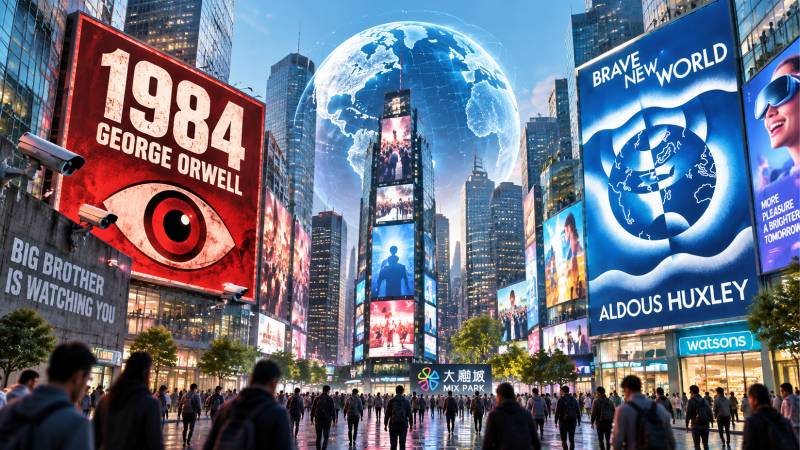
Who knew that one day predictions of George Orwell made in 1948 and Aldous Huxley in 1932 will both be true and there will be times when conditions predicted by both will be prevalent simultaneously. Orwell’s 1984 feared that people will be ruled by pain. Huxley’s Brave New World imagined them being controlled by pleasure. The future predictions made by both are now a reality, operating in tandem, as two sides of one coin. The concept of nation states existing since 17th century expanded dramatically after WWII especially after the decline of European empires and decolonization in Asia and Africa. However, despite attaining the status of sovereign states, the nations world over were classified into Alpha, Beta, Gamma, Delta and Epsilons like the classes of people envisaged by Huxley. The Alphas are intelligent, intellectually superior and occupy positions of authority, while the lower classes are conditioned to accept their predetermined roles and to remain satisfied with trivial pleasures for which they stay in debt to Alphas for the money and technology needed for their pleasure.
Huxley’s warning about the decline of books and serious reading is equally striking. Reading a book requires patience, concentration and solitude which is very difficult to maintain in societies filled with noise of digital and electronic media. Orwell feared that books would be banned. Huxley feared that nobody would want to read them. Now books are published and get perished without creating a ripple in the society. Why read when you can have 2 minutes reel available on digital media explaining the gist of an entire book. Writers and intellectuals, on the other hand, are more concerned with publicity, personal branding and visibility than with the painstaking work of creating meaningful literature; hence books are getting irrelevant so is the habit of reading. No wonder, in literary festivals, sales of samosas and burgers are higher than those of books.
Electronic media has been programmed to keep us engaged, not informed. But innumerable TV channels, social media, Instagram and tik tok is unable to fill the gap between demand and supply of entertainment. Check how much time is spent on social media ? How much screen time is recorded per day on phones? How often do we reach for a distraction the moment we feel uncomfortable, uncertain, or alone? Huxley predicted this. Destruction through distraction has set in.
We are oppressed but oppression is invisible; hence not strong enough to ignite resistance. Goethe, the famous German writer once said ‘None are more hopelessly enslaved than those who falsely believe they are free.’
With Internet, we have infinite world of information and knowledge open to us where we can learn and grow but instead we choose only entertainment. Huxley predicted we would have access to infinite information and use it to avoid deep thinking. In the current flood of information, truth is the first casualty. Censorship is no more required as propaganda is constantly hitting the minds. Coupled with always present entertainment, the search of truth has become not only laborious but also boring.
Middle class is inflating. Pleasure is available on easy instalments. From a car to a mobile, you can have anything by paying peanuts in down payments. A smartphone can provide communication, entertainment, shopping, banking, education and information within seconds. Technology has made us addicted to convenience. But convenience has a cost. We trade attention, privacy and independence for convenience and pleasure. Is it a tragedy or complicity?
In fact, we have been reduced to “instant societies” where we want everything instantly. Instant communication, instant entertainment, instant information and instant gratification. Yet the paradox is that our attention span and retention power both have reduced to dismal levels. Pleasure arrives instantly and disappears just as quickly, forcing us to search for the next stimulus. True to Huxley’s prediction, we drug ourselves, not with soma, but dopamine hits which are dependent on number of likes, followers, comments and notifications on social media.
Diseases that once terrified humanity are now treatable. Life expectancy has risen dramatically. Yet loneliness, fractured relationships and weakening family bonds remain serious features of modern life. Love and relationships are losing their meaning. Divorce rate is high. Grandparents houses have been replaced by old age homes. Technologies like plastic surgeries and cosmetic facial treatments have snatched our originality.
In such a world of countless illusions, people think they are free but they don’t realize that they have been made to don’t want anything that matters. Because thinking deep is hard, because facing reality is uncomfortable, hence we chose numbness over awareness. We are oppressed but oppression is invisible; hence not strong enough to ignite resistance. Goethe, the famous German writer once said "None are more hopelessly enslaved than those who falsely believe they are free."
But despite all this, Orwell has refused to leave the room. Nazi Germany and Soviet Union are gone but still there are countries ruled by tyranny like the boot stamping over the face as portrayed by Orwell. In countries ruled by dictators and kingdoms of ruling families, the stamping boot can still be heard. Big brother is no more there but we are being watched through Facebook, Twitter (X), iPhones and Google and we are not worried about it. Fascists regimes of the past have, in some places, been replaced by the plutocratic rule in the name of democracy, where people don’t resist control but willingly vote for those who they know will oppress them after coming to power.
Orwell warned us about what others might do to us. Huxley warned us about what we might willingly do to ourselves. Nearly a century later, it is frightening to see that both warnings are unfolding at once. Modern societies demonstrate that fear and pleasure can coexist as instruments of control. We can be watched while we are entertained. Where we don’t live under Big brother’s boot, there we live in a brave new world that we have designed ourselves. And the most terrifying part is that we are happy; completely numb to reality, totally oblivious to truth. Not fulfilled but too comfortable to change. We know we are living in dystopia, but who cares?