

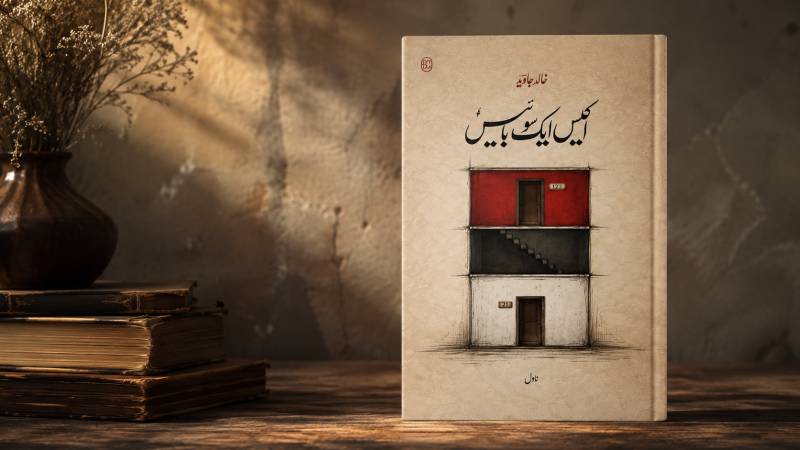
Khalid Javed sahib's latest novel is definitely not for the faint-hearted reader. Furthermore, it is definitely not for the faint-hearted local critic. I say this because if one’s idea of desirable and worthwhile literature is easily discernible, predictable and relatable (even pleasant) plots and themes; one is gladdened by readily comprehensible and not even remotely taxing ideas; and one holds on firmly—like an unimaginative, dogmatic believer—to standard and rather dated notions and frameworks of the shape, structure, texture and feel of a novel, then Ikees Aik So Baais is definitely not for one.
Avoid it with all the self-righteous zeal of your ilk. Also, if you are oblivious to the great strides that the modern novel has taken globally and the new horizons that it now explores; are queasy about the unfamiliar, the unsavoury and the unpleasant; and get easily intimidated and insecure in the presence of complex interplays of multiple narratives, spatial and temporal overlaps, and deep engagement with myth, dogma, nightmares and dreams, you should most certainly look elsewhere for literary distractions.
Having read Maut Ki Kitab and Naimat Khana, I am quite familiar now with some of the characteristic features of Khalid sahib's oeuvre—his masterly combining of the real, the surreal and the nightmarish; his tormented characters desperately seeking some solace in a brutal and ugly world; the mysterious connections of the present with the past—a past both real and mythological; his bold exploration of disease, decay and death, which are, after all, essential parts of our existence; and his empathy for those who are othered and discriminated against, as well as for an ecologically ravaged and damaged world. His dystopias may appear utterly devoid of hope, but they are not.
Hence, it was without any gullibility or naïveté that I approached his latest offering—the fifth in the Maut Ki Kitab cycle. Though I well expected it to be a highly engaging cerebral and psychological experience, given his past practice of richly providing literary and historical allusions and references, I soon realised that, on its first reading at least, I ought to approach this text emotively—to rely more on my senses than on my mind. I was also reminded of my first reading of Crime and Punishment many years ago, when I read it as if in a fevered state, borrowing that state of febrility from the tormented Raskolnikov. I recall getting completely consumed by that masterpiece and reading it in a very short period of time.
With this latest novel, Khalid Javed sahib has further cemented his already lofty status as a writer of deep philosophical, psychological and sociological preoccupations
I read Ikees Aik So Baais in a single, deeply engrossed sitting as the novelist took me on a fantastical journey involving the torments and travails of a man of no achievement, unsightly appearance, little prospects, low self-esteem, and one suffering constantly from maladies of the skin and mind, wracked by unhappy memories, stuck in a highly disagreeable marriage, living in a dystopian and decimated landscape, and catching at straws to retain his humanity.
Self-engrossed and tortured as he is, the third-person narrative conveys how, even as he confronts oppressive social classifications and norms, religious bigotry, despotic notions of sinfulness and divine punishment, environmental degradation, and personal tragedy, there is an essential goodness in him that propels him to do whatever he can for his prematurely born baby, that dissuades him from hurting others, and that enables him to retain devoted remembrances of a long-lost childhood female friend who met a tragic end.
Whenever he looks away from the perpetual trauma of his wretched existence—full of disease, discomfort and discontent—tragedy continues to stare at him from every direction; it appears that the lot of humans is not to escape torment even in the hereafter, at least as envisioned by the custodians of religion and established belief systems. As if the world were not hellish enough, there is one promise even in the next realm. It is indeed an incredibly bleak depiction of the human experience, but then, can we seriously say that it is utterly unrealistic or far-fetched? All that Khalid Javed sahib does is boldly part all the pleasant screens that we employ to hide all that is unavoidably ugly and despicable about societal existence and human life, whether these torments are man-made or fashioned and inflicted by forces beyond us.
Amongst other things, what struck me deeply about the novel was the remarkable flow of its narrative, which sucked me in and completely overcame me with its force and intensity. There are passages which read like high poetry, and it is no coincidence, therefore, that they also connect so seamlessly with select passages quoted from Dante's Inferno. Khalid Javed sahib is trained in philosophy, and even as he utilises his mastery of literary devices to explore existentialist themes, I, for one, particularly value his direct philosophical references as well.
While the book’s first section, Woh (وہ), essentially narrates the protagonist's story in a recognisable space and time, in the subsequent sections, Tughral (طغرل) and Woh Aur Larki (وہ اور لڑکی), we enter fully into the realms of the surreal and magical realism and come across episodes of bizarre and unsettling nature, as well as prose of great intensity, lyricism and evocativeness, speckled with memorable imagery and metaphors. The final section, Professor Hafeez Uddin Aasi (پروفیسر حفیظ الدین عاصی), introduces an unexpected and memorable twist that sheds a very different light on the entire narrative and leaves much room for further, closer study and analysis of the novel.
But as I said, for the first reading at least, I approached this text as an emotive journey, and what a roller-coaster ride it turned out to be. Marked as I did the various philosophical explorations of human life as well as deep sociological critiques to return to the text for deeper immersion, what moved me the most was the tenderness, sensitivity and deep yearning for a more blissful and nurturing notion of life and human relationships that shone through even amidst all the murky sordidness, debilitating doubts, and the harrowing torment and cruelty that the novel navigates. This work will appeal to all those who have philosophical inclinations, appreciate innovations in style, structure and craft, have a penchant for the commingling of the real and the surreal, and have the heart to encounter the macabre, the distasteful and the horrendous, even as they dream of the beautiful.
With this latest novel, Khalid Javed sahib has further cemented his already lofty status as a writer of deep philosophical, psychological and sociological preoccupations. His highly distinctive thematic choices and narrative style endow his writing with an appeal far beyond the Urdu-reading world, even as his works now form an essential, evocative and highly accomplished part of the modern canon of Urdu fiction.