

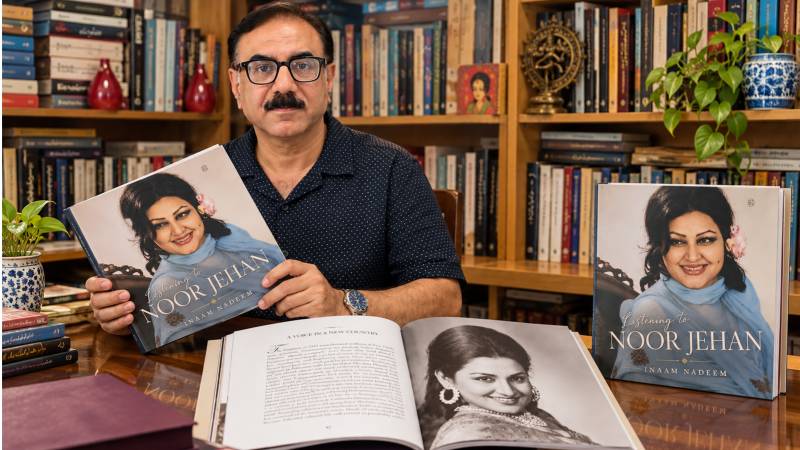
Noor Jehan would have turned one hundred this September. A century is a long time in the life of an artist. Long enough for empires to disappear, cities to change beyond recognition, technologies to become obsolete, and artistic fashions to rise and fade. Cinema itself travelled from black and white to colour, from celluloid to digital screens. Recorded music moved from gramophone records to radio, cassette tapes, compact discs and, eventually, to a world in which a voice recorded seventy years ago can reach us instantly through a phone. And yet some voices seem to have a different relationship with time. They grow old without quite becoming part of the past. Noor Jehan's has always been such a voice for me.
I cannot remember the first time I heard her. Perhaps that is true of the voices that become deeply embedded in our lives. They do not arrive on a particular day. They seem to have always been there. Growing up, Noor Jehan was somewhere in the surrounding soundscape: on the radio, in films, at weddings, on television, on records and cassettes playing in people's homes. Years later, the same songs began to mean different things.
A melody I had enjoyed as a child would suddenly reveal the sadness of a line. A Punjabi song would stop me with its uninhibited playfulness. In a ghazal, a single word would make me listen again. I became fascinated by the way a voice of such power could suddenly become intimate, almost fragile, or how the same singer could inhabit longing, mischief, heartbreak, desire and solitude through the slightest alteration of tone. Somewhere along the way, I stopped merely liking Noor Jehan and began listening to her. That distinction eventually became the beginning of a book.
We have no shortage of superlatives for Noor Jehan. She was Malika-e-Tarannum, the Queen of Melody. She was one of the great singing stars of the subcontinent, an icon of Pakistani cinema and, for several generations, a cultural institution. All of that is true. But declarations of greatness can sometimes prevent us from asking the more interesting question: what actually made the voice great? It was certainly a magnificent natural instrument. There was range, resonance and extraordinary control. There was rigorous musical training and an exceptional command of language and pronunciation. But those qualities alone do not explain Noor Jehan.
What continues to fascinate me is her ability to transform singing into emotional inhabitation. A pause before a word, the extension of a final syllable, the sudden softening of the voice, the decision to let a breath remain audible, or the confidence with which she opened a note could alter the emotional meaning of an entire line. She did not merely sing that a woman was in love. Her voice could tell you whether that woman was confessing love, concealing it, surrendering to it, teasing her beloved, fearing abandonment, or discovering that love had already become loss. At her best, the distance between singer and song almost disappeared. You stopped hearing a beautiful voice and began hearing a human condition.
I became fascinated by the way a voice of such power could suddenly become intimate, almost fragile, or how the same singer could inhabit longing, mischief, heartbreak, desire and solitude through the slightest alteration of tone.
Noor Jehan's career is difficult to contain within a single artistic identity because she lived several artistic lives. There was the child performer, Baby Noor Jehan, for whom music and performance became a profession almost before childhood was over. Then came the dazzling screen presence of the 1940s, when the actress and the singing voice still belonged to the same body. By the time of films such as Khandaan, Anmol Ghadi and Jugnu, she had become one of the major stars of the subcontinent.
Partition cut through that career. She left behind an established film industry and came to a newly created Pakistan whose cinema was still searching for its institutions, resources and identity. Yet migration did not end her artistic life. It transformed it. She acted, sang, directed, and became intimately connected with the development of Pakistani cinema. Then came another remarkable transformation. When Noor Jehan withdrew from acting, what might have looked like a retreat became an expansion. The actress left the screen, and the voice was liberated from her own face.
As a playback singer, she could now become many women. She could inhabit different actresses, characters, ages and emotional worlds. The refinement of her Urdu singing could give way to an entirely different physicality in Punjabi. As her voice matured, its texture changed, but instead of resisting that change she turned it into another expressive resource.
She survived changing musical fashions partly because she knew how to change without ceasing to sound like herself. Her voice also travelled beyond cinema. During the 1965 war, the songs she sang for radio became part of Pakistan's collective memory. The film singer had become, for a moment, a national voice. Yet one image of Noor Jehan means more to me than many images of stardom: the celebrated Malika-e-Tarannum sitting before Ustad Bade Ghulam Ali Khan as a disciple. There is something profound in that image. The world had already declared her a master, but before music she could still be a student.
Books do not always begin when we write their first sentence. Some begin years earlier as an obsession, a question, a memory. Listening to Noor Jehan was such a book for me. I did not want to write a conventional biography. The events of Noor Jehan's life mattered, of course, but a chronological journey from birth to death could not answer the question that had brought me to her: how does a voice acquire a life that extends beyond the life of the person to whom it belonged?
Writing the book required me to return to songs I thought I knew. But a fan listens differently from a writer. A fan can stop at pleasure. A writer has to ask why that pleasure occurs. Why does this line affect me? Why is this word different when Noor Jehan sings it? Why does she open her voice fully here and reduce it almost to a whisper a moment later? Why does the Noor Jehan of a Punjabi film song seem different from the Noor Jehan of an Urdu ghazal, while remaining unmistakably the same artist?
Working on an illustrated book also meant learning to see Noor Jehan again. The photographs ceased to be decoration. They became another narrative: the child performer, the luminous film star, the woman in the recording studio, the public icon, the ageing artist. Together they revealed not a frozen legend but a person moving through time. During my research, a few words written by Noor Jehan herself stayed with me. In an old autograph, she wrote:
"Sur Ishwar hai, yehi saathi hai, aisa jis ne mujhe kabhi dhoka nahin diya." Music is divine. It is the one companion that has never betrayed me. For someone whose life contained extraordinary fame, relationships, separations, public scrutiny, triumph and disappointment, those words seem almost autobiographical. People came and went. Times changed. Cinema changed. Her body aged and her voice acquired the marks of age. The sur remained.
Noor Jehan's centenary inevitably invites remembrance. But "remembering" has always seemed slightly inadequate to me in her case. We do not merely remember Noor Jehan. We still listen to her. The distinction matters. Memory usually points towards something that has passed. Listening happens in the present. A recording may have been made seventy years ago, but when the voice reaches our ears, it becomes present again. Technology alone cannot explain this survival. The world's archives contain millions of preserved voices that nobody listens to. There is a difference between a recording surviving and a voice remaining alive.
A pause before a word, the extension of a final syllable, the sudden softening of the voice, the decision to let a breath remain audible, or the confidence with which she opened a note could alter the emotional meaning of an entire line.
Noor Jehan's voice remains alive because something within it continues to escape its original historical moment. Technologies become obsolete. Musical fashions change. Stardom fades. But longing does not become obsolete. Neither do desire, separation, loneliness, mischief, grief or hope. When an artist succeeds in giving those emotions a convincing human form, the work acquires the ability to travel beyond its time. This, perhaps, is why I find it moving to imagine a young listener encountering Noor Jehan today for the first time on a digital platform. They may know nothing about the film, the composer or the year in which the song was recorded. They may not know the histories that surround it. They simply hear a voice. And if something in that voice makes them stop, if a word makes them listen again, if one song leads them to search for another, then the distance of a hundred years suddenly becomes irrelevant.
When I finally held the published copy of Listening to Noor Jehan in my hands, the moment contained more than the satisfaction of seeing another book completed. Somewhere within it was the child who had grown up with this voice in the background, never imagining that one day he would spend years trying to understand why it had stayed with him. The book is finished. The listening is not. A century has passed since Noor Jehan was born. The child performer became an actress, the actress a star, the migrant an artist of a new nation, the screen singer a playback legend, and the woman eventually became a memory. But through all those transformations, one thing kept travelling. The voice. And somewhere, right now, Noor Jehan is singing again. A century later, we are still listening.