

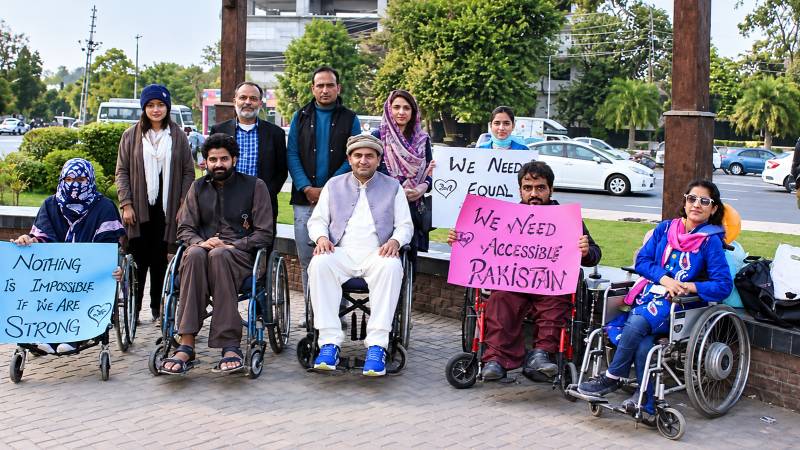
A student using a wheelchair reaches his school but cannot enter because there is no ramp for him to get up the stairs. Every day, he must wait for someone: a family member, teacher or fellow student so that he can get to his classroom. The obstacle is not his wheelchair. It is the building. A visually impaired person faces a similar barrier while performing the most mundane tasks: reading a sign, completing a form, navigating a website. Yet these difficulties are often treated as a consequence of disability rather than a systemic failure of inclusive practices.
According to Pakistan’s 2023 Census, more than 7.4 million Pakistanis are officially recorded as having a disability. Yet disability in Pakistan is still largely treated as an individual problem rather than a failure of public design. Pakistan has inaccessible workplaces, public transport, parks and educational institutions. Creating barriers for people with disabilities. Our challenge is not simply to support them, but to provide an environment where they are treated as equal members of society.
Accessibility extends beyond just ramps. Physical accessibility includes access to sidewalks, toilets, bus services. Whereas educational accessibility includes inclusive classrooms, trained teachers, and assistive technologies. Without these basics, access to everything, from university degrees to jobs, is placed out of reach.
Excluding millions of individuals from the workforce is not only a social issue rather it poses a significant economic loss as well. When workplaces, public transportation and vocational training are inaccessible it increases the number of dependents in the economy and prevents national productivity from reaching its true potential. Integrating disabled individuals into the economy increases household incomes and reduces public welfare costs.
Accessibility is not an act of charity but a fundamental right; Pakistan must dismantle physical, digital and social barriers through inclusive infrastructure, accessible education, equal employment opportunities, and the effective enforcement of disability rights to ensure that every person can participate in society with independence, dignity and equality.
Barriers are not limited towards the physical world, however. In this rapidly evolving world technology is taking centerstage with new innovations changing the way we do everyday tasks. Much of the world is moving towards digital accessibility. Yet Pakistan still lacks websites which cater to the needs of the disabled. Banking, schooling and job applications are all moving online, so this gap is going crowd out an already overlooked part of society.
Behind all of these obstacles lies something less visible: attitude. Society often views disability with pity rather than equality. There is often a certain stigma attached with disability that reduces an individual’s chances of employment or limiting educational opportunities before a person has even had the chance to demonstrate how capable they are. A ramp may remove a physical barrier, but changing attitudes removes a social one.
Designing societies for accessibility makes them more usable for everyone. Accessible sidewalks can help parents with strollers; clear signs can assist people with disabilities as well as visitors unfamiliar with a building. Captioned videos help people who are deaf or hard of hearing, as well as anyone watching without sound. Accessible public transportation benefits elderly people and those with temporary injuries. Inclusive schools benefit everyone.
Realising these benefits will require access on several fronts. We need to challenge stereotypes, represent people with disabilities in the media and public life, and include people with disabilities when designing policies and public places. Governments should enforce accessibility standards in new buildings and public transport, schools should be equipped to welcome every child, and employers should commit to fair hiring. Public awareness campaigns, accessible design training for architects, and assistive technology in every school would be strong places to start.
Pakistan already has legislative framework, such as the Rights of Persons with Disabilities Act, yet a persistent gap remains between policy formulation and actual on ground implementation. Existing building codes and quotas often remain unenforced due to lack of accountability. To bridge this divide, legal directives must be paired with strict compliance monitoring and penalties for non-compliance.
Ultimately, this comes down to a simple principle. A person should not have to depend on others to enter a school, board a bus, use a bathroom, or apply for a job. A disability should not determine how much a person can contribute to society. This is about equality, independence, and dignity—not charity. A truly accessible Pakistan will not be one where people with disabilities are simply accommodated, but one where they never have to ask for permission to participate.