

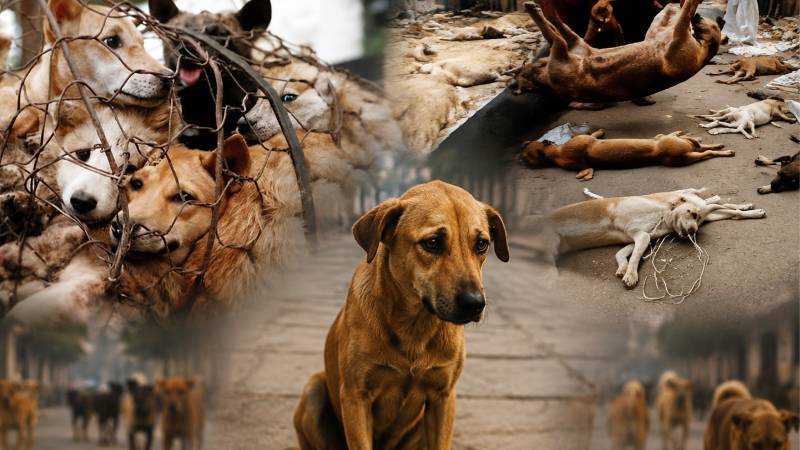
What is happening to stray dogs across Pakistan is not only an animal-welfare issue; it is a question of ethics, public health, and who we choose to protect. It is time that we, as a society, speak about a bitter truth we can no longer ignore: the cruelty currently being inflicted on stray dogs. For years, the killing of stray dogs has been used as a measure to respond to concerns about public safety. But as our understanding of public health and animal welfare evolves, should our methods of population control not evolve with it?
A renewed Municipal Corporation Lahore (MCL) campaign against stray dogs in May 2026 led to allegations from animal-welfare activists that dogs were being poisoned and killed through other inhumane methods in several parts of Lahore. The campaign also led to allegations that activists were detained and subjected to legal action. However, MCL officials rejected these allegations and maintained that the operations were being conducted in accordance with the law and public-safety requirements. This controversy was not confined to one campaign in Lahore.Rather This issue continues to generate, with recent reports again questioning whether culling addresses the underlying problem or merely repeats the cycle. The question, therefore, is not simply whether stray dogs pose a danger, but whether the methods being used to address that danger are actually proving to be effective and necessary.
This statement was made by Karachi Mayor Murtaza Wahab: “Emphasising the democratic will, Mr Wahab said he believes that ‘the will of all the people must be considered,’ adding, ‘a handful of individuals cannot be given supremacy over everyone else".The statement raises an uncomfortable question: when opposition to killing innocent animals is dismissed as the concern of a “handful of individuals,” whose voices are being considered and whose are being ignored?
The concerns surrounding stray dogs should not at all be dismissed. Dog attacks can cause serious injuries, and rabies is a genuine public-health threat.In Fact, According to the World Health Organization, dogs are responsible for the vast majority of human rabies transmission. However, WHO also states that dog destruction alone is not an effective method of rabies control.On the contrary,identifies mass dog vaccination as the most effective way to prevent the spread of canine rabies. WHO recommends achieving vaccination coverage of at least 70% of dogs in high-risk areas to interrupt transmission.
Could humane, evidence-based approaches such as mass vaccination, sterilisation, and responsible population management offer better alternatives to indiscriminate killing?
Consequently, if public safety is the justification for culling, then we must ask whether culling actually provides the safest and most effective solution. Could humane, evidence-based approaches such as mass vaccination, sterilisation, and responsible population management offer better alternatives to indiscriminate killing? In May 2026, the Islamabad High Court also moved against the poisoning, shooting, and indiscriminate killing of stray dogs and directed authorities towards more humane population-control measures.
The problem with relying on mass culling is that it does not address the underlying factors that lead to stray-dog populations to continue growing. Without sustained education, sterilisation, responsible waste management, and long-term population control, killing individual stray dogs does not provide a solution that stops production problems in the first place.We should consider more effective long term solutions such as TNVR(Trap-Neuter-Vaccinate-Release).
A 2024 Gallup & Gilani Pakistan survey found that 57% of Pakistanis supported the mass culling of stray dogs. This statistic reveals how readily fear can shape our response to vulnerable animals. Yet perhaps the most uncomfortable part of this debate is not what the authorities do, but what society is willing to accept. Therefore, the answer is not to ignore the people who have been bitten, attacked, or threatened by stray dogs. Their experiences are real, and governments do have a responsibility to protect them. But should protecting people come at the cost of abandoning evidence, compassion, or effective policy? If cruelty is our first response to fear, what does that say about the kind of society we are becoming?