

Every political organisation is born into a turbulent current of history, shaped not by utopian blueprints, but by the relentless tides of external forces and internal realities. No matter how visionary its founders and dedicated its workers, an organisation's life cycle—its birth, survival, growth, and endurance—is inextricably bound to the inescapable pressures of its time. When the Sindhi Awami Tehreek was founded in 1970, it did not step onto an ideal, neutral ground; instead, it entered a living, breathing arena already defined by heavy structural challenges. Just as a ship must navigate oceanic twists and turns, political leadership cannot escape the elements—it must steer through them. The following dispatch details the external and internal influences that forged the organisational culture and radical politics of the 1970s, charting how the Awami Tehreek plotted its course and sustained its struggle amidst these defining conditions.
- The External Horizon
The Russian Spark: Theory, Class, and Conscience
The Russian Revolution and Marxist-Leninist ideology transformed global politics by demonstrating that working-class movements could dismantle imperialist regimes and establish alternative socioeconomic models, inspiring colonised nations worldwide to launch national liberation struggles. Within colonial India, progressive intellectuals and organisations like the Communist Party of India introduced class consciousness, turning the freedom struggle from an elite nationalist endeavour into a mass-based social awakening focused on agrarian reform and social justice. Following independence, leftist thought emerged in Pakistan as a vital force championing provincial autonomy, workers' rights, and equitable development.
During the 1960s and 1970s, Marxist literature in Sindh sparked a vibrant cultural renaissance, serving as an intellectual engine for social awakening and political resistance. This movement redefined the struggles of peasants, labourers, and suppressed sections of society. Rasool Bakhsh Palijo, as the leader of the Awami Tehreek, contributed deeply to leftist thought through insightful essays analysing the Russian Revolution and international communist movements. Notable works include his essay Azeem Socialist October Inqlab Babat (About the Great Socialist October Revolution), in which he examined the socio-political conditions of pre-revolutionary Russia and highlighted the pivotal role of the Communist Party in leading and sustaining the October Revolution. In Almi Communist Tehreek Jo Masaila (Challenges of the World Communist Movement), he thoughtfully evaluated the diverse conditions and contradictions within various nations, critically examining how different communist parties managed or mismanaged these challenges. Additionally, his essay Trotsky Ji Inqlab Dushmani Kh’an Khabardari (Beware of Trotsky's Hostility to the Revolution) offered a detailed perspective on revolutionary theory and strategy. Through these writings, Palijo enriched regional political discourse by grounding global socialist history in local intellectual and progressive movements.
Poetry and prose evolved into vital mediums of communication, moving away from abstract romanticism toward grounded realism, while literary icons and progressive platforms utilised verse and prose to champion linguistic rights and inspire deep grassroots mobilisation across rural and urban areas.
The Chinese Revolution and Maoism provided a transformative strategic blueprint for South Asia, demonstrating how peasant-led agrarian movements could successfully challenge feudal elites and foreign dominance
Within Sindh, Marxist-Leninist and Maoist ideas fused naturally with Sindh’s nationalism, empowering popular initiatives like the Hari Tehreek to challenge traditional landlord power structures. The progressive movement drew deep inspiration from these revolutionary principles, adapting them to champion Sindh’s rights while mobilising rural women and youth to build a resilient resistance network. Rejecting orthodox federal models, this political current uniquely linked class struggle with linguistic and provincial rights, shaping Sindh's vanguard role in mass resistance against military dictatorships and fostering a vibrant political culture centred on equity, democracy, and social progress.
Strategic learning from this progressive vision led to the founding of specialised grassroots wings, including the Sindhi Hari Tehreek, Sindhi Shagird Tehreek, Sindhiani Tehreek, and Sujag Bar Tehreek. Modelled closely on Marxist-Leninist-Maoist organisational structures, these bodies successfully institutionalised political education, decentralised activism, and community welfare. This structured approach cultivated a disciplined, self-reliant cadre system that deeply embedded progressive values, democratic consciousness, and civic resilience across every tier of Sindhi society.
The Red Blueprint: Maoism and the Sindhi Synthesis
The Chinese Revolution and Maoism provided a transformative strategic blueprint for South Asia, demonstrating how peasant-led agrarian movements could successfully challenge feudal elites and foreign dominance. This approach inspired regional factions to adopt guerrilla tactics and mass mobilisation, driving a profound ideological evolution across communist movements. In India, Maoist principles directly shaped the 1967 Naxalbari uprising by introducing protracted people's war strategies. By mobilising landless peasants and tribal communities against feudal exploitation, this movement forged a persistent left-wing insurgency within Indian politics. Similarly, in Pakistan, Maoist and Chinese revolutionary thought equipped progressive groups with powerful analytical frameworks to examine the central state's military and bureaucratic structure.
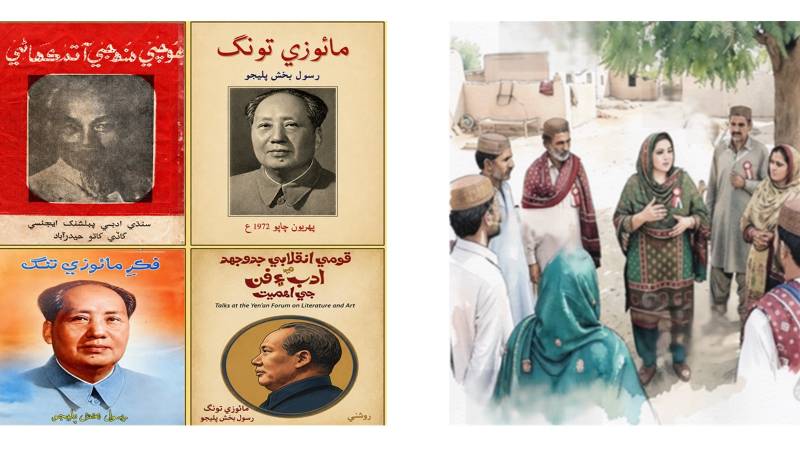
However, in Sindh, under the leadership of Rasool Bakhsh Palijo, the Awami Tehreek creatively synthesised Maoist and Marxist-Leninist theories with Sindhi nationalism. In 1972, Palijo authored Mao Zedong, a compelling biography of Mao written in the Sindhi language. Beyond exploring Mao’s personal life and political evolution, the book highlights how Mao became an inspiring leader by adapting Marxist theory to a rural, peasant society and mastering guerrilla warfare. In addition, the book reveals how Mao unified a fractured nation, mobilised the masses through the Long March, and established China as a sovereign global power, though it touched less upon his ideological zeal and utopian campaigns like the Great Leap Forward and the Cultural Revolution.
The Awami Tehreek deployed the Maoist framework of dual oppression to target both centralised state neo-colonialism and indigenous feudal elites. This ideology directly fuelled the party's radical agrarian strategy through the Hari Tehreek, effectively mobilising landless peasants against traditional wadhera structures and building a resilient, cadre-driven resistance network across the countryside.
The party actively engaged educated youth and urban working people, dispatching them to work directly as a Kul-Waqti-Karkun (full-timer/whole-timer worker) with rural communities to tackle pressing village issues such as water, land, education, women’s rights, and youth opportunities. To make political knowledge and culture widely accessible, they utilised low-cost Sindhi books, dramas, and street theatre. Within this strategic perspective, Palijo translated Mao's foundational lectures, "Talks at the Yenan Forum on Literature and Art," published in Sindhi under the title Qomi Anqlab Men Adab Aen Fun Ji Ahmiyat. In this translated booklet, Palijo highlights Mao’s expectation for writers and artists to firmly take the stand of the proletariat, thoroughly remould their petty-bourgeois feelings by living among the people, and create accessible art that serves the revolutionary struggle by exposing the enemy and uniting the masses.
Likewise, in his translated book Fiqir-e-Mao Zedong, Palijo explores selected topics to show how Mao regarded Marxism-Leninism as the essential scientific guide for revolution and cultural work. Mao insisted that writers and artists study it seriously and apply its principles to actual social conditions, maintaining that literature and art are never neutral, but must serve workers, peasants, and soldiers rather than the elite. Palijo explains that Mao viewed culture as a powerful weapon to educate and unite the people, driving social progress and liberation forward.
The movement sparked vibrant grassroots cultural mobilisation and advanced women's emancipation through the vital organising work of the Sindhiani Tehreek. Guided by the Maoist emphasis on the mass line and popular resistance, the party played a vanguard role in the Movement for the Restoration of Democracy. Ultimately, this synthesis ensured that the struggle for Sindhi national rights remained inextricably bound to a rigorous, anti-feudal class struggle. Through it all, Rasool Bakhsh Palijo earned renown among his peers as a true devotee of Mao’s ideas, moving close associates like Siraj Memon to affectionately call him "Mini-Mao."
Cold War Realities: Navigating Global Chessboards
Superpower competition during the Cold War deeply shaped South Asia, positioning the region as a theatre of strategic alignment. India maintained strategic autonomy through the Non-Aligned Movement (NAM), securing diverse global support to strengthen its national foundation. Pakistan pursued a pro-Western foreign policy via CENTO and SEATO pacts, acquiring resources for national development while fostering domestic resilience amid complex security landscapes.
These international dynamics profoundly conditioned progressive and nationalist movements across Pakistan, including Sindh, Balochistan, and the NWFP. Within Sindh, leftist organisations like the Awami Tehreek utilised this geopolitical backdrop to champion anti-imperialist principles and advocate for indigenous rights. Rather than adopting orthodox external models, Rasool Bakhsh Palijo strategically navigated Cold War politics by formulating a localised Marxist-Leninist-Maoist synthesis. Championing a fiercely independent platform, he channelled global anti-colonial sentiments into grassroots mobilisation against feudal exploitation and central state centralisation, protecting the party's ideological purity and building a resilient base rooted in Sindh's cultural realities.
The Anti-Colonial Echo: Rejecting Internal Hegemony
Anti-colonial movements worldwide profoundly shaped Asian struggles for national and class liberation, forcing complex debates over identity and economic exploitation. In Pakistan, however, the state inherited a powerful, highly centralised bureaucratic and military apparatus from the British Raj. Compounded by frequent military interventions dominated by a single federal unit and a foundation of religion-based nationalism, this institutional legacy systematically suppressed indigenous Sindhi, Baloch, Pashtun, Punjabi, and former Bengali identities, creating a hostile terrain for progressive politics in Sindh.
Compounding these domestic inequalities, the civil-military elite aligned the young state closely with Western imperial powers. It was within this suffocating political climate that the Awami Tehreek forged a tripartite stance: addressing the national question, liberating exploited rural masses, and maintaining a staunchly anti-imperialist posture inspired by anti-colonial resistance across Africa, South Asia, and Southeast Asia. In an interview published in Awaz magazine (Karachi, February 1979), party leadership praised the heroic struggle of the Vietnam Liberation Front, highlighting its unified leadership, profound sacrifices, and clarity of purpose. Rasool Bakhsh Palijo translated Ho Chi Minh's autobiography into Sindhi under the title Hochi Minh Ji Atam Katha (published by the Sindhi Adabi Publishing Agency, Hyderabad: 1972, 1975, 1982). This translated work celebrated the Vietnamese people's relentless resistance against first French occupation and later American imperialism.
An examination of the early literature of the Sindhi Awami Tehreek reveals how this Vietnamese anti-colonial solidarity fundamentally shaped the party’s organisational culture, tactical approaches, and spirit of sacrifice. Grounding its platform on three core pillars—the destruction of feudalism (wadherashahi), the redistribution of unequal land, and resistance against an over-centralised Pakistani state—the Awami Tehreek argued that traditional colonialism did not end in 1947. Instead, British imperial structures were simply inherited and repurposed by domestic feudal elites and a centralised military-bureaucratic hegemony, a systemic reality the movement defined as internal colonialism.
- The Internal Arena
Peasant and Labour Struggles: Dismantling the Wadhera
British land-revenue systems commercialised agriculture, leaving the rural population impoverished and heavily indebted. Historically, anti-colonial political movements relied heavily on rural mobilisation, which eventually sparked intense debates over land reform, spurred militant trade unionism, and led to the formation of peasant organisations. In Pakistan—and particularly in Sindh—politics remained tightly bound to the dominance of powerful landlords, known as wadheras.
Although the historic Sindh Hari Committee had already blazed a trail, the ongoing urgency of the peasant question across South Asia compelled the Awami Tehreek to launch a dedicated agricultural wing: the Sindhi Hari Tehreek. This new front forged its entire political identity around a steadfast anti-feudal and anti-imperialist struggle. In packed general gatherings, the leaders of the Sindhi Hari Tehreek delivered stirring speeches demanding the equitable distribution of agricultural water rights, challenging state-backed landlord hegemony, and fiercely opposing the illicit allocation of lands to retired military officers and industrialists.
State Repression & Military Rule: The Crucible of Resistance
Pakistan’s recurring military dictatorships are deeply rooted in the viceregal system of the British Raj, which systematically prioritised executive fiat and military dominance over legislative accountability. State security doctrines were engineered around maintaining internal control, treating political dissent as an existential threat. Consequently, leftist and democratic movements—including the Awami Tehreek, the National Awami Party (NAP), and the Movement for the Restoration of Democracy (MRD)—bore the brunt of intense state repression, martial laws, and targeted crackdowns. These groups rightly framed their resistance against the dictatorships of Ayub Khan, Yahya Khan, and Zia-ul-Haq as an ongoing war against the survival of colonial-style authoritarian governance.
Throughout these repressive eras, progressive leaders faced relentless persecution. Rasool Bakhsh Palijo, a towering figure of the leftist movement, spent a cumulative 10 years, 4 months, and 5 days behind bars across multiple detentions spanning from his first arrest in 1969 to his final arrest in 2001. His longest and most punishing imprisonment began in 1979 under General Zia-ul-Haq's martial law, keeping him incarcerated for 6 years and 6 months. These sweeping arrests crippled the momentum of popular movements and saw political workers rounded up in droves, plunging the country into one of the darkest and most desolate chapters in Pakistan's modern history.
Student, Literary & Cultural Movements: Awakening the Conscience
Modern educational institutions in India, established during the British era—such as the early universities in Calcutta, Bombay, and Madras—gradually evolved into vibrant centres for anti-colonial nationalism. Supported by progressive political organisations and writers' associations, student bodies became active guardians of secularism, anti-imperialism, and social justice.
Following independence, student organisations in Pakistan played a pivotal role in campus activism, championing democratic freedoms and challenging military regimes. Despite facing severe state suppression, including imprisonment and torture, students remained resilient. The historic Bengali student and language movement of 1948 set a powerful precedent, fiercely defending linguistic rights and laying the groundwork for regional resistance against state-imposed cultural hegemony.
Throughout the 1960s, student groups like the National Students Federation (NSF) in Karachi led inspiring grassroots struggles, mobilising youth against rising tuition fees, inadequate campus facilities, and administrative overreach. These early campaigns built strong solidarity among students, laying vital groundwork for broader civic and political resistance. This momentum culminated on the 4th of March 1967, when students in Hyderabad launched a movement against the excessive interference of Hyderabad Division Commissioner Masroor Hasan. This popular mobilisation successfully laid the groundwork for the broader Anti-One Unit Movement.
Visionary leaders like Rasool Bux Palijo provided crucial support by securing bails for arrested students and authoring influential pamphlets under the pen name of student leader Muhammad Yousif Laghari. Imprisoned alongside students in the Central Jail of Hyderabad, Palijo transformed his time inside into an opportunity for political education, connecting daily campus activism with deep political consciousness. This exchange of ideas significantly shaped the foundational ideology of the Sindhi Awami Tehreek in its formative years.
Prior to these political milestones, the Sindh Adabi Sangat played a transformative role in shaping Sindhi nationalism. Celebrating the Sindhi language and cultural heritage, the organisation fostered a powerful sense of civic pride and gave communities a unified identity. Vital spaces for grassroots discussions on language rights emerged, inspiring widespread community engagement.
Building upon this cultural foundation, the 1970s witnessed the rise of vibrant cultural events. Organisers launched "Sindhi Sham" to promote Sindhi culture, while communities celebrated "Latif Day" (Jashan-e-Latif) across academic institutions, towns, and major villages. These gatherings galvanised society, providing constructive avenues for cultural expression and democratic solidarity. For the Sindhi Awami Tehreek and similar movements, these cultural celebrations served as effective platforms to connect with followers, share their vision, and foster positive civic participation.
Blending Marxist-Leninist and Maoist frameworks with Sindhi nationalism, leaders like Rasool Bakhsh Palijo constructed practical tools to challenge internal feudal control and centralised state authority. This specific fusion bridges urban and rural divides, translating anti-imperialist concepts into grassroots organising through the Hari Tehreek, Sindhiani Tehreek, and student networks. Ultimately, the movement indicates that political endurance requires maintaining intellectual engagement with global liberation struggles while committing daily effort to the cultural and economic interests of working communities.
Looking forward, this legacy offers vital relevance for contemporary politics, charting a clear pathway where sustained grassroots activism meets modern democratic demands. By keeping alive the core ideals of equity, Sindh’s autonomy, and social justice, the struggle inspires future generations to adapt these timeless lessons to new horizons, proving that democratic resilience and popular mobilisation remain the true engines of lasting societal transformation.