

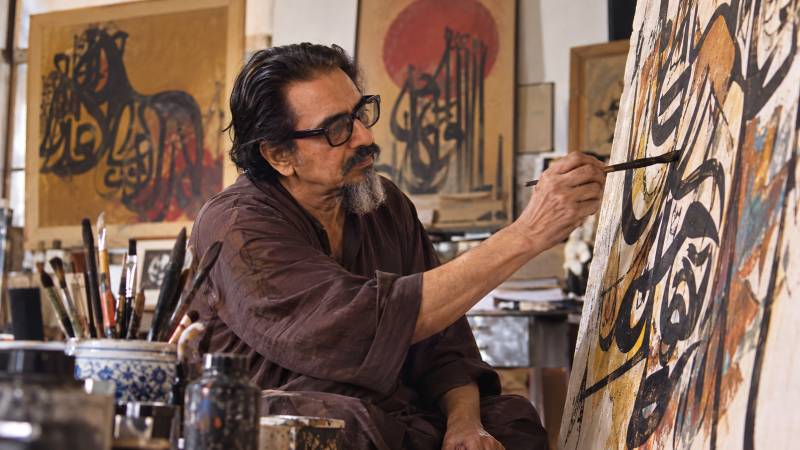
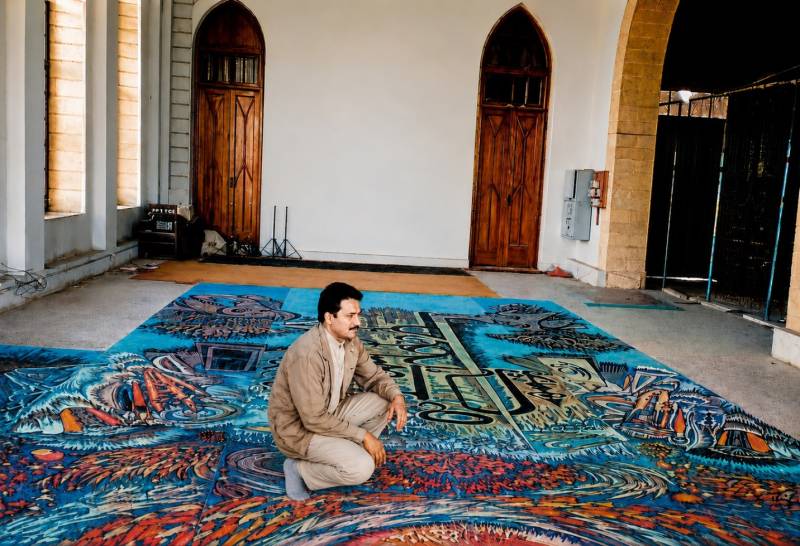
The author was granted the rare privilege by Sadequain of adding a few brushstrokes between the calligraphic forms—an honour I continue to regard as deeply special. The mural can still be seen on the vaulted ceiling of Frere Hall. There is something revealing about the way we write about great artists after they are gone. The artist leaves behind paintings, drawings, murals, calligraphy, poetry, friendships, conversations and memories. With time, another body of work accumulates around him: interpretation. Scholars construct theories through which the artist is viewed. This can illuminate, but it can also obscure.
Sadequain has increasingly been situated within calligraphic abstraction, postcolonial modernism, decolonisation and the relationship between Islamic calligraphy and modernist abstraction. Such inquiry can illuminate, but two questions remain: what did Sadequain himself think he was doing, and what was Sadequain actually like? I ask the second with some personal hesitation because I knew him—not as an art historian, critic or biographer, but as a young man fortunate enough to spend time in his company. I invariably came away richer from those encounters.
Conversation with Sadequain was never merely social. He had much to offer a mind genuinely thirsting for knowledge. His intellectual range was formidable: art, literature, religion, philosophy, human behaviour and society could enter the same conversation. He was remarkably well read, possessed great intellectual depth and had an equally commanding knowledge of religion, accompanied by an acute awareness of human frailty and, above all, empathy.
There was unusual openness. Ideas could be questioned, assertions challenged and arguments debated without causing offence. He could be unabashedly blunt, even in the presence of the powerful and privileged, and appeared unimpressed by rank or social consequence. Yet his bluntness was seldom discourteous. He could speak with startling candour while maintaining civility, disagree forcefully without becoming unpleasant, and challenge an argument without diminishing the person making it.
In his personal needs, Sadequain was an extraordinarily simple man. But there was nothing simple about his mind. He required remarkably little for himself and seemed consumed by creation. This austerity existed alongside artistic confidence, intellectual curiosity and cultural knowledge. The dimensions of the man extended far beyond the brush and pen.
He was also an extraordinarily giving man. That generosity drew around him not only genuine friends and admirers, but also those who understood the advantages of proximity to an artist of his stature. Some benefited from the reflected glow of his reputation, the access his company afforded and, at times, the generosity with which he gave away his own work. Many a collection in Pakistan remains testament to that largesse. Yet Sadequain seemed largely indifferent to such calculations, giving freely of his time, knowledge, companionship and art even when not everyone around him was motivated by affection, admiration or intellectual fellowship alone.
The answer is not theory at the expense of the person; it is balance. We should study Sadequain's art rigorously, but also listen to his own words, preserve the memories of those who encountered him, and allow his humour, austerity, generosity, spontaneity and humanity to coexist with the monumental artist.
One memory remains vivid. It was late 1984 or very early 1985. I was in medical school and had known Sadequain for some time through his admission to the Special Ward at JPMC. The devastating African famine was then at its height, particularly affecting Ethiopia, Sudan and Chad. Images of suffering produced in me a mixture of anguish, frustration and helplessness, out of which came an azad nazm ( a free verse poem) entitled “Afreeka Mat Ro” — “Africa, Do Not Cry.” Its lament was not simply about Africa. It was also about us: about the inadequacy of our response to suffering and the uncomfortable distance between professions of faith and indifference to human misery. Among its lines were:
میری بصیرت محدود ہے، میری سماعت اُس لاؤڈ اسپیکر تک محدود ہے
جو دن میں پانچ دفعہ چیختا ہے۔
My vision is limited; my hearing extends only as far as the loudspeaker that cries out five times a day. I believe it was in early 1985 when I visited Sadequain on the first floor of Frere Hall in Karachi, where he was camped and working on the Quranic verses from Surah Rahman mural, later installed on the ceiling. I told him about the poem and asked whether I might read it to him. He listened, and those particular lines immediately caught his imagination.
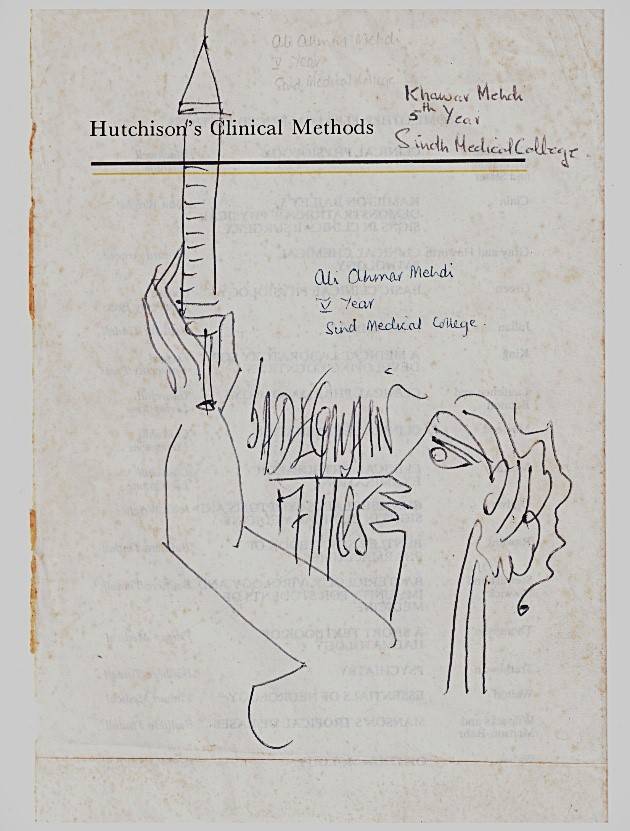
He instructed his assistant to arrange a plain white sheet on a drawing board. Then, in that unmistakable stentorian voice, he repeated the verses that had arrested him. The conversation suddenly became creation. With those distinctive bent fingers, Sadequain began to draw with the black broad tip marker. On one side emerged the African continent with two or three African faces staring directly ahead. On the other appeared a mosque, its minarets and a stern-faced mullah—perhaps more than one—wearing an amama and reciting the azaan while facing Africa. Between them he wrote the lines from the poem. The irony was clear: religion was audible; suffering remained distant.
Poetry had become drawing. A young man's lament about distant suffering had entered the imagination of a master artist and emerged transformed and made visible. He signed the drawing. I was mesmerised by the experience of watching my words take visual form before my eyes. Then came the Sadequain whom no theoretical vocabulary can quite capture. He looked at the finished work, a mischievous glint appeared in his eyes, and he said:
“Khawar Mian. Log mera andaz-e-drawing pehchantay hain aur dastkhat bhee mera hee hay. Shair yaqeenan apka hay magar log tou mera hee samjhain gey.”
People recognise my style of drawing, he was telling me, and the signature is mine too. The verse is certainly yours—but people will assume that is mine as well. The solemnity of Africa, famine, religion and human suffering dissolved momentarily into laughter. So much of Sadequain was contained in that encounter: the artist who instantly recognised the visual possibilities within an idea; the informed man for whom religious imagery carried layers of meaning and contradiction; the empathy that allowed distant suffering to matter to him; the intellectual freedom to engage critically with the world; and finally, the wit—the refusal to become imprisoned inside his own greatness. That Sadequain is harder to discover through terminology and scholarship alone. Alas, the drawing is no more in my possession.
The scholar seeks categories. Modernism, abstraction, postcoloniality and decolonisation may all have explanatory value. But interpretation must remain the servant of understanding. There is a difference between placing an artist within history and making an artist serve one's theory of history. When the framework becomes more prominent than the person and the work, something essential begins to disappear.
Sadequain painted, drew, wrote poetry and experimented with script, responding freely to whatever stirred his imagination—religion and mythology, society and nature, beauty and pleasure, loneliness and suffering, humour and the absurdities of human behaviour. He could be profound without being solemn and serious without taking either himself or life too seriously. There was a distinctly laissez-faire quality about him: he enjoyed the beauty and pleasures around him even as he remained sensitive to suffering and the human condition. Scholarship must guard against becoming so elaborate—or so earnest—that this spontaneity and vitality recede from view.
The cactus at Gadani offers a simple example: where scholarship may analyse abstraction and the transformation of natural forms into script, Sadequain simply saw in the cactus forms that suggested the essence of calligraphy. Perhaps that is what personal acquaintance adds to scholarship. It does not invalidate interpretation; it restores proportion. The Sadequain I encountered combined intellectual depth with an easy humanity: deeply conversant with religion yet alert to hypocrisy, fearless before the powerful yet unfailingly civil, appreciative of beauty and life’s pleasures, and still capable of puncturing his own stature with wit and mischief.
Great artists inevitably become historical subjects, and scholars will continue to interpret them. That is necessary and valuable. But the answer is not theory at the expense of the person; it is balance. We should study Sadequain's art rigorously, but also listen to his own words, preserve the memories of those who encountered him, and allow his humour, austerity, generosity, spontaneity and humanity to coexist with the monumental artist. Only then does the tapestry become complete.
Sadequain was not merely a practitioner of calligraphic abstraction or a representative of postcolonial modernity. He was a man of remarkably modest personal needs and enormous intellectual resources; deeply conversant with art, literature and religion; capable of empathy, irony, argument, laughter, pleasure and intellectual generosity.
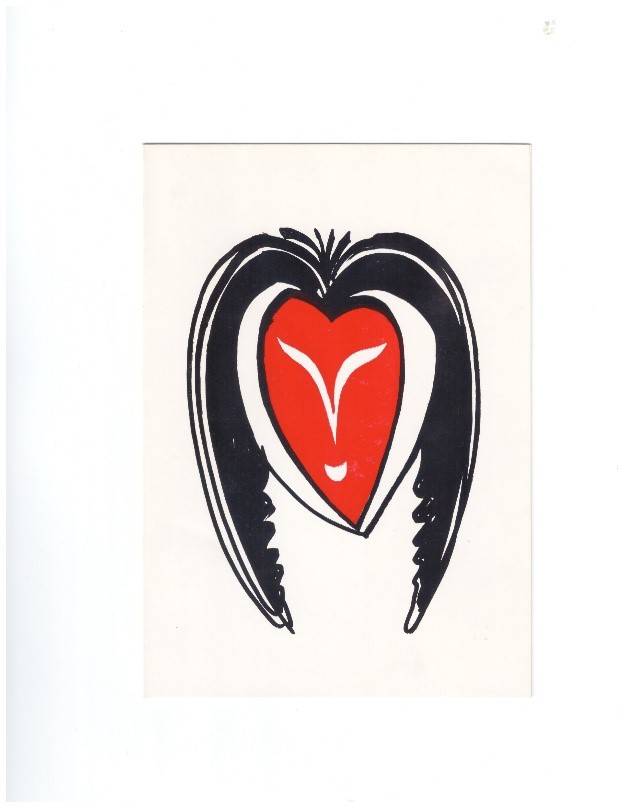
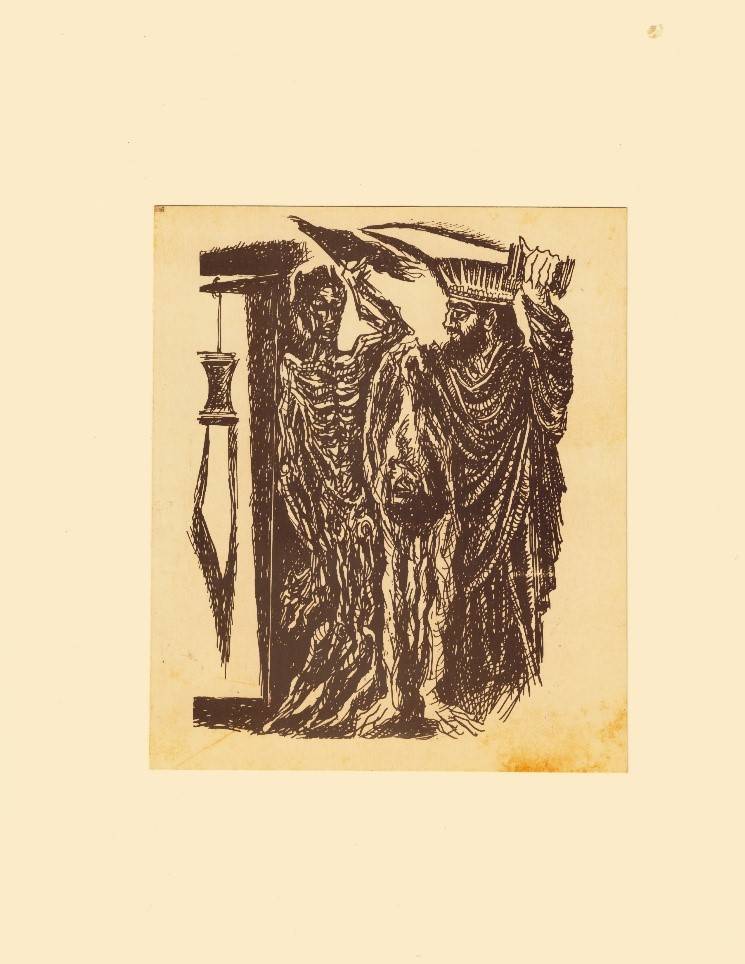
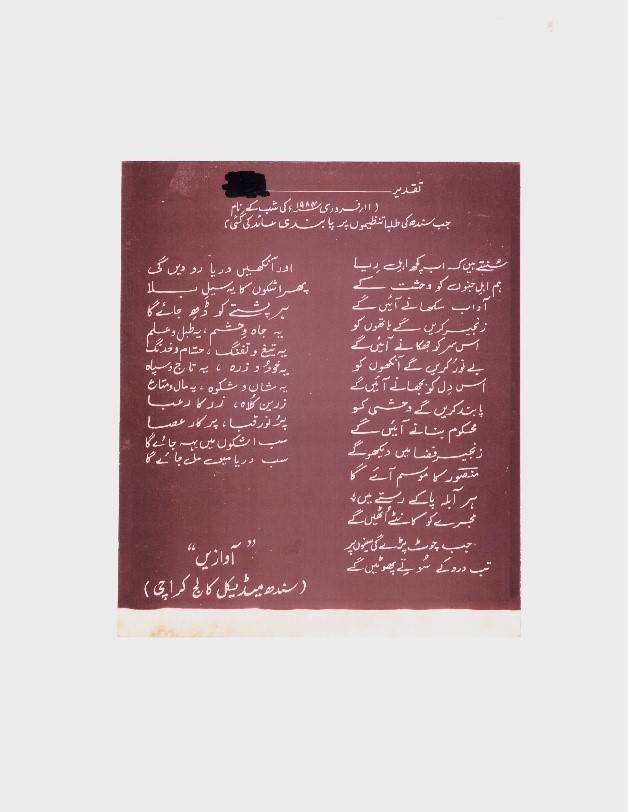
Awazain (Voices) handbill to commemorate the ban on student unions in Pakistan- Sadequain gave me permission to use his painting image for the handbill. On front is the image and a poem on back.