

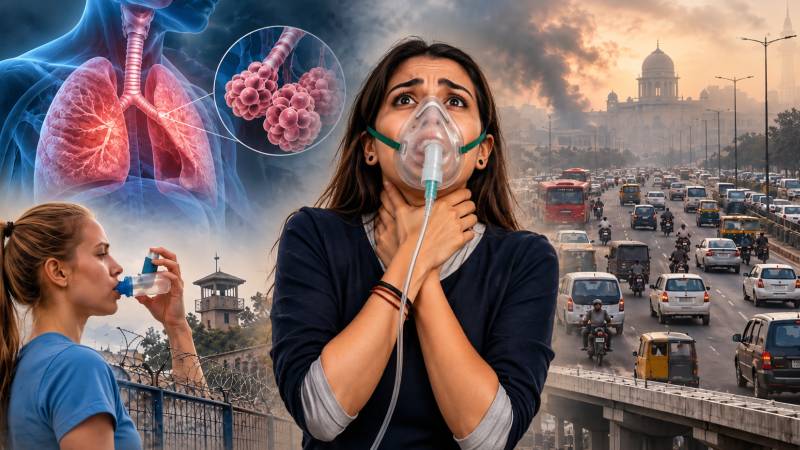
The congestion in my chest is symbolic of the congestion of my space in society. I was diagnosed with asthma when I was in Grade 7, and my mother forbade me from mentioning the name of the disease in front of anyone. I started to wonder: how could my individual problem be an issue for others? When I was strictly asked to keep it confidential, my curiosity to learn more about asthma increased. In science class, we learned about respiratory disorders, and the details of each disorder ended with a line saying that it could be fatal if not properly taken care of.
As a child, this gave me serious anxiety but also a strange fascination with early death. Whenever I had severe asthma attacks, I'd think, It's about time... But eventually, life taught me one thing: “Death isn't so easily attainable.” By the time I reached college, I had experienced too much to worry about it anymore. Well... one doesn't die but lives miserably. That's the caveat of these times and spaces. They don't kill you; they just make your space congested enough to choke you. The barricades on city roads, the fencing around private land, the electric wires around homes, the high-security entrances in military residential areas, and the guards at the entrance gates of each department at my university, making sure that students from one department don't step into another, are all signs of a diseased system.
Insecurity no longer lies with the state alone; every person feels threatened by another. The gated enclaves reflect a deeper social distrust rooted in a highly individualistic society. I try to speak, but my voice is strained. My airways are clogged, just as highways are blocked to ease the mobility of the political elite in my city. My chest wheezes as bikes and cars honk because of their proximity to one another. The noise of traffic irritates me, just as the noise of my nebuliser irritates my sister. She rebukes me when I turn on my nebuliser in the morning, again in the afternoon, and then at night before bed.
It doesn't provide instant relief anymore; however, it prevents me from feeling guilty about not taking proper care of myself. In fact, it has become a metaphor for my impotence as I watch the so-called Beautification of Punjab. Is the state really more concerned about my mobility than my health when it spends more of its budget on the construction of flyovers than on hospitals? The pavements remain broken, although there are more pedestrians in the city than car drivers. Yet, new roads, flyovers and underpasses remain the main focus of the city's development. Those pristine structures now look more dignified than an ordinary person in society.
My beloved city now suffocates me because a parking plaza has been allowed to take precedence over its historic public park. The trees that were cut down were no less alive than I am. The despondency I experience does not belong solely to me; my city experiences it too when it is stripped of its breathing system. However, we both look appealing from afar.