

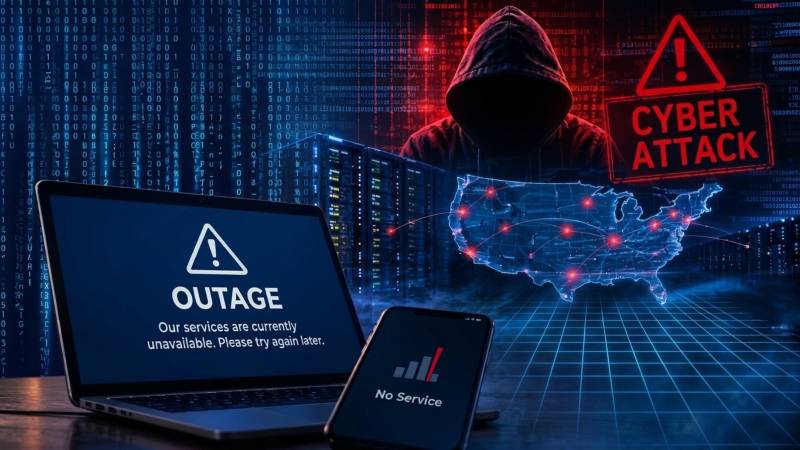
Recently, a string of technology failures stoked fears of a cyber-attack in the US and beyond, while private companies and the government insisted that there had been no cyber attack. Officials are probably right. While there is hope that such incidents will not recur in other countries, outages of services will not happen again. Cybersecurity is nonetheless considered a “serious” national security issue. Less discussed are the intricacies and downstream effects of the cyber-domain’s features. What the recent incidents have made clear is that the traditional distinction between civilian and military interactions in cyberspace is outdated.
Cyberattacks and tech outages are two sides of the same coin. Both affect user and consumer confidence in services, and ultimately, the state. Cybersecurity shapes the psychological sense of safety individuals and groups possess. Lawmakers and government officials should realize this and work within a holistic framework of security. Citizens look for upkeep of services, but also explanations and assurance that services will be restored. There should be credible, routinized procedures for disclosing what the governments can reveal, it's level of confidence and what to expect.
Between November 12th and 17th 2026 a series of tech failures took place. First, Microsoft’s suite of services including Outlook, Teams and Sharepoint went dark across the world, affecting manufacturers, banks, and even courts. The US-based provider restored service on the Friday the 13th, after identifying the defect was linked to a network upgrade. The same afternoon, the Federal Aviation Administration grounded departing flight in the country for nearly five hours – the longest stop since 9/11, over 18,000 flights were cancelled. Transportation Secretary Sean Duffy traced the problem to a router made by Juniper Networks, and installed by L3Harris which overloaded air traffic control networks. Although Hewlett Packard Enterprise, which owns Juniper disputed the statement, saying the device worked as programmed. Outages at the aviation giant United Airlines and bank JP Morgan Chase followed. Next one of the United States’ government’s top intelligence authorities, the NSA’s internal network, NSA Net was affected, Director of National Intelligence Jay Clayton linked the outage to patching a critical PHP vulnerability.
The official explanation seemed to shift. On the night of the ground stop Homeland Secretary Markwayne Mullin said there was no indication of an attack but ruled nothing out, while Transportation Secretary Sean Duffy raised a $50 billion funding request to Congress to modernize the air traffic control system. Three days later, Mullin said he was 98 percent certain there was no cyberattack, and a tech insider told him that “super-intelligence” was overwhelming old systems. Director Clayton said at a congressional hearing, “they are not a coordinated or state-sponsored attack.” He said the scramble to patch PHP flaws which AI agents found last month lead to downstream effects on other services.
On November 17th PBS Newshour led with a story on technological outages, Geoff Bennett said “The incidences are said to be unrelated, but their timing has fueled concern about whether something more is at work.” On the same program cybersecurity analyst Eric O’Neill said investigators “can’t be confident at all” that intrusions weren’t the case, adding that “right now we have 53 percent more cyberattacks than this time last year.”
These events have left the public and government officials wondering. Even staunch Trump allies accused the administration of lying to Americans about the true causes of the outages. Online, Americans processed the events through memes - one joked about an advent calendar but for tech failures. A crystallization of popular sentiment: the outages have the public guessing about reliability and safety of national systems.
The Promethean Gap
In sociology and international relations ontological security refers to the ephemeral sense of safety derived from belonging and routine. Individuals feel safe when they can continue in their life without worries that their day-to-day will be disrupted. This ties into psychological needs for shelter, food and social contact. Familiarity with the processes and entities, make individuals and interactions feel secure. This week the United States collectively found that cybersecurity is tied to ontological security.
Ontological insecurity therefore refers to unmet needs regarding routinization, or lack of confidence in interactions. How does a society feel unsafe in the cyber realm? When software and services they expect to work do not. Add to these worried phone calls from family members, uncertainty regarding when flights may resume and a lack of clarity on the root cause, and perceptions of insecurity abound.
Today’s routines run on code and processes which are essentially opaque to the layperson. German Philosopher Gunther Anders called this the Promethean Gap: a titanic gulf between what we can build and what we understand. Paying rent, purchasing tickets, and ordering lunch now pass through large software systems, generated by millions of lines of code, separated by a galaxy infrastructure from the user’s end experience. When a banking app goes down, the user is left wondering whether it has to do with internet service provider, an outdated app, the bank’s own service infrastructure or a foreign actor. The gap is partly involuntary, a matter of expertise required to fully understand end-to-end technology services. It is also partly deliberate, the result of propriety systems and disclosure protocols of companies and government entities. The net effect is that from the outside, cyberattacks are virtually indistinguishable from service outages.
The resemblance is hardly coincidental. Attacks and accidents travel through the same systems and produce similar symptoms: errors messages, timeouts, broken services, and system failures. In 2024, when a faulty patch pushed live by the cybersecurity firm CrowdStrike affected millions of Windows machines, grounding flights, disrupting hospitals and banks. For hours it was indistinguishable from an attack, until the firm voluntarily disclosed the cause. The same year, a botched update cut off telecom provider AT&T’s service across the country, prompting investigation from the FBI and the Department of Homeland Security before the company tracked down the cause as an internal error. In 2023, the FAA’s nationwide ground stop turned out to be the work of contractor errors. When Cloudflare suffered a global outage in November last year, even its own engineers first suspected an attack. The real cause was determined to be a faulty configuration file. The ambiguity runs both ways, Stuxnet one of the first sophisticated cyberweapons, was deliberately designed to make the damage it did look like equipment failure.
Nor do the outages occur in a vacuum, and the public has been primed by a history of publicly attributed cyberattacks. As far back as 2014, North Korean hackers targeted Sony Pictures, over release of The Interview, showcasing the political nature of cyber-attacks. The Colonial Pipeline ransomware attack in 2021 led to fuel shortages in parts of the American South. In October this year, French supermarkets across the country experienced cyberattacks raising temperatures on freezers. In November, a similar trend repeated in at least seven European countries, pushing freezers to 50 degrees Celsius and forcing grocery stores to dump inventory. EU food commissioner Christophe Hansen called the supermarket attacks, “a deliberate attempt to disrupt” the blocs food supply.
We can no longer pretend the cyberdomain is separate and what happens therein does not translate to so called real life. Some have argued that cyberattacks do not threaten ontological security because they are hard to observe and do not create long-lasting scars on the collective consciousness. I disagree, though admittedly this may have been the case when cyberattacks were narrower. The Office of Personnel Management Hack exposed millions of government records, and prompted a government-wide “Cybersprint” , but barely touched most American’s daily lives. Grocery scarcity, fuel shortages and grounded flights are noticed.
Attacks and accidents travel through the same systems and produce similar symptoms: error messages, timeouts, broken services and system failures, making it increasingly difficult for ordinary citizens to distinguish between malicious intrusions and technical breakdowns.
Every time a service is provided without a hitch, it strengthens the feeling that things are alright. However, it takes little time for this sense to fall apart because users notice failures far more than successes. The erosion of trust can magnify other problems. Logistics is a business of tight deadlines and precision, as the supply chain crises during the Covid-19 pandemic showed. In a panic delays can mean shortages and the effects may ripple through the economy. If adversaries were to go after critical infrastructure, such as hospitals or water treatment, then entire cities could see deprivation of key services. By getting ahead of failures, making processes more transparent and building credibility with the public, governments can sustain the sense of security it all rests on.
The cyber domain is also strategically clandestine space, home to statecraft’s oldest repertoire: espionage and secret interactions. States have a vested interest in keeping their activity secret, to protect their assets, mislead enemies and preserve confidence of the public. This secrecy naturally gives rise to anxiety and conspiratorial thinking.
Adversaries are aware of this. The US government has accused Chinese state hackers including the group Volt Typhoon with prepositioning inside United States’ critical infrastructure, and former CISA director Jen Easterly warned such operations aim to “induce societal panic.” Psychological effects are a familiar tool. Russian influence operations have likewise sought to undermine confidence in institutions. To achieve meaningful effects, an adversary does not need to attack a service outright, only to create the impression of vulnerability. A real attack becomes virtually indistinguishable between a series of technology failures. And failures which are not explained clearly, can end up assisting adversaries.
At their base, a tech outage and cyberattack are both failures of services. Tech outages are public by nature, experienced as not being able to reach information, complete a task or use a service. Cyberattacks can pursue private ends, such as sabotage or information theft, but their public face is usually the same denial of service and can sap public confidence. So, the reasons for staying quiet about the former, look very much like reasons for staying quiet about the latter: embarrassment, liability or reluctance to admit vulnerability.
Committing cyberattacks carries costs, and capable adversaries are more likely to spend hard-earned access for tactical or strategic advantage rather than to pester. That is one reason that last week’s failures were probably accidents. Still, a desperate state on the backfoot, eager to show it can impose costs, might do exactly this.
If a real attack did occur, would the public be told? I believe the answer centers on the costs of disclosure, and the calculus of how these costs come out of material factors such as money, or immaterial factors such as legitimacy. Three considerations stand out:
First, does mitigating harm rely on the public? If stopping damage requires citizens to act in a certain way, the disclosure may come fast. This can be likened to advisories on water, requests to not pull money from banks for fear of insolvency. If the harm is confined entirely to government systems, the pressure to disclose is weaker. Even here the problem is two-faced, because officials can ask the public to act without saying why. A utility company can announce technical issues witThird, the objective of the attack and the cost of naming them. Attribution of attacks in cyber- is slow, and iterative. Operators piece together technical details of an intrusion which can help reveal motive and connect it to known modus operandi. Once the scope of the attack is determined and attribution made, announcing is a political matter. There are legitimate reasons for silence: disclosure can expose vulnerability or tip off an attacker. But the same logic covers service outages. Governments and companies will naturally be reluctant expose their blunders or suggest their systems are insecure but may do so if they feel their can benefit from popular support.
Second is the level of exposure, and whether the damage can be fixed quietly. Time matters, the longer a service stays down the more distrust grows. States and companies with greater cybercapability; human and artificial intelligence resource may be able to patch vulnerabilities quickly before users can notice. The longer the wait, the greater the risk of whistleblowers and public consternation. How visible the fix is depending on how many people use the service and scope of the break.
Third, the objective of the attack and the cost of naming them. Attribution of attacks in cyber- is slow, and iterative. Operators piece together technical details of an intrusion which can help reveal motive and connect it to known modus operandi. Once the scope of the attack is determined and attribution made, announcing is a political matter. There are legitimate reasons for silence: disclosure can expose vulnerability or tip off an attacker. But the same logic covers service outages. Governments and companies will naturally be reluctant expose their blunders or suggest their systems are insecure but may do so if they feel their can benefit from popular support.
The Right to Know
Disclosure is a governance problem and a question of democratic accountability. Both, the government and private firms have parts to play in accountability and providing ontological security. Norms on cybersecurity governance are still unsettled, and the companies that run critical services largely defend themselves. US firms have considerable leeway to affect this perception of security in the cyber domain and companies such as Microsoft have taken positive steps. The government sets standards through the National Institute of Standards and Technology (NIST) and issues advisories through the Cybersecurity and Infrastructure Security Agency (CISA). Beyond this there should be disclosure rules in place, which tell citizens about the scope of the problem, and what to expect.
When hackers stole $6.3 billion from cryptocurrency exchange Binance in October, the company assured users that their money was safe. Washington moved quickly as well. The FBI attributed the attacks to the North Korean Trader Traitor group and authorities worked with partners including stablecoin issuers Tether and Circle to freeze over $2.7 billion. The Justice Department was authorized to seize or restrain $1.2 billion in stolen assets. The saga shows a possible division of labor: companies fix and reassure, while governments attribute and intervene. The recent outages have had no such clarity. This is the gap to close.
Things will break, government responses can help the public understand and modulate. The overall goal is to build and maintain public trust. The government should work with private companies to share information which can be released and protect what cannot. Below are four recommendations:
One confident public-facing voice
After significant national disruptions, government representatives should summarily communicate to the public what they know, even if the answers are incomplete. The National Cyber Director, or CISA can help fulfill this role, using standard vocabulary on the level of confidence they have and whether malicious actors were involved, in easy-to-understand common parlance.
Least conflation and politicization
Incidence reporting should be treated like a public service announcement. Causes and findings of investigations should be kept separate from public debates on use of resources or conduct of representatives. Raising a funding request on the night of an outage invites speculation and garbles the message.
Public reviews and advisories
Major outages of critical services should get public reports. The Cyber Safety Review Board was built for this kind of work and could be revived to cover non-malicious failures. Critical sectors should have public advisories ready, “Here is what to do if your flight is grounded” or “we expect email to be restored within hours”. Messages should be crafted for businesses and the person staring at their banking app. Redundancies and fallbacks will help.
Disclosure duties for critical sectors
Public companies already disclose high profile incidents to investors. The government should recognize that email and banking services are critical service and should require public notices of failures and causes. It should also do more in helping businesses prepare for and recover from such incidents. The industry and government deploying AI to find and patch these vulnerabilities is a positive signal, but the public should be informed of these especially where service may be affected.
Joint determinations and pronouncements among the states, could make public confidence additive and harder to exploit. It goes without saying, greater cooperation and controls in the international sphere would reinforce this.