

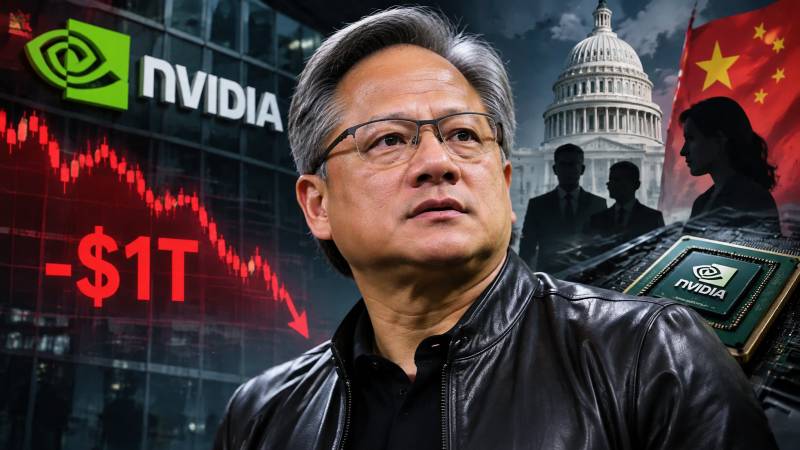
The ongoing controversy surrounding Jensen Huang, the celebrated co-founder and Chief Executive Officer (CEO) of Nvidia, offers a sobering lesson about the intersection of personal conduct, corporate governance, national security and financial markets. What began with revelations about the personal relationships of one of the world's most influential business leaders has escalated into a corporate crisis involving allegations of foreign intelligence activity, concerns about the possible compromise of sensitive technology, congressional scrutiny and extraordinary volatility in the company's stock.
At the centre of this controversy is Jensen Huang, whose extraordinary entrepreneurial achievements have made him one of the most influential figures in the global technology industry. His leadership helped transform Nvidia from a graphics-chip manufacturer into a company central to the future of artificial intelligence. Yet the recent revelations demonstrate the risks inherent in concentrating so much corporate authority, influence and institutional knowledge in one individual.
Reports emerged that Huang had an intimate relationship with Alice Huang, a Chinese businesswoman and former executive associated with Megaspeed International, a Singapore-based company that purchased Nvidia's advanced processors. American intelligence authorities reportedly suspected that she was working on behalf of the Chinese government. These allegations raised concerns that Huang might have been targeted as part of a foreign intelligence operation.
Huang subsequently acknowledged that he had been unfaithful to his wife and apologised to his family and colleagues. The controversy intensified as further reports emerged concerning alleged relationships with Nvidia employees, including a senior executive who reportedly worked under him. These circumstances demand serious scrutiny. A chief executive responsible for a company whose products are considered strategically important to American economic and military interests cannot afford to underestimate the risks associated with personal relationships involving individuals connected to sensitive business transactions.
One of the fundamental questions raised by this episode is whether a corporate leader's private conduct should be treated as entirely separate from their professional responsibilities. Infidelity is generally a private moral matter. However, the distinction between private conduct and professional responsibility becomes less straightforward when personal relationships create conflicts of interest, expose confidential information, undermine workplace safeguards or introduce vulnerabilities that foreign intelligence agencies could exploit.
The reported relationships involving subordinates raise another ethical dimension. A CEO holds considerable authority over employees' careers, compensation and professional advancement. Even where a relationship is consensual, the imbalance of power raises questions about workplace fairness, conflicts of interest, retaliation and the integrity of internal reporting mechanisms. The issue, therefore, is not simply whether Huang was faithful to his wife. It is whether his personal decisions compromised the standards of conduct expected of someone entrusted with leading a strategically important corporation.
Perhaps the most serious dimension of the Nvidia controversy concerns national security. Advanced AI processors are no longer merely commercial products. They are strategic assets with applications in scientific research, economic competitiveness, intelligence gathering, military planning, surveillance and autonomous systems. Access to the most advanced processors can provide a country with a substantial technological advantage. The United States has consequently imposed restrictions on the export of certain advanced semiconductor products to China. Nvidia's board initially stated that it had no reason to believe that national security or company secrets had been compromised. That assurance must now be assessed in light of the findings of the ongoing investigations.
Another striking aspect of the Nvidia saga is the extent to which the company's fortunes have become associated with the personality and leadership of Jensen Huang. Huang is not merely Nvidia's CEO. He is its co-founder, public face, principal strategic communicator and one of the most influential advocates of artificial intelligence. His distinctive leadership style, technical understanding and ability to articulate Nvidia's vision have contributed significantly to the company's success.
Investors have come to associate his continued leadership with the company's future growth. His public statements can influence market expectations, government policy discussions and the confidence of business partners. This concentration of influence creates a serious governance problem. What happens when the individual most closely identified with a company's success becomes the source of its greatest reputational, legal or strategic uncertainty? The answer should be obvious: no company, however large, should be so dependent on one individual that it cannot function effectively without that person's continued leadership.
The events surrounding Huang's departure and subsequent reinstatement demonstrate the difficulty of separating a corporation's fortunes from those of its founder. Following his resignation on 12 November, Nvidia's board reinstated him on 24 November after conducting its review and receiving reported assurances concerning national security. This dramatic reversal itself illustrates the extraordinary influence Huang continues to exercise over the organisation.
The fundamental issue is not whether Jensen Huang is an exceptional entrepreneur or whether Nvidia can continue to prosper under his leadership. The issue is whether a corporation of such enormous economic and strategic importance has adequate safeguards to ensure that its future does not depend excessively on the conduct and judgment of one individual.
Perhaps the most extraordinary aspect of the controversy has been its impact on Nvidia's market valuation. Following the revelations and the uncertainty surrounding Huang's position, Nvidia shares experienced substantial volatility. At one point during the turmoil, the company's market capitalisation reportedly fell by approximately $1 trillion. Subsequent developments surrounding his departure and reinstatement triggered further dramatic fluctuations in its share price.
Such figures are difficult to comprehend. A personal controversy involving one individual can apparently influence the market valuation of a corporation by hundreds of billions of dollars, or even trillions. These developments demonstrate how closely financial markets have tied Nvidia's prospects to the reputation, judgement and continued leadership of its CEO.
The consequences of these developments are not confined to wealthy investors, hedge funds or technology entrepreneurs. Millions of ordinary people have indirect exposure to Nvidia through retirement accounts, pension funds, mutual funds, exchange-traded funds and broad stock-market indices. Nvidia's enormous market capitalisation gives it substantial weight in major market indices. Consequently, movements in its share price can influence the performance of investment portfolios, even when individual investors have never purchased Nvidia shares directly. A company that becomes sufficiently large can influence the financial well-being of people who have never consciously chosen to invest in it.
Today's stock market increasingly reflects the fortunes of a relatively small number of major technology corporations. Companies involved in artificial intelligence, semiconductor manufacturing, cloud computing and digital platforms have acquired market valuations that would have been almost unimaginable a generation ago. Their influence extends well beyond their respective industries. Because major stock indices assign substantial weight to the largest companies, a handful of technology stocks can materially affect the direction of the broader market.
This concentration creates several risks. The problem is compounded by the possibility that market valuations have become excessively dependent on expectations of future AI growth. If those expectations prove overly optimistic, the resulting correction could affect not only technology investors but also pension funds, retirement accounts and the wider economy. A financial system in which the decisions of a few individuals can produce enormous fluctuations in the wealth of millions deserves closer scrutiny. The responsibility for preventing such vulnerabilities cannot rest solely with chief executives. Corporate boards have a fundamental obligation to protect shareholders and ensure that management operates within appropriate ethical, legal and security boundaries. A board that allows a CEO to become effectively untouchable has failed in one of its most important responsibilities.
An organisation of Nvidia's strategic importance should have a capable leadership team able to maintain continuity regardless of what happens to its CEO. The reinstatement of Huang makes this issue even more important. The board's decision should not be interpreted as proof that all ethical, governance and security questions have been resolved. The company must demonstrate that its internal controls are strong enough to protect it against similar vulnerabilities in the future.
The Nvidia saga exposes a contradiction at the heart of modern capitalism. On the one hand, markets celebrate entrepreneurial vision, bold leadership and the ability of exceptional individuals to create extraordinary economic value. On the other hand, the concentration of so much influence in a single person can expose corporations, national security interests and millions of investors to risks that conventional governance arrangements may be unable to manage.
Business success cannot exempt a corporate leader from ethical responsibilities, institutional oversight or accountability. Nor should a company become so dependent on its founder that its board feels compelled to overlook serious concerns simply because investors fear the consequences of his departure. Ultimately, the lesson is that corporate governance, national security and financial stability are no longer separate subjects. In an economy increasingly dominated by strategically important technology companies, they are closely interconnected.
The Nvidia controversy should serve as a wake-up call for corporate America, financial regulators, national security agencies and investors. It demonstrates that the personal decisions of an extraordinarily powerful executive can have consequences extending far beyond the executive's family or workplace. They can raise questions about the security of strategic technology, destabilise a corporation's leadership, trigger enormous changes in market valuation and affect the retirement savings of millions of ordinary people. The fundamental issue is not whether Jensen Huang is an exceptional entrepreneur or whether Nvidia can continue to prosper under his leadership. The issue is whether a corporation of such enormous economic and strategic importance has adequate safeguards to ensure that its future does not depend excessively on the conduct and judgement of one individual.
The ultimate test of a great corporation is not simply how much wealth it creates or how innovative its products become. It is whether it can sustain its success through strong institutions, ethical leadership, effective oversight and responsible management. Jensen Huang helped build Nvidia into one of the most powerful companies in modern history. But the company must now demonstrate that it is bigger than the individual who built it. That is the real test of corporate maturity and a lesson that the entire technology industry would do well to learn.