

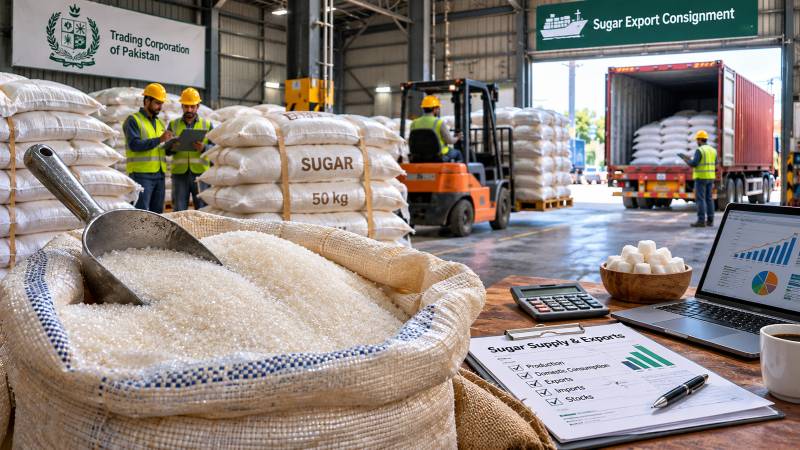
Pakistan has imported sugar to meet domestic requirements and is now preparing to export a substantial part of those imports. This unusual sequence raises serious questions about how the government forecasts production, assesses available stocks and coordinates decisions on exports and imports. It is not simply a matter of changing market conditions. It points to weaknesses in the planning and management of an essential commodity.
The figures presented by the government in Parliament tell the story. According to the Ministry of National Food Security and Research, domestic sugar consumption during the 2023-24 crop year was estimated at 6.4 million tonnes, while production was projected at 6.7 million tonnes. Adding 823,000 tonnes of carry-forward stocks brought total availability to approximately 7.6 million tonnes.
On the basis of this expected surplus, the government permitted exports in four phases: 150,000 tonnes in June 2024, 100,000 tonnes and 40,000 tonnes in August 2024, and another 500,000 tonnes in October 2024. The total export authorisation amounted to 790,000 tonnes. The proposal to export surplus sugar was initially considered by the Sugar Advisory Board in April 2024, under the Ministry of Industries and Production. In its parliamentary reply, the Ministry of National Food Security and Research explained that production in the following season was expected to increase because sugarcane cultivation had expanded by 1.2 per cent. However, heatwaves and crop disease affected the crop, and actual sugar production fell short of expectations by around one million tonnes.
This shortfall helps explain the subsequent pressure on domestic supply. However, it also raises an important question: were the assumptions behind the export decision sufficiently cautious, given the risks associated with agricultural production? As an economic analyst, my view is that the problem goes beyond an unexpected decline in sugar production. It reflects weaknesses in forecasting, coordination and the management of public-sector commodity operations. Agricultural risks are unavoidable, but government planning must take these risks into account before making decisions with significant consequences for consumers, producers and public finances.
The government subsequently turned to imports. According to the Ministry of Commerce, in its reply to a question in the National Assembly, the Trading Corporation of Pakistan (TCP), acting under decisions of the ECC, Federal Cabinet and Steering Committee on Sugar, imported 306,737 tonnes of sugar. As of August 31, 2026, TCP had incurred a total cost of Rs54.16 billion on these imports, including incidental charges and mark-up. The Ministry of Commerce reported that the corporation had sold 198,668.30 tonnes at a weighted average price of Rs168.24 per kilogram, while 108,069 tonnes remained in its warehouses. The Ministry also clarified that the 20 per cent customs duty had been waived.
To avoid a repeat of the 2024 decision, export permissions should be granted in phases and linked to independently verified surplus stocks. There should also be clear review triggers if production estimates decline or available stocks fall below agreed levels.
Importantly, the Ministry stated that it could not yet provide the net financial gain or loss because the disposal process had not been completed. The Rs54.16 billion should therefore be understood as the reported cost of the imports, not as a confirmed loss to the public exchequer. The matter took another turn when TCP issued an international tender on November 6, 2026, for the export of 108,000 tonnes of imported white refined sugar stored at its Pipri warehouse in Karachi. According to the tender document, the sugar was imported in 2025, and the Federal Government had authorised TCP to export it. The final financial outcome will depend on the price realised and the costs associated with procurement, financing, storage and disposal.
There are also wider concerns about the reliability of information used in sugar policy decisions. In December 2025, the National Assembly Standing Committee on Commerce reported that a subcommittee had identified misreporting of quantities, artificial shortages and inconsistencies in official records. The committee also pointed to weak monitoring and verification mechanisms. These findings make the case for stronger oversight and more reliable information even more compelling.
The government should use this experience to introduce a transparent and coordinated system for managing essential commodities. In the case of sugar, a comprehensive national supply and demand assessment should be prepared before every crushing season. It should cover opening stocks, expected production, domestic consumption, private and public inventories, and likely export or import requirements.
To avoid a repeat of the 2024 decision, export permissions should be granted in phases and linked to independently verified surplus stocks. There should also be clear review triggers if production estimates decline or available stocks fall below agreed levels. Crop estimates and stock positions should be updated regularly through a shared information system involving federal ministries, provincial governments, sugar mills and TCP.
Import decisions should similarly be based on a clearly established supply gap and verified inventories. Once a public-sector import or disposal operation is completed, the government should publish a financial review showing procurement costs, sale proceeds, storage and financing expenses, outstanding receivables and the final gain or loss to the public exchequer. Sugar is not an isolated case. It is a test of the government's ability to move from reactive crisis management to evidence-based planning. Better forecasting, coordination and accountability can help protect consumers, reduce avoidable costs and strengthen public confidence in government decisions.