

There is something quietly ambitious about designing a space intended to change the way people think. In a world where we have museums that invite visitors to look at objects, or corporate offices that are seeking to communicate efficiency and professionalism, MindLab asks its inhabitants to become more conscious of how they make decisions. Established within the Finance Department of the Government of Khyber Pakhtunkhwa, MindLab is Pakistan’s first behavioural insights unit for public policy.
Its identity, designed by Sahar Zafar, extends beyond a logo or a set of communication materials into the interior of the workplace itself. This results in an exercise in visual communication that considers how an institution presents itself along with how design influences the people who inhabit it.
Behavioural insights, in simple terms, concern the gap between how people are expected to behave and how they actually behave. The premise is that small interventions, in the way information is presented, can influence decisions without removing an individual's freedom of choice. For MindLab's visual identity, Sahar takes this premise seriously and makes design part of the institution's working methodology alongside its public face.
Sahar's design process began with familiar visual associations of the mind: brains, human profiles, fingerprints, pathways, and patterns. The selected identity moves away from literal illustration towards an abstract geometric symbol that indicates a maze and a modular system. This is an effective conceptual decision. A brain icon would have communicated the subject immediately but risked reducing behavioural science to a generic symbol of intelligence or cognition. The maze, by contrast, introduces uncertainty. It proposes that decisions are rarely as straightforward as they appear, and that the routes people take are shaped by habits and circumstances they may not always recognise.
MindLab introduces a different register through which civil servants can encounter their workplace
The geometry also offers practical advantages. It can function as an independent graphic element across signage, publications, digital communication, and other applications. The identity is not dependent on the logo alone; its visual language can expand into patterns, directional graphics, and environmental interventions. This flexibility is significant for an initiative that must communicate across government departments and audiences unfamiliar with behavioural science.
Balancing Distinction and Institutional Integration
The colour palette establishes another productive relationship between institutional continuity and visual distinction. Government green, drawn from the identity of Khyber Pakhtunkhwa's government, and yellow, associated with the SEED programme under which the unit was established. The palette avoids the temptation to make the unit look entirely detached from the bureaucracy it seeks to influence. Instead, it gives MindLab a recognisable identity while retaining its institutional affiliations. This balance matters: the project needs to be distinctive enough to suggest a different way of working, yet sufficiently integrated to be taken seriously within the existing administrative structure.
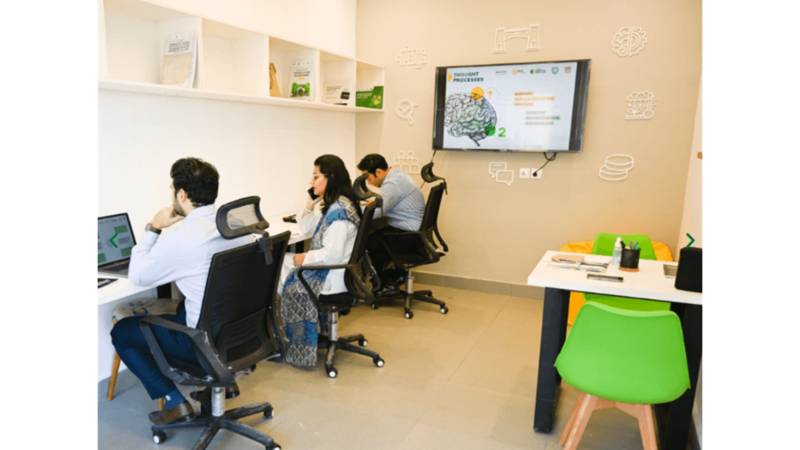
An interesting aspect of MindLab is the translation of this identity into physical space. The geometric language and colour system extend across the office through signage, murals, lighting, wayfinding, and three-dimensional iconography. Colour-coded pathways guide movement through corridors and stairways, while motivational prompts and a maze-inspired mural introduce behavioural cues into an otherwise conventional working environment.
Here, the identity begins to operate on two levels. It identifies the institution to outsiders and creates an environment in which its own principles are continually encountered by its staff. There is a smart approach. Government offices are often associated with rigid hierarchies, functional interiors, and forms of communication that prioritise instruction over intrigue. MindLab introduces a different register through which civil servants can encounter their workplace. Instead of reserving creativity for presentations or public campaigns, the project incorporates it into everyday movement.
Interventions and Local Context
MindLab's context makes this distinction particularly important. Khyber Pakhtunkhwa faces its own administrative, economic, and environmental challenges, and behavioural interventions must respond to the circumstances in which citizens encounter the state. The unit was developed through collaboration between the provincial government, SEED, and B4Development Foundation, Qatar's behavioural insights initiative. Its ambitions therefore sit at the intersection of local governance and internationally shared expertise.
One of its early experiments, conducted with the Khyber Pakhtunkhwa Revenue Authority, tested different combinations of text-message reminders and warnings among 18,087 registered service providers. The published study, Nudging Tax Filing Through Text Message Combinations: Evidence from Pakistan, is a useful qualification to the enthusiasm surrounding behavioural design. The interventions did not significantly improve filing rates on average compared with existing messages, although certain combinations improved compliance among particular groups, especially longer-registered taxpayers. Other groups responded differently.
This finding is worth considering alongside the visual identity. Both the experiment and the design recommend that small interventions can matter, but neither supports the assumption that a particular stimulus will produce a uniform response. Context matters. A message that encourages one person may discourage another. The value of behavioural insights lies in testing assumptions and remaining attentive to differences.
A Meaningful Measure of Success
MindLab shows how graphic design and interior design can work together to give an abstract institutional mission a tangible presence. The project is also a reminder of the fact that design within public institutions need not be limited to communicating authority. It can create space for alternative ways of thinking and make room for uncertainty within systems accustomed to established answers.
Therefore, MindLab's achievement is not that it makes a government office look different, although it certainly does. It is that the visual identity proposes a different relationship between the institution and its employees, and then between the employees and the decisions they make. Its most meaningful measure of success will be what happens after the prompts have been noticed: whether the people who encounter them begin to question not only the behaviour of others, but also the assumptions embedded in their own decisions.