

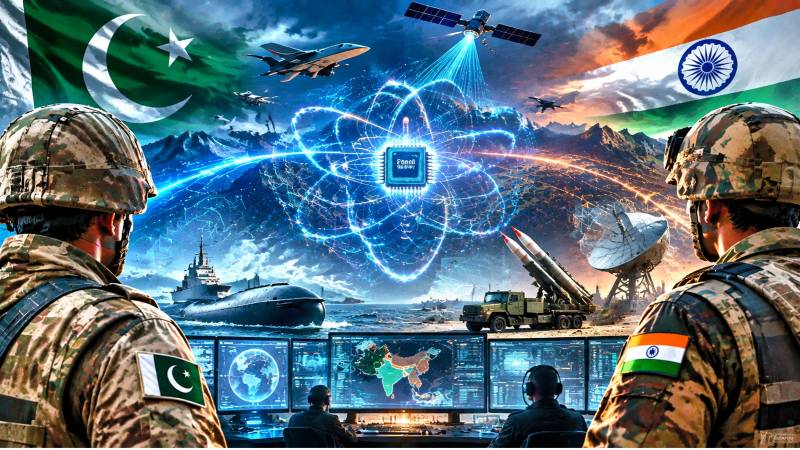
Let us consider a scenario involving India and Pakistan in which Pakistan’s military leadership can no longer be certain that its decisions have remained secret. Its encrypted communication channels may have been monitored for years from the other side of the border as part of India's new military framework based on quantum technologies. Nothing has happened; not a single shot has been fired yet. Both sides are making their plans while taking into account what their adversary might be capable of doing. This uncertainty stems from advancements in quantum technology.
The military is increasingly integrating quantum technologies, focusing on sensors, secure communications and cryptography to address challenges that conventional computing cannot adequately tackle. Quantum sensing is one of the key components of quantum technology. It detects atomic and subatomic interactions, such as gravity and magnetism, potentially undermining the effectiveness of stealth technologies. This shift could erode the advantages of submarines and stealth aircraft, altering nuclear deterrence and the dynamics of traditional warfare.
For Pakistan, the quantum threat is real. On January 22, 2026, India's former Chief of Defence Staff, General Anil Chauhan, formally released the Military Quantum Mission Policy Framework (MQMPF), thereby integrating quantum technologies into military planning, operational capabilities and doctrines. This framework aims to incorporate quantum technologies, including quantum communication, computing, sensors and materials, into military planning and operations across all three services. India's increasing investment in quantum technologies could significantly transform the security dynamics between India and Pakistan. However, many commentators in defence and security studies have described this development as the "beginning of a quantum arms race" between India and Pakistan. Nonetheless, this is a misconception, since a race requires two competitors, and Pakistan is significantly behind India. In 2023, India launched its National Quantum Mission (NQM), investing 6,003.65 crore rupees (approximately $750 million) in quantum technologies. In contrast, Pakistan launched its National Centre for Quantum Computing in 2024.
Nevertheless, many Pakistani analysts argue that the country substantially lags behind India in quantum computing research and development. Therefore, this is not a race but rather a gap, and the real danger does not lie in the gap itself but in how each side perceives it. New Delhi has consistently demonstrated its military and economic dominance over Islamabad. However, Pakistan developed nuclear weapons to ensure its survival and maintain peace in the region. Nuclear deterrence, in turn, depends heavily on a sophisticated nuclear command-and-control system whose encryption cannot easily be broken by conventional computers.
If encryption fails, early-warning systems, missile launch codes, and Pakistan’s second-strike retaliatory capabilities could be compromised.
However, India's growing capabilities in quantum technology pose significant challenges to Pakistan's nuclear command-and-control system. Quantum computing could potentially make it possible to break the encryption protecting nuclear command systems, including the control mechanisms designed to prevent unauthorised access to nuclear weapons. If encryption fails, early-warning systems, missile launch codes and Pakistan's second-strike retaliatory capabilities could be compromised, undermining the foundations of Pakistan's nuclear deterrence and creating a dilemma with serious consequences for national security. Furthermore, many states are concerned about the concept of "harvest now, decrypt later", which involves collecting encrypted data today with the intention of decrypting it in the future using advanced quantum computers. Pakistan's secure communications systems could therefore face risks from India's use of quantum computing under its National Quantum Mission.
Moreover, quantum sensing presents another unprecedented challenge in the military domain. India's advancements in quantum technology could threaten Pakistan's conventional military capabilities, including navigation, submarine stealth and surveillance. Pakistan uses submarines to enhance its second-strike capabilities against India, as these submarines could potentially be equipped with submarine-launched nuclear cruise missiles. Submarines remain hidden and difficult to detect. Their underwater stealth capabilities allow them to conduct reconnaissance missions and, in the case of nuclear-powered platforms, deploy both conventional weapons and ballistic missiles, providing them with the capability to carry out a third-wave attack. However, in the future, if India develops advanced quantum sensing capabilities, one of the primary advantages of submarine stealth could be diminished, as quantum sensors may be able to provide highly precise information about electric signals, magnetic anomalies and inertial navigation.
This quantum gap is particularly critical for Pakistan. If the gap continues to widen and one side continues to develop increasingly advanced technological systems, the consequences could be dire. Such an asymmetry in an already tension-ridden region is deeply alarming. Pakistan is not currently losing a quantum race, as no such race exists, but a gap does. At present, neither side possesses fully developed military applications based on these technologies. India may take years to integrate quantum technologies fully into its military apparatus. Pakistan must bridge this gap to reduce its vulnerabilities relative to India during times of crisis. Several recommendations have been put forward, including adopting a national encryption strategy that incorporates post-quantum cryptography (PQC), developing a funding roadmap, establishing laboratories within universities, training local experts and forming strategic alliances. This approach emphasises that quantum security is vital to deterrence, rather than focusing solely on defence spending in comparison with India.