

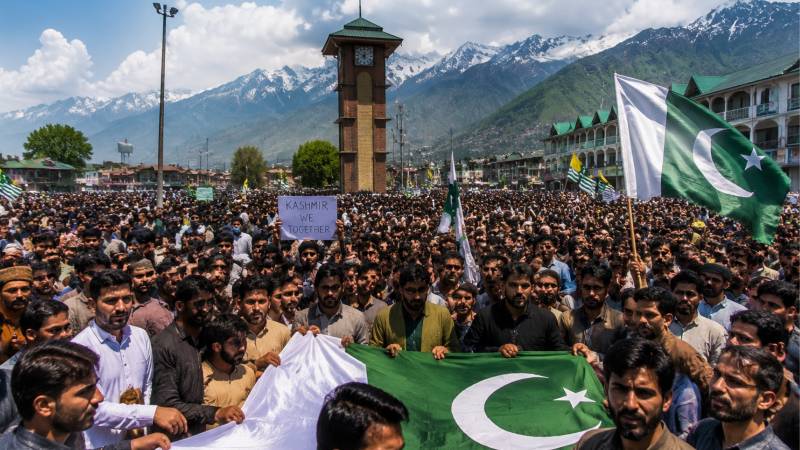
Frankly I have rarely paid much attention to this part of Pakistan. I come from Balochistan and KP and live in Islamabad. In 2005, I spent some time in AJK because of the horrible earthquake which destroyed many parts and took thousands of souls. I spent the better part of 3 years rebuilding this area. From my recollections of that time, when we crossed the Kohala bridge via Murree, or the Gendla and Kalliari bridges through Kotli Sattian there were no signs or posts which separated the ‘two countries. But the locals asked ‘which part of Pakistan was I from or had I come from Pakistan?’. The invisible but tangible line was crystal clear.
Since 1947 despite the disputed status Kashmir has in the federation of Pakistan, the state has chosen to invest resources disproportionately. Today we see and feel the resentment of the Kashmiris against the State of Pakistan, but let’s not forget there are grounds for the rest of Pakistan to resent Kashmir’s golden child status since 1947. In spite of the State’s subsidizing all aspects of life in Kashmir the local sentiments remain udhar aap idhaar hum.
Kashmir has the highest literacy approximately 78%; Pakistan proper has subsided this region in terms of its annual budget, practically free electricity and various other financial packages for generations. This has naturally created a local culture of complete dependence on the public sector. This is evident in the complete absence of industry of any kind in the three divisions, resultantly there is little commercial enterprise economic generation. It has been like indulging a beloved child without building any life skills.
There is no doubt that the Kashmiris of the valley in occupied Kashmir, have never wanted to be part of India, comparatively the Kashmiris of Muzaffrabad, Poonch and Mirpur were not hostile to Pakistan quite the contrary- but kept their separate identity quite clear. I believe we seemed to have forgotten that part.
There is no doubt that the Kashmiris of the valley in occupied Kashmir, have never wanted to be part of India, comparatively the Kashmiris of Muzaffarabad, Poonch and Mirpur were not hostile to Pakistan quite the contrary- but kept their separate identity quite clear.
Having created a dependent population many problematic behavioural patterns emerged. I witnessed in 2005 a population which was either incapable of self help or reluctant to work. This was even if it meant rebuilding their own lives and homes. . Astonishingly the majority of the work force in AJK was Pukhtun (some might have been Afghan) who had travelled from all corners of KP living in deplorable conditions but worked to the bone. There was no gratitude rather deep-seated resentment and racism amidst all the chaos of recovery and rebuilding. I remember very clearly being very amazed at this state of mind.
It has never left me that sense of entitlement of the Azad Kashmiris. All behavior is taught. The establishment led Pakistani state has (relatively) pampered and indulged this region for generations. Yes, it is a part that remains disputed and therefore needed to be kept in pristine and perfect condition; but it was also used and abused. Within Pakistan proper’s murky undemocratic shenanigans, the 12 muhajir seats in the AJK assembly have been the establishment’s mouth speak within. This has festered resentment. The Pakistani state’s disregard for perfunctorily democratic processes has also spilled over into the management of AJK. 2023 saw a ‘change in prime minister’ without elections which I believe tipped the changing attitudes towards AJK- Pakistan relations.
This resentment hasn’t emerged from a vacuum it has been building and festering with every slight, taking for granted and disrespect from ‘Pakistan proper. ’ The once diaspora more loyal than the king has had enough. They can question and demand more because they have learned abroad and from education that they can. This about turn is not something anyone should ignore. Especially those in charge of running Pakistan.
Unlike Balochistan and KP which have always had differences of perspectives on what constitutes the federating units of Pakistan; AJK has been in complete alignment with the establishment. No longer. Why? Disrespect and taking for granted your most obedient child will have consequences. The Kashmiri diaspora also lives in a society and environment that allows the idea of freedom, human rights, human dignity, voice and accountability as a legitimate norm. These feelings were inevitably going to trickle down to their ‘motherland’.
Add to these inconvenient ideas, in Pakistan proper the deteriorating economic conditions started the reduction of the subsidies in AJK- this was not welcome. Remember the inflation riots and devaluation protests across Pakistan were most pronounced in AJK. Urban educated centers, will always have more organized movements. And if they are pissed off legitimately or otherwise, we will hear of it more loudly and probably more effectively.
Who are these pesty Jammu Kashmir Joint Awami Action Committee (JAAC) wallas? Pmln ppp and until recently pti played the merry go around in this neighborhood. Are they an Indian funded movement or indigenous? Perhaps the Indians may have taken advantage of discontented sections of society in Kashmir, but why are they upset in the first place educated, better off than most of Pakistan, what do they have to complain about?
Why and how has this space been created for outside forces to win over local sentiments? The state must be doing something extremely wrong for large swathes of citizens to turn towards the enemy? Are citizens Pakistani proper or almost so fickle, that outside support is so easily accepted? What kind of people are the Kashmiris ( sairiki,balochis & pukhtuns ) who have no sense of national identity nor sense of loyalty towards a collective future?
Something to think about. What makes citizens so weak Or what perhaps makes weak citizens? The argument of the ungrateful leach sounds very similar to what we are told about the corrupt Baloch sardars as the cause of all woes of Balochistan. As an outsider I see Kashmiris unhappy, so much so they are willing to be killed on the streets. Fear of the hard state is not keeping them away. The diaspora will not forget this. How many of the 5 million are involved? I do not know and does it matter?