

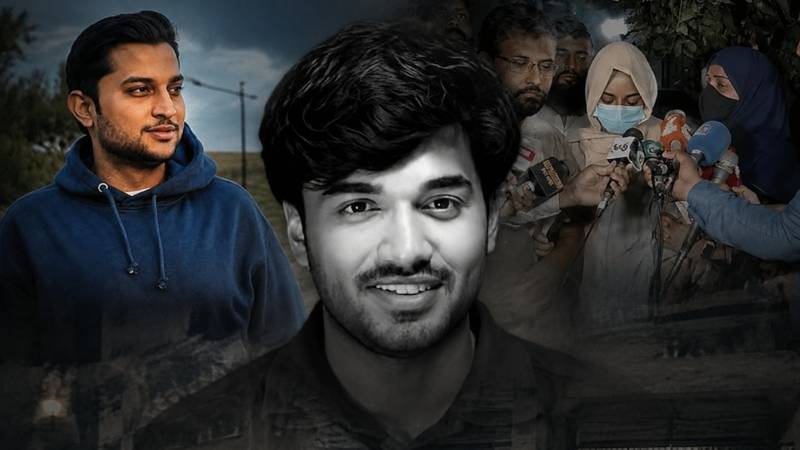
There are, it turns out, two efficient ways to close a murder in Karachi. You can shoot the men accused of committing it before any of them reaches a courtroom, or you can decide that the victim shot himself. This summer the city managed both, on two young men, within a fortnight of each other, and in each instance the machinery moved with a speed it never seems to find for the duller business of a trial.
Begin with Dr Akash Kumar, who was twenty-eight and had the particular misfortune of being useful, visible, and, on the morning of the fourteenth of July, carrying nothing that could save him. He was a house officer at Jinnah Postgraduate Medical Centre, the eldest of five siblings, unmarried, a doctor of the kind the country trains at great expense and then fails to keep alive. He had gone with his father to a bank near Teen Talwar to withdraw around two million rupees. Four men on two motorcycles intercepted the car in broad daylight. One of them reached the rear window and shot him. They took the envelope and were gone before he reached the hospital where, until that week, he had worked.
The outrage was immediate and, for once, effective. Doctors protested. The medical association issued its condemnations. The mayor arrived at the protest to offer condolences and a promise. The chief minister took notice, which in this country is a specific administrative event, rather like a signature. And the apparatus that is usually said not to exist suddenly existed. Investigators pulled footage from more than a hundred cameras, including the Safe City network we are periodically assured is watching over us, and within thirty-six hours three suspects were in custody, along with cash, weapons, and the reassuring vocabulary of a case being solved. Then the case was solved in the other sense.
Days later the three men, Suresh, Ram Chand and Anil, were taken by a police team to identify their alleged hideouts and accomplices. There, the police explained, armed men opened fire, and in the resulting exchange all three suspects were killed while an officer was conveniently wounded. A judicial magistrate, to his credit, asked the only question worth asking, which was how three men in police custody had managed to end up dead. He will not receive a satisfactory answer, because a satisfactory answer would have to come from the very people who would then need to be tried themselves.
Consider what died on that road with those three men. Their testimony died. The route to the other accomplices died, including a woman the police themselves admitted was still at large. Whatever they knew about who had planned the robbery, who had watched the doctor at the bank, where the two million went, all of it died with them, tidily, on a patch of ground far from any protest. Dr Akash's murder was not solved. It was closed. These are different words, and the distance between them is the entire subject of this column.
Now turn to Mir Raza Ali, who was twenty-five, an IBA graduate, and the owner of a small dessert brand called Wafflix that he had built with the earnest energy of a young man who believed the city would let him build something. On the night of the twenty-eighth of July he left home saying he would be back in ten minutes. He was not. His body was found the next day in the bushes near a wedding ground in Gulistan-e-Jauhar. Here the machinery selected its other setting. The first official story was suicide. A young man in financial difficulty, the account gently suggested, had taken his own life, and the file could be marked accordingly and set aside. It is a very clean story. It requires no suspects, no encounters, no inconvenient questions. It asks only one thing, which is that the family agree to it.
There are, it turns out, two efficient ways to close a murder in Karachi. You can shoot the men accused of committing it before any of them reaches a courtroom, or you can decide that the victim shot himself.
The family declined. His father and his lawyer insisted, against the entire drift of the investigation, that he had been abducted, tortured and killed. They pushed until the body was exhumed and examined a second time, by a board of eight doctors, and the second post-mortem said what the first had somehow failed to notice: a bullet that had entered through the upper right of his back and left through his chest, along with multiple injuries inflicted before death and the internal signs of a beating. Only then was the kidnapping case at Ferozabad police station quietly upgraded to murder. Only then did the province announce a judicial inquiry. The family's lawyer put the matter without decoration, saying the police had set out not to investigate the death but to humiliate, harass and exhaust the family until they let it go. That is the sentence to sit with. The exhaustion was not a by-product of the process. It was the process. A family was expected to tire, to accept the suicide, to bury the boy a second time, and to allow the file to close. They simply refused to be tired.
Set the two cases side by side and the pattern stops being subtle. In one, the state answered a murder by producing corpses. In the other, it answered a murder by producing a suicide. An encounter and a false suicide are the same administrative act performed from opposite ends. Both make the file vanish. Both foreclose the one slow, unglamorous, accountable thing that neither case was ever going to be permitted to reach: a trial, with evidence that can be tested, witnesses who can be questioned, and a verdict that can be recorded, appealed, and remembered. The system is not incapable of speed. It moved with real urgency. It simply aimed that urgency at closing the cases rather than at understanding them.
And notice what it took, in each instance, to move the machinery at all. A hundred cameras. A mayor at the protest. A chief minister's notice. A well-known rights lawyer. A trend on the internet. Justice in this city is not a standing institution so much as a kind of weather. It gathers when the public mood grows loud enough to summon it, and it evaporates the moment attention drifts elsewhere. For the young man who dies without an outraged crowd behind him, there is no mayor, no second post-mortem, no eight-member board. His file was closed correctly the first time, and nobody dug him up to check the spelling.
I want to resist flattening these two into a single grievance, because they are not identical. Dr Akash was a Hindu doctor shot in a robbery, his death settling into the older and quieter dread of a minority that is reminded, at intervals, how exposed it remains. Mir Raza was a young entrepreneur whose killing the state first tried to erase altogether. But the two files rhyme, and the rhyme is the whole of my argument. In both, the state's opening instinct was not to find the truth but to reach for an ending, and in both the truth survived only to the degree that someone with a name, a lawyer, and a crowd refused to accept the ending on offer.
So the cases are closed, or closing. In one, the men who could have explained everything are in their graves. In the other, the victim had to be lifted out of his so that the state might be forced to admit how he had arrived there. The difference between Dr Akash Kumar and Mir Raza Ali is not that one of them received justice. It is that one of them received a second post-mortem. We have not, in this city, learned how to solve the killing of our young. We have only learned, with genuine fluency, how to close it.