

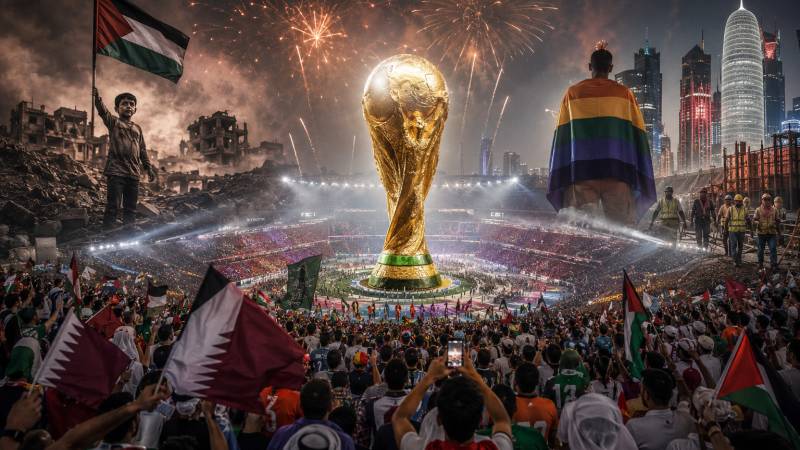
International sport has never existed in a vacuum, but this FIFA World Cup has pushed the boundary between athletics and geopolitics more than any tournament in recent decades. What was once marketed as a global celebration of football has increasingly become a stage for diplomatic signaling, nationalist messaging, and political controversy. From high‑level phone calls between world leaders and FIFA officials to symbolic gestures on the pitch, the tournament has become a mirror reflecting global tensions.
The most visible example came when U.S. President Donald Trump reportedly contacted FIFA leadership during a dispute involving match officiating. While leaders occasionally comment on major sporting events, direct intervention at this level is rare. The episode underscored how football’s global reach now intersects with political influence, national pride, and international alliances. For some observers, it was a reminder that even the world’s most popular sport is not immune to geopolitical pressure.
Another flashpoint emerged with Egypt’s unexpected elimination, which quickly took on political overtones. Egyptian fans and commentators framed the loss not merely as a sporting disappointment but as part of a broader narrative of regional frustration. In a country where football is deeply tied to national identity, the defeat sparked debates about fairness, officiating, and the role of global institutions. While no evidence suggests political interference in the match itself, the reaction highlighted how national sentiment can transform a sporting result into a political symbol.
Argentina added its own layer of controversy when players displayed a Falklands‑related banner during celebrations. The Falkland Islands—known in Argentina as Islas Malvinas—remain a sensitive territorial dispute with the United Kingdom. By bringing a politically charged message into a global sporting event, Argentina reignited diplomatic tensions and drew criticism from international observers who argued that the World Cup should remain neutral ground. For supporters, however, the gesture was an expression of national pride and historical memory. The incident demonstrated how athletes, willingly or not, can become conduits for political messaging.
International sport has never existed in a vacuum, but this FIFA World Cup has pushed the boundary between athletics and geopolitics more than any tournament in recent decades.
Israel’s participation also became a focal point of debate. In a year marked by heightened conflict and humanitarian concerns, Israel’s presence in the tournament triggered protests, calls for boycotts, and heated discussions across social media. Some fans argued that sports should transcend politics, while others insisted that global events cannot ignore geopolitical realities. The tension surrounding Israel’s matches illustrated how international conflicts spill into cultural and sporting arenas, where global audiences amplify every gesture and decision.
These controversies did not arise in isolation. They reflect a broader trend: the politicization of global sports is accelerating. Several factors explain why this World Cup, in particular, became such a lightning rod.
First, football’s global audience is larger and more interconnected than ever. With billions watching, every incident becomes instantly magnified. Social media transforms local disputes into international debates within minutes, and national governments understand that football offers a powerful platform for shaping narratives.
Second, geopolitical tensions are rising worldwide. From territorial disputes to ideological divides, nations increasingly use cultural and sporting events to assert identity and influence. The World Cup, with its symbolism of unity and competition, becomes an attractive arena for soft power.
Third, FIFA itself has become a political actor. Its decisions on host countries, disciplinary actions, and tournament logistics carry diplomatic weight. When controversies arise, governments often respond not as spectators but as stakeholders.
Athletes today are more vocal and politically aware. Whether advocating for social justice, national causes, or personal beliefs, players recognize that their visibility gives them influence beyond the pitch. While some fans welcome this, others argue that political expression distracts from the sport. The result is a tournament where football and politics are intertwined more tightly than ever. For some, this evolution enriches the sport by acknowledging the realities of the world. For others, it threatens the spirit of global unity that the World Cup is meant to represent.
What is clear is that this FIFA World Cup will be remembered not only for its goals and drama but for the political currents running beneath every match. Whether this trend continues will depend on fans, players, and global institutions—but the line between sport and politics has undeniably shifted. Hope is that Morocco will be a better venue in 2030 and lastly congratulations to Spain for winning this one.