

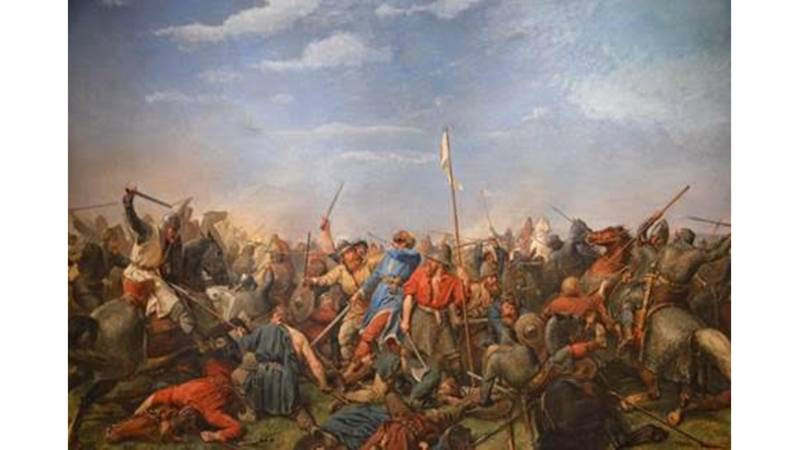
The battle was fought on the 14th of October 1066 and is sometimes called the Norman Conquest of England. What makes the Battle of Hastings stand out in world history is that it did not simply replace one ruler with another. It changed England’s ruling class, language, land ownership, institutions, and geopolitical orientation.
Jorge Luis Borges, a very well-known Argentinean scholar of English and Anglo-Saxon literature, commented that if the battle had not been fought: “England today would be, let us say, another Denmark, a very educated country, and politically admirable, but a provincial country” with no great influence on world history. He goes on to argue that without the Norman Conquest, there would have been no British empire and probably no United States of America.
Of course, that is a bold statement. But he is not the only scholar making that comment. Similar assertions can be found in the satirical history of England, 1066 and All That, and The Enigma of Hastings.
The famous battle had been preceded by another battle close to the town of York on the 25th of September. In that battle, King Harold Godwinson of England, a Saxon, faced off with his brother Tostig and Harald Hardrada, the King of Norway. These two, along with the Duke of Normandy, were claimants to the throne of England. The wars of succession were triggered by the death of King Edward the Confessor in January 1066, who had died without an heir.
Before the battle, Harold offered his brother a third of England and his forgiveness. So Tostig asked what was being offered to Harald and was told: “Six feet of English ground, and because he is so tall, one extra foot.” The offer was rejected, and the Battle of Stamford Bridge began. Harold won, and Tostig and Harald were slain.
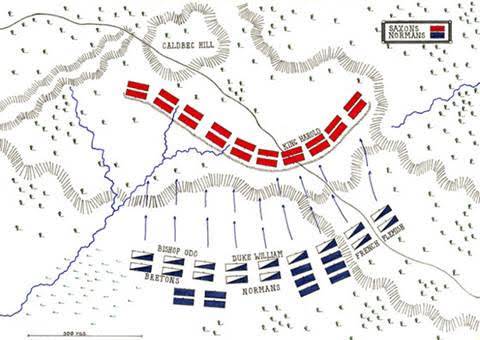
Just as victory was about to be toasted, a courier brought the grim news that the Normans, led by William the Bastard, another claimant to the English throne, had invaded England. Harold hurried southward, traversing 200 miles from York to London in just five days. In another two days, he arrived at Hastings. On the 14th of October, that fateful date, he met William, the Duke of Normandy, in battle. There were roughly 5,000 to 7,000 troops on each side. Initially, it seemed to go England’s way.
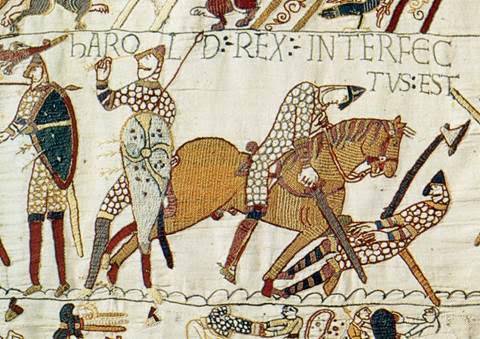
The Normans withdrew in a feint which drew the English troops into a massacre. A chance arrow hit Harold in the eye, slaying him. His corpse, stripped of all clothing, lay among the hundreds of naked men who had fallen. It was identified by a woman who was variously described as a common-law wife by some and as a friend by others. William built an abbey over the gravesite to honour the fallen and to commemorate his victory. After some skirmishes, he prevailed over the remaining Saxon resistance.
William was crowned the King of England on Christmas Day in Westminster Abbey. But he spent most of his remaining years in France and died there.
For two centuries, the English language went underground. French became the court language, Latin was spoken by the clerics, and the people spoke Saxon. In the Atlas of Military History, Aaron Ralby writes that prior to the Battle of Hastings, “Harold and the English forces spoke a Germanic language known as Old English. William, though of Norse descent, spoke old French. Over time, Old English and Old French merged together as languages, creating the language we know today as English.”
R Ernest Dupuy and Trevor N Dupuy, writing in The Encyclopedia of Military History: From 3500 BC to the Present, assert: “No battle was ever more hard-fought than Hastings; no battle has had more momentous results. In one respect this was merely the conclusion of a dynastic war. But in fact, this battle was a turning point in history; the initiation of a series of events which would lead a revitalized Anglo-Saxon-Norman people to a world leadership more extensive than that of ancient Rome.”
The Broad Historical Context: Hastings and Yorktown
The Battle of Hastings fought in 1066 can be compared in some ways with the Battle of Yorktown, which was fought more than seven centuries later in 1781. England lost both battles. But the geographic impact of the latter was far bigger than that of the former.
Where Hastings transformed England through foreign conquest, Yorktown helped establish an entirely new sovereign nation whose subsequent development profoundly influenced global politics, economics, and political thought.
Although the Revolutionary War did not formally end until the Treaty of Paris in 1783, Yorktown effectively ended Britain’s realistic prospects of restoring control over its rebellious American colonies. Yorktown was decisive because it helped secure the independence that the American colonies had declared five years earlier, in 1776.
The consequences were enormous. The United States subsequently developed a constitutional republic with an elected president, a federal legislature, and an independent judiciary. Its Constitution, adopted in 1787 and effective in 1789, became an influential model for constitutional government elsewhere. Yorktown did not directly create these institutions, but it made their independent development possible.
Like Hastings, Yorktown also changed Britain. The defeat helped bring down Lord North’s government in 1782 and contributed to Britain’s acceptance of American independence.
| Dimension | Hastings (1066) | Yorktown (1781) |
|---|---|---|
| Immediate result | England lost to the Normans | England surrendered to American and French forces |
| Political effect | Replacement of ruling dynasty and elite | Securing American independence |
| Language | Major long-term transformation | English remained dominant |
| Institutions | Reorganization of monarchy and landholding | Independent constitutional development |
| International effects | England's closer integration with continental Europe | A new sovereign republic and altered Atlantic power relations |
| Long-term legacy | Formation of medieval and modern English institutions | Emergence of the United States as a world power |
Over time, British imperial expansion increasingly focused on other regions, particularly Asia. Britain had already established a major presence in India before Yorktown, notably following Plassey in 1757. The loss of the American colonies reinforced the importance of its remaining imperial possessions.
A Legacy of Transformative Battles
The Battle of Hastings can also be compared with several pivotal battles that were fought elsewhere in different millennia. The list includes:
- The Battle of Gaugamela (331 BCE): Alexander the Great broke the power of the Achaemenid Persian Empire. It opened the Middle East to Greek political and cultural influence and helped create the Hellenistic world, in which Greek language, philosophy, and urban culture spread from Egypt to Central Asia.
- The Battle of Actium (31 BCE): Octavian defeated Antony and Cleopatra. The victory cleared the way for Octavian, later Augustus, to become Rome's first emperor. It marked the decisive military turning point in the transition from the Roman Republic to the Roman Empire, which shaped European and Mediterranean history for centuries.
- The Battle of Yarmouk (636 CE): Arab Muslim armies defeated the Byzantine Empire. This victory opened the way for the permanent loss of Byzantine Syria and accelerated the expansion of Muslim rule across the Middle East. Over subsequent centuries, Arabic language and Islamic culture transformed much of the region. Its consequences were especially profound for Syria, Palestine, and the wider Levant.
- The Battle of Talas (751 CE): Abbasid forces defeated a Tang Chinese army. The battle marked a setback for Tang influence in Central Asia and strengthened the position of Muslim powers. It is often associated with the westward spread of papermaking, although that story is more complicated than popular accounts suggest. Its cultural importance is real, but it is frequently exaggerated as a single decisive turning point.
- The Battle of Manzikert (1071 CE): Seljuk Turks defeated the Byzantine Empire. This provides one of the closest parallels to Hastings. The Byzantine defeat accelerated the loss of imperial control over Anatolia and facilitated Turkish settlement. Over several centuries, a predominantly Greek-speaking Christian heartland became increasingly Turkish-speaking and Muslim. The transformation of Anatolia from a predominantly Greek-speaking Christian region into the Turkish-speaking heartland of Turkey was remarkable.
- The Fall of Constantinople (1453 CE): Ottoman Turks conquered Constantinople. The conquest ended the Byzantine Empire and established Constantinople as the Ottoman imperial capital. It transformed the city's political, religious, and cultural character and confirmed the Ottoman Empire as a major European and Mediterranean power.
- The First Battle of Panipat (1526 CE): Babur defeated Ibrahim Lodi. This battle established the foundations of the Mughal Empire in northern India. Babur's victory initiated an empire whose cultural legacy outlasted its political dominance. Mughal influences remain embedded in South Asian architecture, languages, food, music, and institutions. Mughal rule profoundly influenced architecture, administration, painting, literature, cuisine, and the development of Indo-Persian culture. Its legacy remains visible in India, Pakistan, and Bangladesh.
- The Fall of Tenochtitlan (1521 CE): Spanish and Indigenous allied forces defeated the Aztec Empire. This conquest, following a prolonged siege, transformed the political, religious, linguistic, and demographic history of Mexico. Spanish colonial institutions and Catholicism spread, while Indigenous societies suffered devastating losses through warfare, disease, and exploitation. Modern Mexican culture emerged from this turbulent encounter and its aftermath.
- The Battle of Plassey (1757 CE): The British East India Company defeated the Nawab of Bengal. Plassey was a decisive step toward British territorial domination of India. Its consequences eventually included the transformation of economic institutions, education, law, administration, and political life across the subcontinent. A relatively small foreign commercial-military power began acquiring sovereignty over an enormous population, eventually reshaping an entire subcontinent. It also helped set the stage for the eventual emergence of India, Pakistan, and Bangladesh.
- The Battle of Sekigahara (1600 CE): Tokugawa Ieyasu defeated rival Japanese warlords. This victory paved the way for the Tokugawa shogunate, which governed Japan for more than 250 years. It helped end prolonged internal warfare and established a relatively stable political order that shaped Japanese society, urbanisation, culture, and relations with foreign powers.
What makes these battles stand out is not simply who won or who lost. Battles rarely transform cultures overnight. Yet some battles create the political conditions for changes that often unfold over generations or centuries, and that’s what makes them stand out.
An Important Historical Distinction
There are two categories of transformative battles.
The first category changes who rules a country. Hastings, Panipat, and Plassey belong primarily to this group. Their cultural consequences emerge through changes in political power, institutions, and elite composition.
The second category changes the religious or civilizational orientation of a region. Yarmouk, Manzikert, and the conquest of Constantinople are examples. Their consequences can be even more enduring because they affect language, religion, and collective identity.
Some battles belong to both categories. Yarmouk in 636 and Manzikert in 1071 are especially important examples of military victories that helped bring about enormous long-term cultural transformations.
There is also an interesting counterexample: the Battle of Tours (732), where Charles Martel defeated an Umayyad raiding army. It is often described as having saved Christian Europe from Muslim conquest. Modern historians are much more sceptical of that sweeping interpretation, illustrating how easily the significance of a battle can be exaggerated.
The larger lesson is that military victories can change political sovereignty in a day, but their deepest historical consequences emerge when they redirect institutions, language, religion, and cultural identity for centuries.