

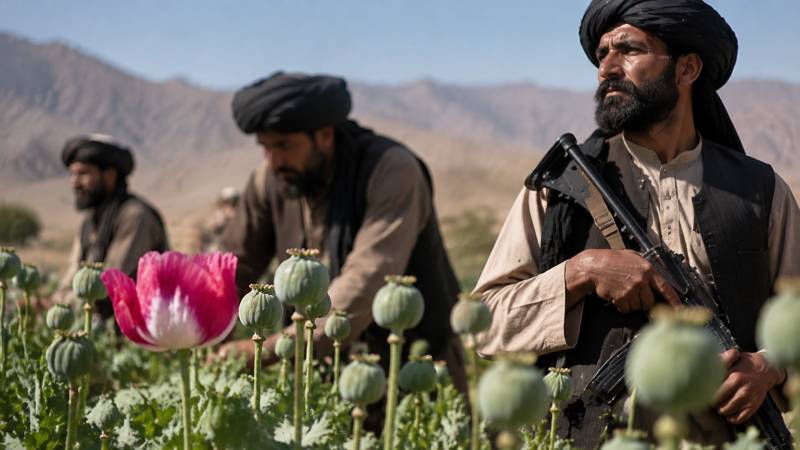
Hardly anyone thought the ban would last. When the Taliban’s supreme leader outlawed poppy in April 2022, the usual reaction, in Islamabad as much as anywhere, was a shrug. Afghanistan’s opium economy had outlived warlords, a Soviet invasion, a civil war and twenty years of American eradication money. Why would a decree change that? It did. UNODC now puts poppy cultivation at about 10,200 hectares in 2025, down from 232,000 in 2022. Potential opium output is 296 tons, against roughly 6,200. Myanmar overtook Afghanistan as the top producer in 2023 and now makes more than 1,000 tons a year.
It’s easy to underrate how big a change that is. In 2017 Afghan farmers planted a record 328,000 hectares and produced 9,000 tons. Two decades of Western programmes, with far more money behind them, never came close to the Taliban’s result. And it has held: 433 tons in 2024, then another 32 percent drop in 2025. But look at who paid for it. In 2022, opium was equal to 29 percent of the value of Afghanistan’s entire agricultural sector. A year later, farmers’ income from it had fallen from about $1.36 billion to $110 million. Families in four key provinces who switched to wheat gave up around $1 billion in potential income. In 2025 it fell again, by 48 percent, to $134 million. The Taliban say they destroyed more than 4,000 hectares last year. UNODC couldn’t verify that, but says it would be about 40 percent of the crop. Whatever the exact figure, this is a ban held up by force in a country with little to put in poppy’s place.
Then there’s the part that gets less attention: stockpiles. Years of huge harvests left a lot of opium in storage, and that has been feeding the market while new production stayed low. UNODC’s World Drug Report 2026 says those stocks will probably last only until the end of this year, and that recent seizures mostly reflect old stock being sold off. It’s late October. One estimate, cited in the European Drug Report, puts what was stored at about 12,000 tonnes in 2025, though that figure comes from the firm Alcis, not UNODC. Last year’s harvest could be turned into only 22 to 34 tonnes of export-quality heroin. In 2022 the figure was 350 to 580. When the old stock runs dry, that gap will be felt, and so will the pull to plant again.
Meanwhile, the trade is changing shape. UNODC found that methamphetamine seizures in and around Afghanistan rose from 2.5 tons in 2017 to 29.7 tons in 2021, and says synthetic drug trafficking has kept growing since the ban. Wild ephedra grows in Afghanistan, but UNODC cautions that the quantities needed and unreliable harvests make it unlikely the trade can rely on the plant. The real bottleneck is diversion and smuggling of bulk chemical precursors, which is a border problem. Meth needs no growing season and not much space, and a small lab is far harder to spot than a field of poppies.
The trade is changing shape: old trafficking routes are being used for new products, while synthetic drugs such as methamphetamine create challenges that are harder to detect and control.
For Pakistan this is not abstract. On 11 February, Pakistan’s Anti-Narcotics Force (ANF) announced it had seized 1,353 kilograms of narcotics, worth more than 77.85 million rupees (about $280,000), in seven operations across the country. Nine people were arrested, and investigations are continuing. Most of that weight came from a single truck. Officers stopped it on the Panjgur–Turbat highway and found 1,200 kilograms of hashish in hidden compartments. According to the ANF, the network was moving drugs from Panjgur through Turbat to Gwadar and Pasni, where high-speed fishing boats would carry them onward to Gulf countries, Yemen and Tanzania. The suspects reportedly told investigators the shipment had been smuggled in from Afghanistan.
Hashish is not opium, and one seizure says little about the poppy ban. But the same set of operations also turned up 1.3 kilograms of crystal meth in Peshawar, and suspects arrested in Karachi and Hyderabad admitted selling to students. That is the shape of the problem: old routes, new products, and customers inside Pakistan. UNODC’s latest survey says that cultivation, prices and seizures together point to fundamental changes in drug markets and trafficking in and around Afghanistan. The pressure on farmers is also growing. About four million Afghans have returned from neighbouring countries, roughly a tenth of the population, and more than 40 percent of farmland lay barren in 2025 because of drought. UNODC warns that, with aid cuts, these factors could make poppy more attractive again. It also says falling production and prices might push growers to try cultivating opium in other countries. Pakistan has every reason to watch that warning closely. A lull in poppy cultivation does nothing about any of it.
So what would help? Three things, none of them glamorous. First, precursor control. UNODC’s director has said regional coordination against diversion and smuggling is essential, and that takes customs officers on every border sharing information, not statements at summits. Second, livelihoods. UNODC has called for strong investment in sustainable livelihoods since 2023, and wheat plainly can’t replace poppy income. Third, data: UNODC itself says counter-narcotics strategies have to broaden beyond opium, and that means Iran, Pakistan and Central Asia pooling seizure figures so everyone can tell whether trafficking is shrinking or just changing form. The Taliban have shown that a determined state can empty the poppy fields. They haven’t shown it can empty the drug trade. Afghanistan’s neighbours have a short window, probably just the next few months, to build real controls before the stockpiles are gone and the next adaptation arrives.