

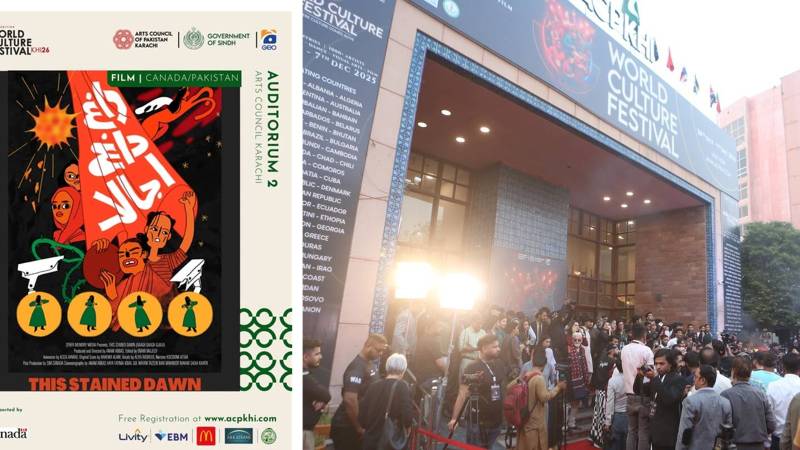
In recent times, city life in Karachi has generally been starved of cultural activities, leaving evenings deprived of cinema, theatre, music concerts, exhibitions, and other forms of entertainment. Against this backdrop, revitalising art and culture in Karachi, whose image was long tarnished by frequent violence, terrorism, and ethnic strife, is an incredible feat. For us Karachiites, it is truly heartening to see the metropolis actively reclaiming its dynamic social fabric through the regular organisation of events like international cultural, literature, and book festivals. Currently, the third edition of the World Cultural Festival is underway, featuring more than 140 participating countries. Among them, 1,000 international artists alongside 500 Pakistani performers are demonstrating their talent across theatre, dance, music, film, visual art, and workshops. This is an amazing accomplishment, considering how the Arts Council of Pakistan, Karachi, successfully launched, sustained, and exponentially expanded it year after year.
Within a short span of two years, the Arts Council hit the ground running, expanding its major international partnerships from six to seventy-two. Besides merely securing these alliances, coordinating and confirming numerous global participants is a formidable undertaking. Managing visas and logistical arrangements is no small task—a challenge I can deeply relate to from my own experience of organising an international conference during my time at the British Council. Therefore, the President of the Arts Council, along with its newly constituted governing body, truly deserves recognition. They have not only conceptualised this vision but also practically translated it into reality, elevating the event to the globally acclaimed ranks of India’s Serendipity Arts Festival, Bharat Rang Mahotsav, and the Jaipur Literature Festival, as well as the Edinburgh Festival Fringe and Paris’s Festival d'Automne.
The true measure of a cultural festival’s success lies not in its international visibility, but in its ability to make society more conscious of itself, compelling us to reflect on our inequalities, contradictions, and unrealised possibilities
Another commendable aspect of the festival is its choice of themes, such as peace and harmony—values desperately needed at home and internationally. In this regard, Sindh has much to offer the world. As the Chief Minister of Sindh proudly noted in his inaugural speech, not a single weapon was discovered during the excavation of Mohan Jo Daro, proving that this ancient land is rooted in peaceful coexistence. However, a critical caveat remains: the world will only pay attention to our message if we actively embody societal qualities that foster peace. Moreover, we must remind ourselves that the iconic Dancing Girl also belongs to Mohan Jo Daro: dance deserves to be celebrated as an integral part of our cultural heritage rather than looked down upon by those who reject it. Ultimately, we must work hard to prove ourselves true heirs of this civilisation, embracing the entire legacy of Mohan Jo Daro without any selective picking and choosing.
As the event grows in scale and scope, it naturally invites attention towards areas that tend to be overlooked, presenting opportunities to make an even greater impact. While bringing in artists from nations experiencing intense geopolitical conflict, such as Palestine, Iran, and the US, deserves immense appreciation, it raises an important question: what about Pakistan’s own historical and ongoing tensions with India and Afghanistan? Given that Pakistan has frequently sought to play a constructive role in regional peacemaking and diplomatic efforts, a similar level of cultural initiatives could be leveraged to help bridge these immediate internal and external divides. Actively ensuring the participation of artists from these neighbouring nations could serve as a powerful exercise in cultural diplomacy, paving a meaningful path towards cross-border reconciliation.
While it may sound inconvenient, art and culture cannot be revitalised through festivals alone. Instead, these events act as catalysts, offering a temporary platform to showcase talent. Therefore, a serious debate must be initiated with international participants on how to build a sustainable ecosystem for artistic production, promotion, and grassroots outreach—one that extends far beyond the walls of conventional galleries and stages.
This brings us to a fundamental question we often avoid asking: what is the true role of art in politics, and should the two remain separate? In reality, art never emerges in a social vacuum; its production, patronage, distribution, and reception are inherently shaped by the political and economic structures of society. It cannot, so to speak, be divorced from politics. Consequently, the experiences of the powerful, wealthy, and influential are too often heavily represented, while the lived realities of the oppressed and “the wretched of earth” remain invisible.
Artists who lack political consciousness tend to inadvertently serve and legitimise established power and social hierarchies. While art must remain free, its true purpose is neither to blindly endorse power nor to oppose it mechanically. Rather, it exists to preserve the freedom of human imagination, expression, and critical inquiry.
Thus, the ultimate measure of a cultural festival’s success lies not in its international visibility, but in its ability to make society more conscious of itself, compelling us to reflect on our inequalities, contradictions, and unrealised possibilities.