

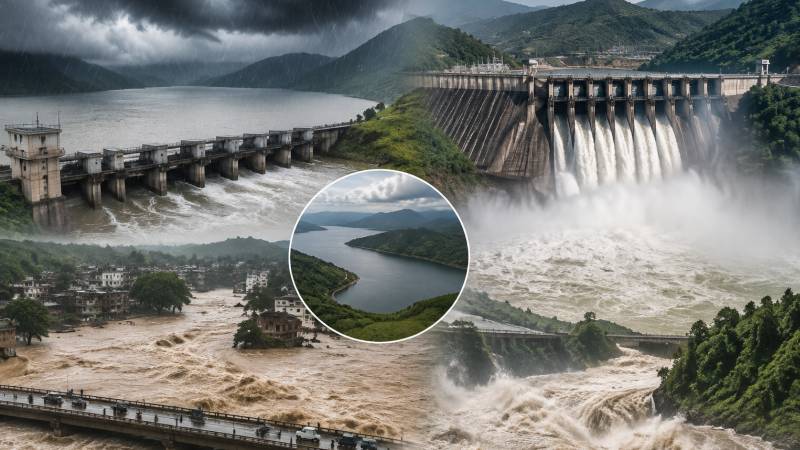
In the early hours of 10 August, after days of rapid filling, Tarbela touched its maximum conservation level of 5.58 million acre-feet. Mangla, on the Jhelum, sits marginally above last year and close to its five-year average, though still below its ten-year norm. Even Chashma is near-full, just half a foot below its maximum level. Taken together, Tarbela and Chashma compensate for Mangla's relative shortfall to keep the combined total broadly in line with the ten-year norm. For water managers, this is the desired state heading into late monsoon. For everyone else, full dams change the nature of the game. When a reservoir is filling, the risk is shortage. When it is full, the risk shifts. Every additional drop from the mountains must now be handled in real time, released through power tunnels, passed through spillways, or pushed into canals. The storage cushion is gone. What remains is operational nerve. The monsoon that cannot decide
Pakistan's 2026 monsoon has been a study in contradictions. Kashmir has delivered. The Jhelum at Mangla is running 24 per cent above its five-year average. But the Indus mainstem at Tarbela has trailed its recent norm by 6 per cent, and the Kabul at Nowshera has fallen 22 per cent below. The mountains are not speaking with one voice, and the plains have stayed largely dry. The Pakistan Meteorological Department's August outlook projects below-normal rainfall over most of the country, with above-normal temperatures. Yet it warns of intense monsoon spells in the north that could send sudden surges down the Indus, alongside elevated risks of glacial lake outburst floods and landslides. An earlier National Disaster Management Authority seasonal outlook projected 22 to 26 per cent more rain than last year, a gain against a deficit season, but still below the PMD's long-term baseline. If that additional rain materialises mainly in the upper catchments, it will arrive at Tarbela and Mangla with little warning and little room.
The numbers reflect the divide. The Jhelum's inflows at Mangla have run well above the five-year average, allowing managers to hold water. The Indus at Tarbela and the Kabul at Nowshera have trailed their recent norms. Total inflows are better than last year, but last year was itself a deficit season, so clearing that bar is no comfort. Inflows remain short of the five-year average. This is not a robust, system-wide monsoon. It is a selective one. The response is telling. They have cut Mangla outflows to a trickle, just 7,000 cusecs. They have throttled the Chashma-Jhelum Link sharply, dropping it 65 per cent to 4,000 cusecs. Down the Indus mainstem, volume is being pushed southward. By the time the water reaches Sukkur, heavy withdrawals have pulled discharges 18 per cent below average. The river is being spent as it travels.
Pakistan's reservoirs are brimming; a mid-monsoon achievement that brings both relief and risk. The real test is not filling the dams. It is managing what comes next.
This is not mismanagement. It is deliberate restraint, filling the tanks while the northern rivers still yield water, conserving the Jhelum's healthy inflows while the Chenab holds steady at its seasonal norm, and avoiding premature releases because the plains already feel moisture stress. Mangla itself remains only 64.5 per cent full despite receiving above-average inflows. Managers are banking that water, knowing the early melt pulse is already passing and the months ahead look dry. That is not abundance. That is triage with a favourable balance sheet. Tarbela is full not because the rivers were unusually generous, but because managers throttled releases and cut the Chashma-Jhelum Link. Full storage, achieved against below-average inflows, is a management victory, not a hydrological one. The water that arrived was captured through operational discipline, not meteorological luck.
Tarbela's 5.58 million acre-feet is its Maximum Conservation Level, the ceiling for water held for power and irrigation. The dam itself can physically hold more. Above conservation level sits the flood-surcharge zone: a narrow band of temporary capacity designed to absorb a single surge, not to store water through a season. Once you enter surcharge, you are no longer managing. You are reacting. What's easily missed: full conservation pools mean the passive buffer has disappeared. When a dam is filling, unexpected surges can be parked in empty space while managers decide how to release them gradually. When the conservation pool is full, every cubic foot that arrives must be passed through immediately, via spillways, power tunnels, or canal diversions, or the dam enters emergency operations. There is no shock absorber left. A glacial lake outburst does not arrive as a gradual rise. It arrives as a surge that can overtake the remaining surcharge capacity within hours, leaving no margin between emergency release and structural risk.
With the conservation pools already full, managers face three difficult choices: hold the water and risk emergency surcharge operations; release pre-emptively and flood downstream areas not even in the surge's path; or wait and see, the most dangerous option, because a GLOF does not give time to react. The 2022 super-flood and the 2025 Hunza glacial lake outburst showed that Pakistan's rivers can rise faster than institutional coordination can respond. With full reservoirs, that lag time becomes the difference between a managed release and an uncontrolled one. We no longer have the luxury of treating floods as generational anomalies. The super-floods of 2022 were followed by deadly monsoon surges in 2023, severe urban flash floods in cities like Lahore in 2024, and the catastrophic Hunza glacial lake outburst of 2025. The "once-in-a-century" flood has become a recurring reality. This August, the conservation pools are already full. The buffer is gone.
When a reservoir is filling, the risk is shortage. When it is full, the risk shifts. Every additional drop from the mountains must now be handled in real time, released through power tunnels, passed through spillways, or pushed into canals. The storage cushion is gone. What remains is operational nerve.
Pakistan's water institutions now face their annual examination. WAPDA controls the dams. IRSA coordinates provincial indents based on availability. Provincial irrigation departments run the canals. The Federal Flood Commission monitors infrastructure. NDMA issues warnings. When a surge comes, these bodies must coordinate in hours, not days. Full dams should make the coordination mandate unambiguous. There is no space left to defer decisions. But clarity of mandate is not the same as capacity to execute. Execution requires trust among FFC, NDMA, WAPDA, and IRSA, between IRSA and the provinces, and between NDMA and the Federal Flood Commission, that release decisions will be driven by inflow gauges and pre-agreed thresholds, not by last-minute political negotiation.
The fix is unglamorous but essential. A standing FFC-WAPDA-IRSA-NDMA monsoon operations cell. Pre-agreed release triggers tied to real-time inflow thresholds, published before the season begins. Decisions made on hydrology and schedule, not negotiated province by province once the surge is already at the dam. None of this is new. These mechanisms have been recommended after every major flood since 2010. What has been missing is not the design but the institutional will to implement it before the next surge arrives.
Three tests are arriving together. First, flood buffering: pre-emptive release decisions must be made in time. Second, equitable distribution: if below-normal plains rainfall intensifies crop stress, political pressure to open the taps will mount quickly. Third, the Rabi season: full dams in August are valuable only if the water is still available in December. For a cotton or rice farmer in southern Punjab watching his Kharif canal run lean in August while the reservoirs upstream sit full, the arithmetic is cruel. His crop is in the ground, needing water to survive the late-summer heat. But the dam is holding those flows for December's wheat. The system is solvent; his field is not. Canals may stay lean now, but the storages improve the odds of winter irrigation, provided the water is released on schedule and in the right quantities.
For those in the northern valleys, communities in Hunza and Shigar still piecing their lives back together after last year's glacial floods, the warning is sharper. Intense monsoon bursts and accelerated snowmelt can turn abundance into disaster faster than any bulletin can predict. With no upstream storage to slow a GLOF before it reaches them, those communities remain exposed regardless of how full Tarbela is. And downstream, with the conservation pools already at capacity, there is no cushion left to absorb what comes after.
For the rest of the country the lesson is straightforward. Pakistan does not have a water-shortage problem in August. It has a water-management problem that lasts all year. The dams are full. The rivers are flowing. The monsoon is delivering. Sawan is ending; Bhadoon waits with its share of rain. What is still missing is the institutional machinery and operational discipline to turn seasonal gifts into year-round security, and to handle the floods that may still come. The water now sitting in Tarbela and Mangla is not a surplus. It is a loan against a winter that may not deliver. Whether that winter replenishes what has been stored is not guaranteed. It rarely is, in a system this stretched. That is not a hydrological failure. It is a governance one. And no amount of reservoir water can store its way out of that.