

Nagarparkar is home to several historic villages. One such village is Kharerio, which is located about 14 km southwest of Nagarparkar town. Once a prosperous and flourishing village in Nagarparkar, it is now reduced to a few households. Several communities, including Thakurs, Kolhis, Meghwars, Rabaris, Kumbhars, Gureras, and others, lived in Kharerio. Many people migrated from the village due to a lack of economic facilities. Some went to neighbouring villages, and others migrated to barrage areas in different districts of Sindh. However, their sacred spaces were left behind, and these continue to dot the cultural landscape of Kharerio village. Today, only a few households of Rabaris, Gureras, and Kumbhars are located in Kharerio village, while Kolhis live a little distance away.
I first visited this village in 2004 with Haji Kumbhar of Kharerio village, one of my key informants during my fieldwork in Nagarparkar. He introduced me to several members of the local community, including Bhuro Rabari of Lakarkhadio. Bhuro generously shared his knowledge of Rabari customs, beliefs, and the cult of Pabuji.
I returned to Kharerio village in 2011 and again in 2013, with each visit opening new perspectives on the people of Nagarparkar and their cultural heritage. Most recently, I interviewed Dr Shankar Lal D Motiani of Kasbo and Sathi Somji Kolhi, Chairman of the Union Council of Adigam, to verify and update some information I had collected over the years. Both possess an intimate knowledge of Nagarparkar's history, culture, and heritage. My conversations with them helped clarify several important details. Experiences like these remind me that ethnographic research is an ongoing journey. Every return to the field and every conversation with knowledgeable local people brings fresh insights.
The Value of Ethnographic Research
Ethnographic research gives a unique window into people's lives. It helps researchers understand how communities think, live, and make sense of the world—insights that are often difficult to obtain through other research methods. By spending time with people in their everyday social and cultural settings, researchers gain a deeper appreciation of their beliefs, traditions, customs, and everyday experiences. This close engagement produces authentic, reliable, and richly contextual information that cannot be captured through surveys or secondary sources alone.
Hero stones stand as enduring tributes to men who sacrificed their lives – showing a society that deeply admired courage, selflessness, and honour
Throughout my research career, ethnography has been my most valuable research approach. It has enabled me to explore the cultural landscapes, heritage, traditions, and social life of communities not only in Tharparkar but also across many other districts of Sindh and Punjab. Long-term engagement with local communities has given me access to oral histories, indigenous knowledge, cultural practices, and local perspectives that might otherwise have remained undocumented. Time and again, my fieldwork has shown that the richest understanding of a community comes not from archives or official records alone, but from listening to people, observing their everyday lives, and learning from their lived experiences.
Sacred Spaces: The Shiva Temple and Historic Wells
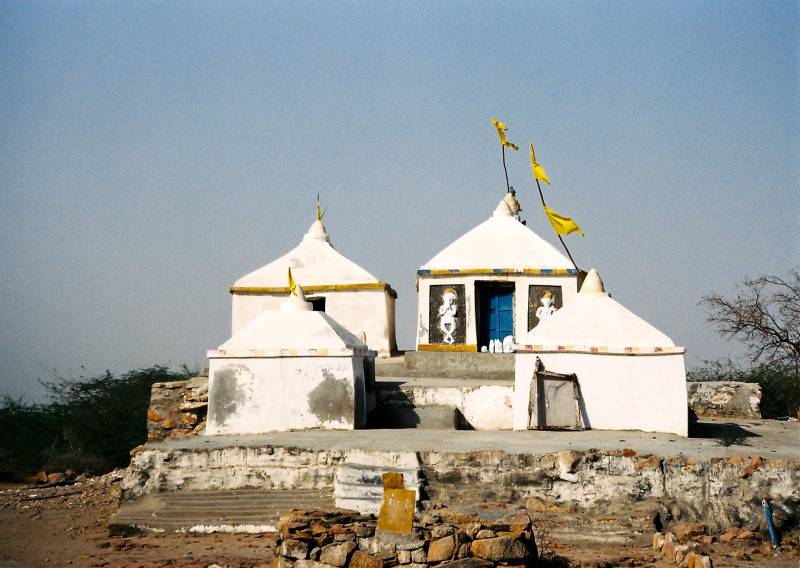
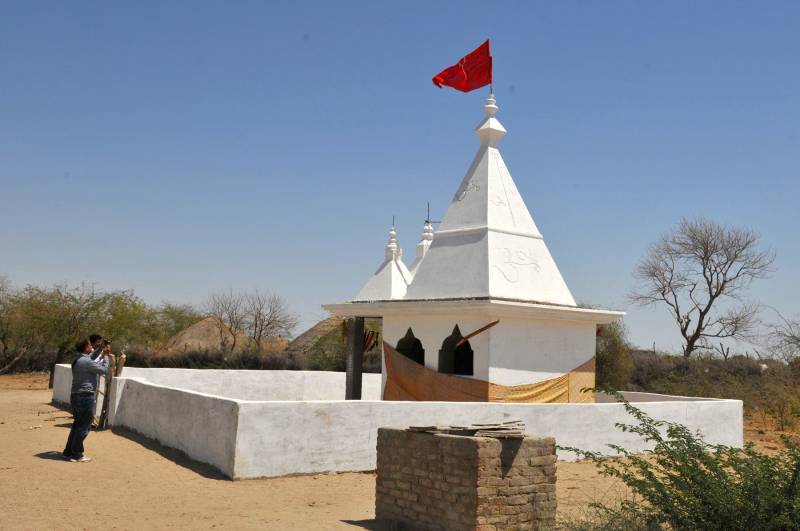
During my ethnographic research in Kharerio, I met people, visited sacred religious spaces, and documented them. The most prominent sacred space in Kharerio village is the temple of Shiva, locally called Neel Kanth, built on a raised platform and conspicuous from a distance. There are several temples in Tharparkar and Umerkot districts. The Shiva temple of Kharerio is also included among the earliest temples in both districts. When the village was fully populated, this temple drew devotees every day. Now, devotees visit on special occasions. There was only one small structure dedicated to Lord Shiva. Later, another shrine, containing an image of Hanuman, was constructed to the left of the Shiva temple.
Two structures, locally called Dera, are dedicated to the Shivaderi (caretakers) of the Shiva temple, who are believed to have taken jivat samadhi (living samadhi). It is not known when they took jivat samadhi. Beyond the Shiva temple is a historic well, now called Bai Waro Vav. But it is not known what it was called when it was constructed or who built it. It is made of large stone slabs which were brought from other areas. Such stone is not locally available. This well is known after an incident when a woman from the Bai family jumped into the well and committed suicide, and hence it is called Bai Waro Vav or Khu.
Thaans and Local Deities
The Shiva temple is taken care of by the Kolhi community. Apart from the Shiva temple at Kharerio, one can also find new temples that are being built in the vicinity of the neighbouring villages of Kharerio. One of the temples dedicated to Kali Mata has been built in Wadan Jo Wandio village, which is located 2 km west of Kharerio village and situated between Sabusan and Lakarkhadio villages. This new temple is built on the old Kali Mata Jo Astan. The wealthy Lohana Hindus of Mithi and Islamkot have built this temple.
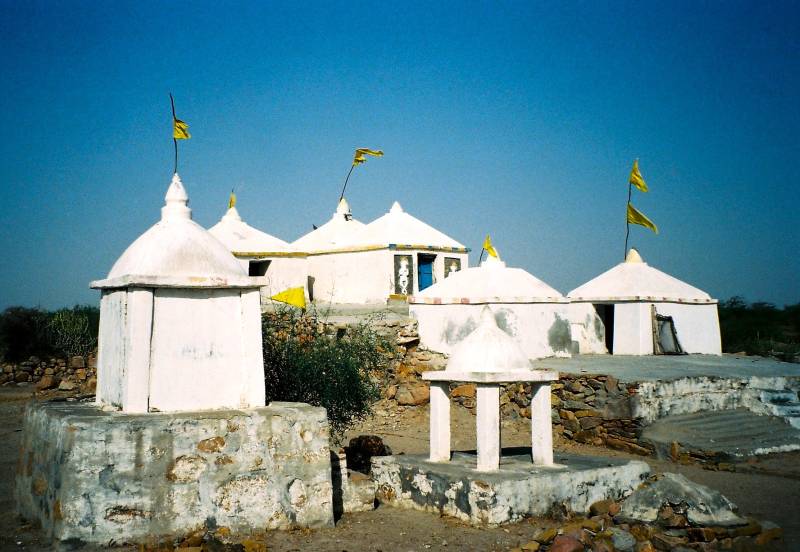
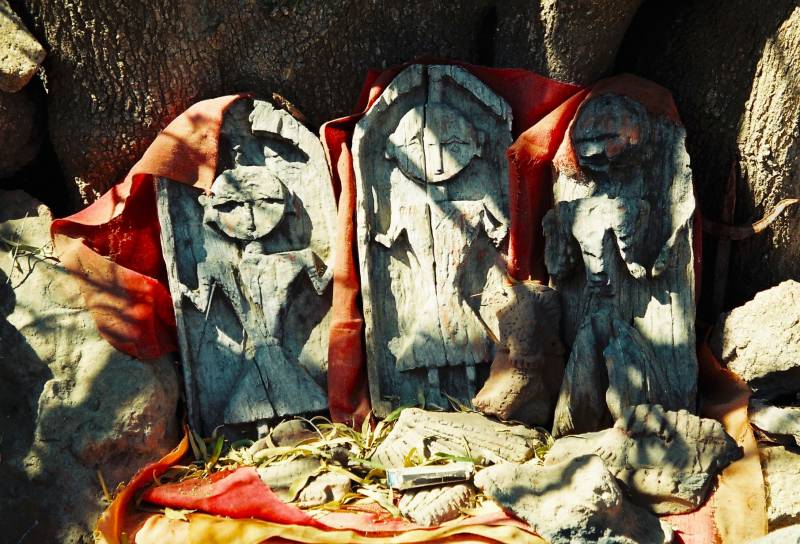
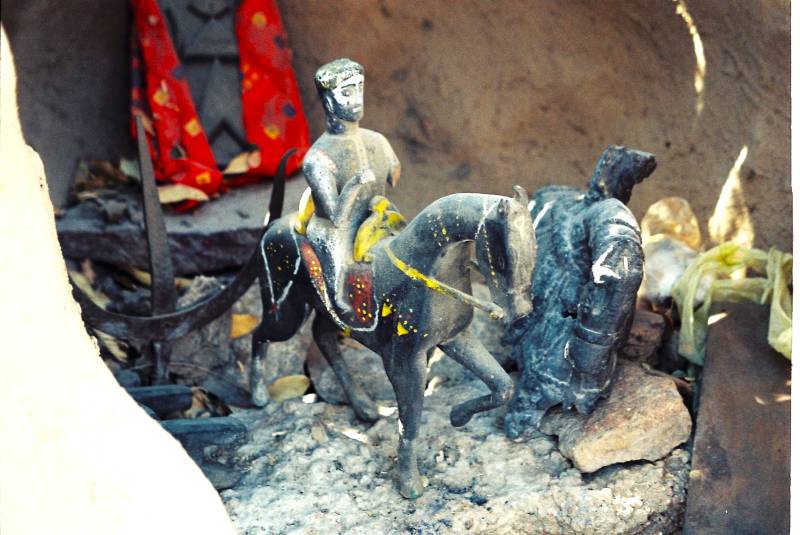
Apart from the Shiva temple, Kharerio village hosts a few old thaans, notably dedicated to Sachiya Devi and Pabuji Dhandal Rathore. The famous thaan of Pabuji Rathore is the main place of worship for the Rabari community of Nagarparkar, where carved wooden statues of Pabuji have been placed. One of the carved wooden tablets shows him riding on a horse. This is Pabuji's popular iconography. His wooden tablet is placed inside a small covered mud structure locally called thaan. Although Pabuji is worshipped by many other communities in Nagarparkar, he is regarded as the tutelary deity of the Rabari community. Other tutelary deities of Rabari communities in Nagarparkar include Mamai Devi. Thaans, or Mad (small domed structures in the courtyard of a Rabari household), are found wherever Rabaris live in the villages of Nagarparkar.
Apart from the thaan of Pabuji, there are thaans of devis of Meghwars at Kharerio. Newlywed couples visit these thaans and perform certain rituals there. There is also a thaan of Sachiya Devi of Thakurs at Kharerio village. Regarded as an embodiment of the divine feminine (Shakti), Sachiya Devi is associated with truth, protection, prosperity, fertility, and the well-being of her devotees. It is believed that the Thakur and other communities worship Sachiya Devi at Kharerio village.
Hero Stones: Monuments of Sacrifice
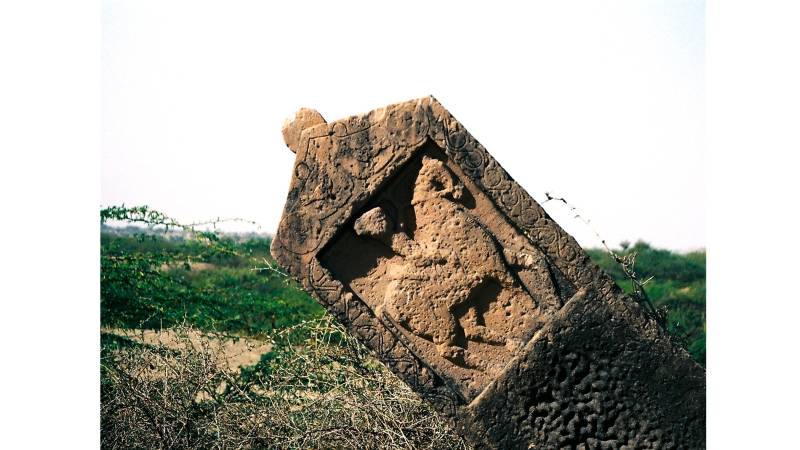
Apart from temples and thaans of deities, there is a hero stone at Kharerio. It belongs to a Thakur who was killed in a certain battle. He was commemorated with a hero stone. It lies in a very bad state of preservation. It features both an inscription and a carving of the deceased hero, who is shown riding a horse. He is also shown holding a spear in one hand and a bow in the other. The uppermost part of the hero stone depicts a pair of peacocks. The topmost part of the memorial stone is decorated with a turban similar to those seen on the Chaukhandi tombs in various districts of Sindh. It appears that the inspiration for this memorial stone came from the memorial stones in Nagarparkar.
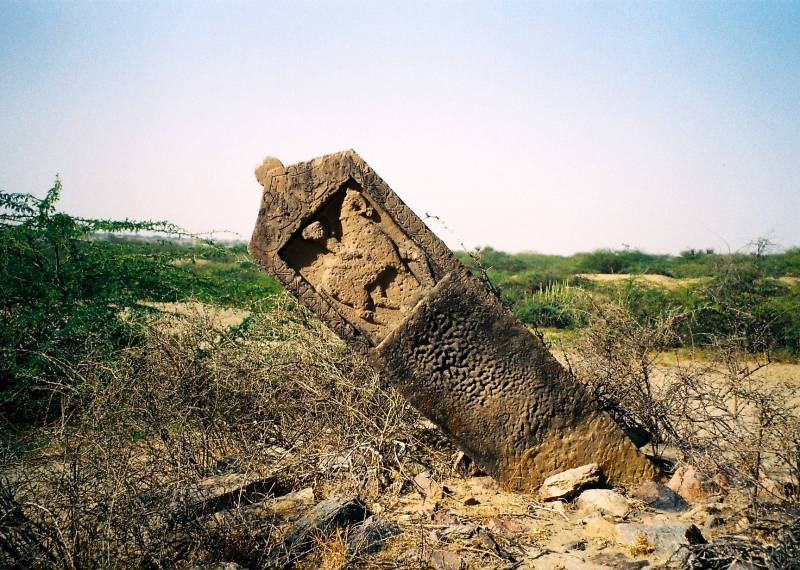
Hero stones are found throughout Nagarparkar. They stand as enduring tributes to men who sacrificed their lives defending their families, communities, and livelihoods. More than simple memorials, these monuments reflect a society that deeply admired courage, selflessness, and honour. Those who fell in acts of bravery were not forgotten; they were remembered, celebrated, and revered by their communities. Through these stones, their stories of sacrifice have continued to inspire generations, preserving the values and ideals that once defined the cultural life of Nagarparkar.